




























Views
Downloads

Transparency Science Worksheet | Grade 1 Printable

Paste this activity's link or code into your existing LMS (Google Classroom, Canvas, Teams, Schoology, Moodle, etc.).
Students can open and work on the activity right away, with no student login required.
You'll still be able to track student progress and results from your teacher account.
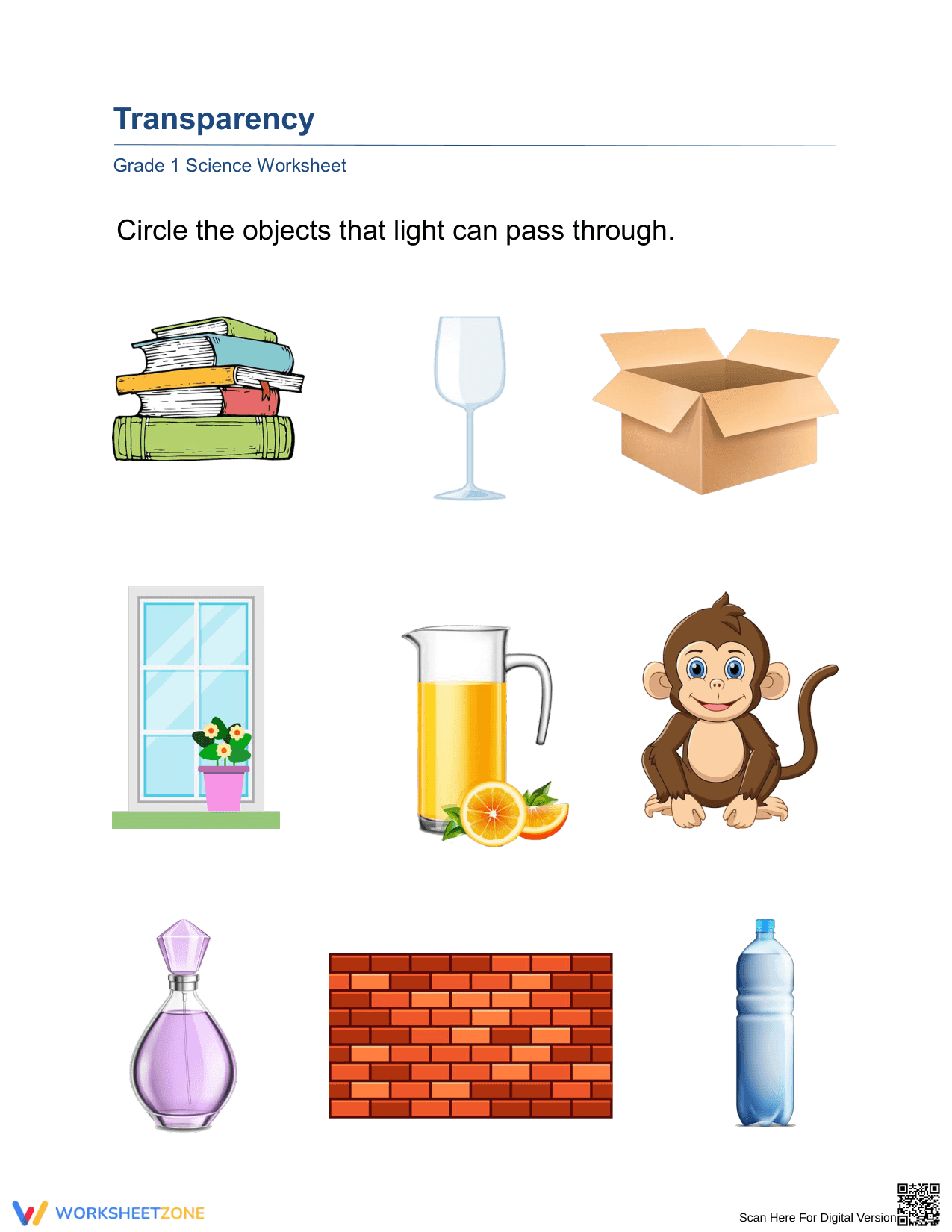
This Grade 1 science worksheet helps students identify materials that allow light to pass through them. By evaluating nine common objects, learners develop a concrete understanding of transparency and physical properties. This resource provides a clear student outcome: the ability to distinguish between transparent and opaque materials through visual classification.
At a Glance
- Grade: 1 · Subject: Science
- Standard:
1-PS4-3— Determine the effect of placing objects in the path of light- Skill Focus: Identifying transparent materials
- Format: 2 pages · 9 problems · Answer key included · PDF
- Best For: Quick formative assessment or science centers
- Time: 10–15 minutes
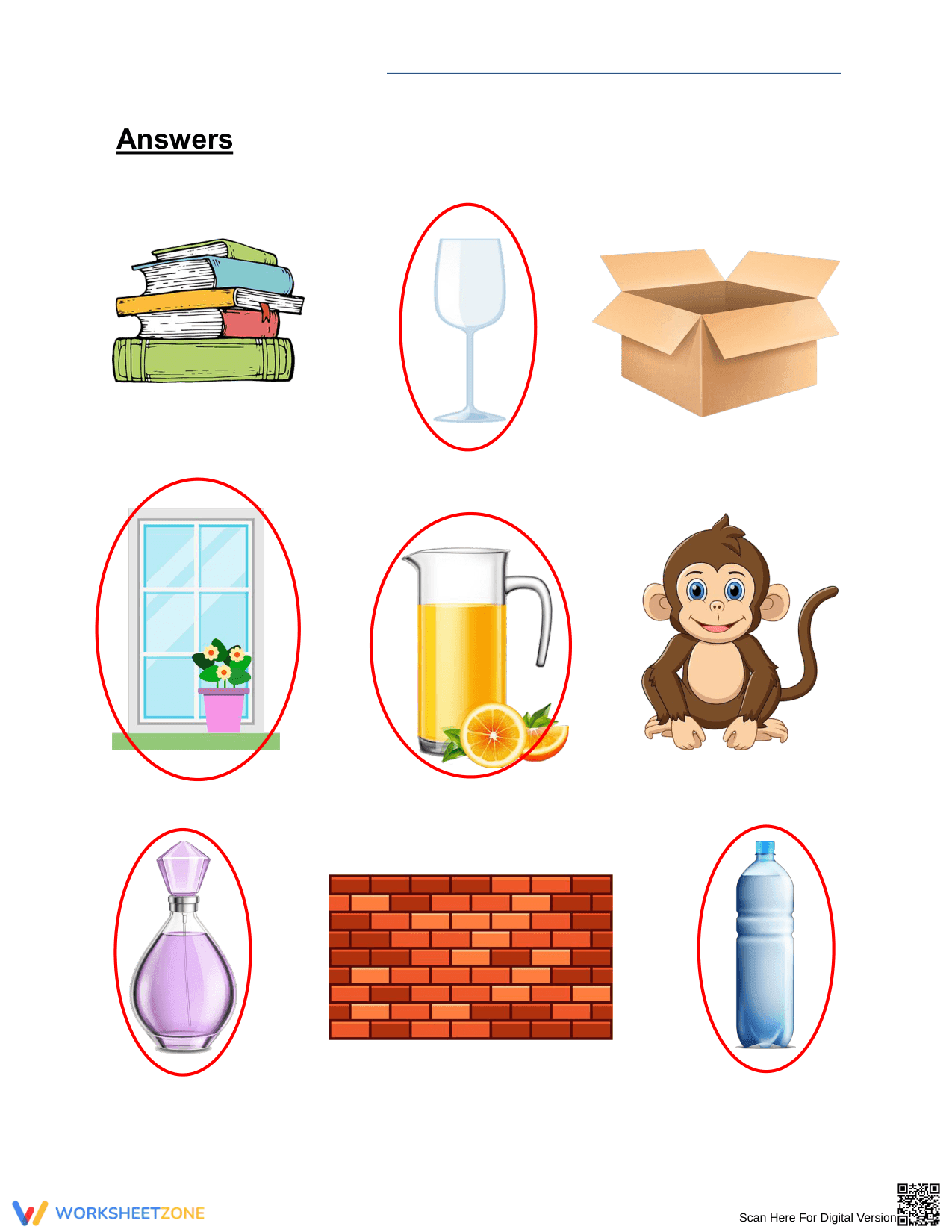
What's Inside: This two-page PDF includes a student activity sheet and a corresponding answer key. The worksheet features nine high-quality illustrations of everyday items, such as a glass, a cardboard box, a window, and a brick wall. Students are tasked with circling only the objects that light can pass through, providing a simple yet effective way to check for understanding of light behavior.
The zero-prep design allows for immediate implementation in any classroom setting. First, print the single-page student sheet in less than 30 seconds. Second, distribute the worksheet during your physical science block or as a transition activity. Finally, use the provided answer key to review the results with the whole class or for quick grading. Total teacher preparation time is under 2 minutes, making this an ideal resource for substitute folders or last-minute lesson adjustments.
Standards Alignment: This resource is specifically designed to meet `1-PS4-3`, which requires students to plan and conduct investigations to determine the effect of placing objects made with different materials in the path of a beam of light. By categorizing these items, students demonstrate their knowledge of how light interacts with matter. Both standard codes can be copied directly into lesson plans, IEP goals, or district curriculum mapping tools.
How to Use It: Use this worksheet as a formative assessment after a hands-on demonstration with a flashlight and various classroom objects. It also works well as an independent station in a science center. Teachers should observe whether students correctly identify the water bottle and perfume bottle, as these often require more careful thought than a simple window. Expect students to complete the task in approximately 12 minutes.
Who It's For: This worksheet is tailored for first-grade students beginning their study of light and sound. The heavy reliance on visual cues makes it an excellent choice for English Language Learners (ELL) and students with IEPs who benefit from non-linguistic representations. It pairs naturally with a classroom anchor chart about light or a direct instruction lesson on the properties of matter.
Research by Fisher & Frey (2014) emphasizes the importance of visual non-linguistic representations in early science education to build conceptual understanding. This worksheet aligns with 1-PS4-3 by requiring students to categorize materials based on their interaction with light. By identifying objects like glass, water, and windows as transparent, students develop the foundational vocabulary necessary for later physical science mastery. Studies from EdReports (2024) suggest that high-quality instructional materials must provide clear, scaffolded opportunities for students to apply scientific principles to real-world objects. This resource provides exactly that, offering 9 distinct items for classification. The inclusion of an answer key ensures immediate feedback, which is a critical component of the gradual release of responsibility model. Educators can use this tool to bridge the gap between observation and scientific reasoning in early elementary classrooms.


