


























Views
Downloads

Printable Algebraic Expressions Translation Practice
Paste this activity's link or code into your existing LMS (Google Classroom, Canvas, Teams, Schoology, Moodle, etc.).
Students can open and work on the activity right away, with no student login required.
You'll still be able to track student progress and results from your teacher account.
This comprehensive algebra worksheet focuses on the fundamental skill of translating verbal phrases into mathematical language. By mastering the translation of words into algebraic expressions, students develop the critical logic necessary for solving complex multi-step equations and real-world word problems. This resource ensures learners can confidently navigate variables, constants, and operations.
At a Glance
- Grade: 7–8 · Subject: Algebra / Math
- Standard:
CCSS.MATH.CONTENT.6.EE.A.2.A— Write expressions that record operations with numbers and with letters standing for numbers- Skill Focus: Algebraic Expression Translation
- Format: 3 pages · 24 problems · Answer key included · PDF
- Best For: Independent practice and skills reinforcement
- Time: 25–40 minutes
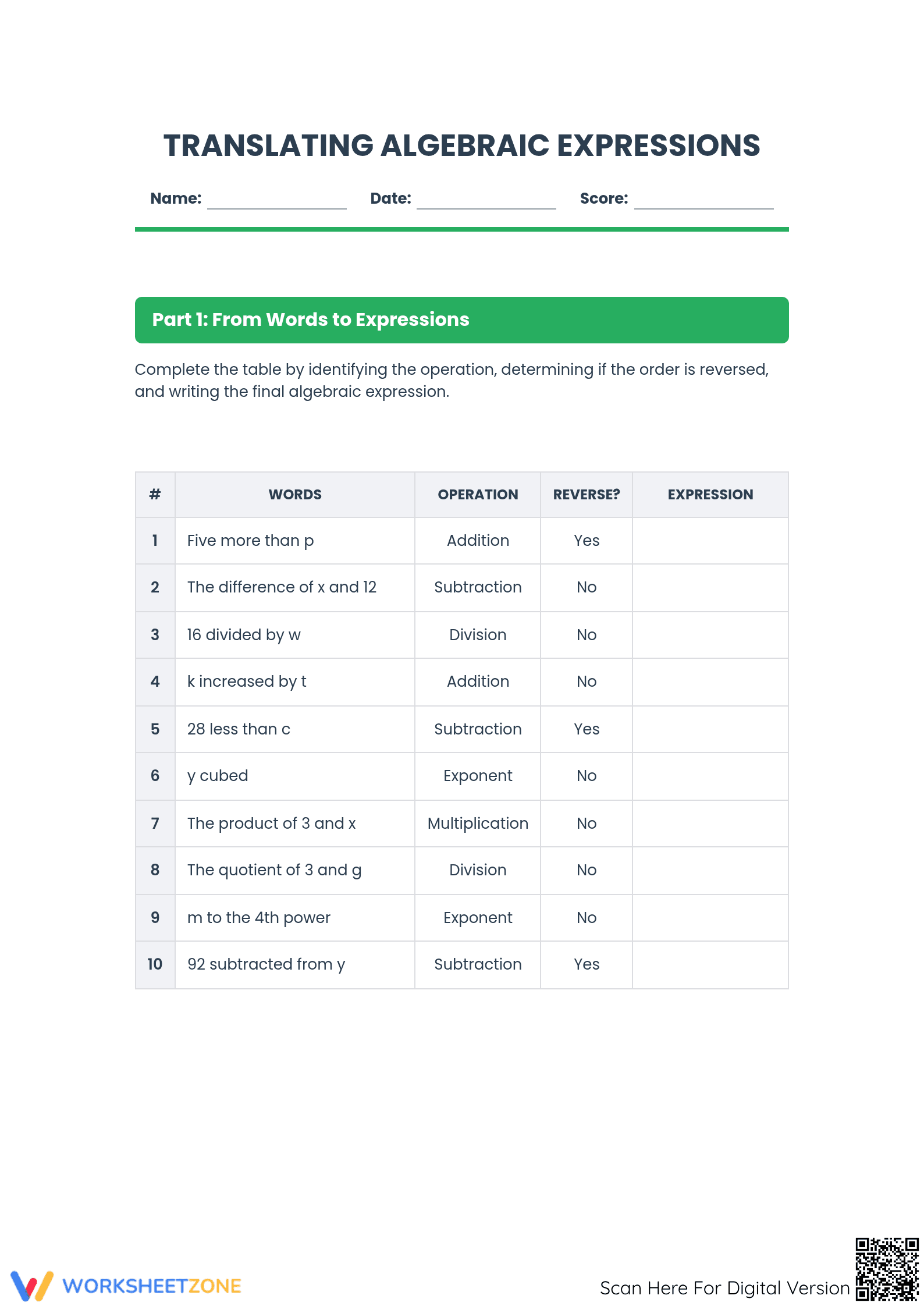
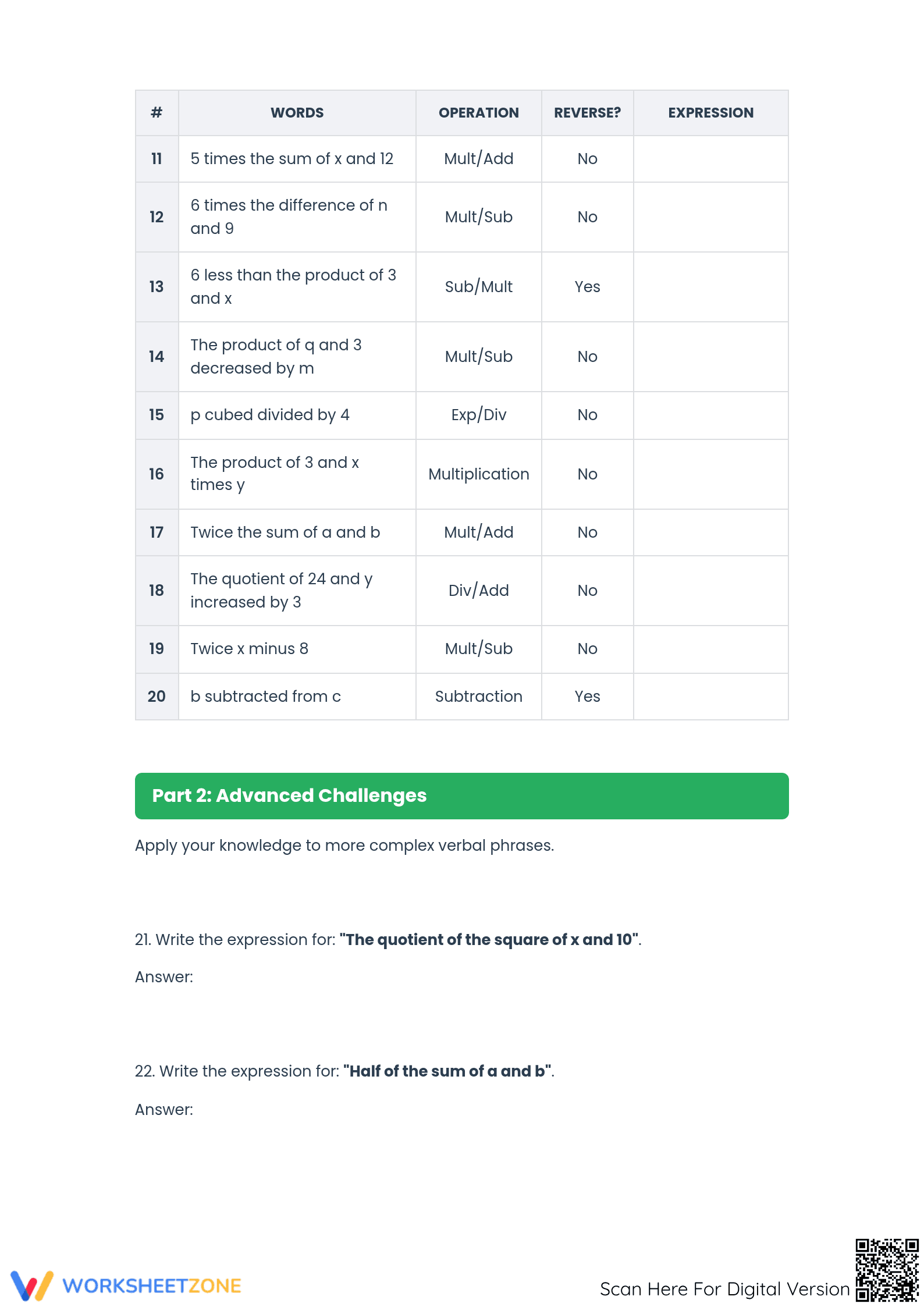
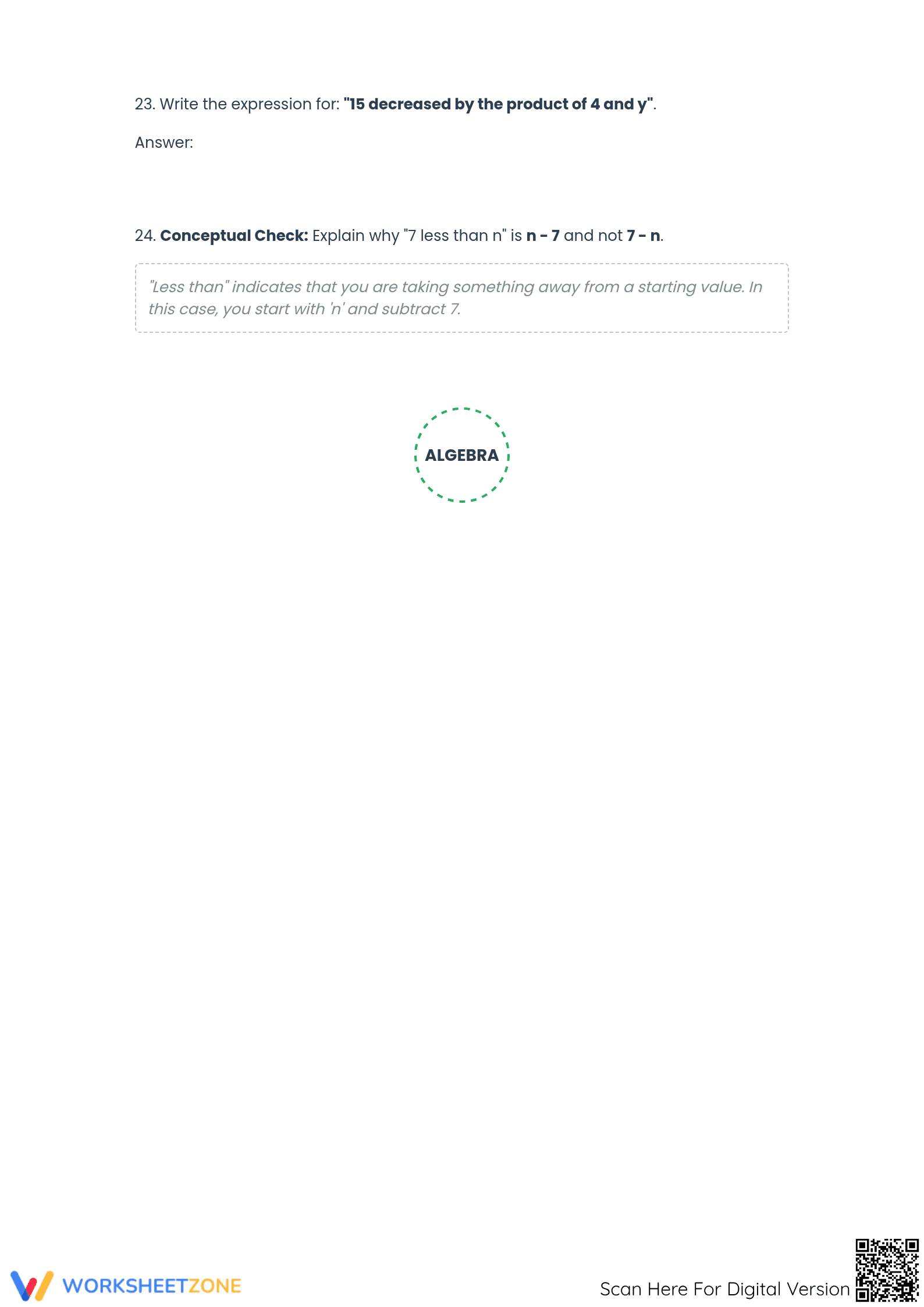
This three-page resource features 24 structured problems designed to bridge the gap between language and mathematics. The first two pages provide a tabular format where students identify the operation, determine if the order of terms must be reversed (crucial for subtraction and division), and write the final algebraic expression. The final page includes advanced challenges and a conceptual check to ensure deep understanding.
Skill Progression
- Guided Practice: Problems 1–10 introduce basic single-operation phrases like "more than" and "quotient of," using a guided table to help students identify reverse-order operations.
- Supported Practice: Problems 11–20 introduce multi-operation phrases and powers while maintaining the scaffolding of the operational table.
- Independent Practice: The final section (Problems 21–24) removes the table entirely, requiring students to translate complex verbal challenges and explain the underlying logic of "less than" constructions.
This sequence follows a gradual-release model (I Do, We Do, You Do), moving from structured identification to independent synthesis.
Standards Alignment
This worksheet is primarily aligned to CCSS.MATH.CONTENT.6.EE.A.2.A, which requires students to write expressions that record operations with numbers and letters. It also supports higher-level standards by preparing students to use variables to represent quantities in real-world problems. Both standard codes can be copied directly into lesson plans, IEP goals, or district curriculum mapping tools.
How to Use It
This worksheet is best utilized after a direct instruction lesson on algebraic vocabulary (e.g., sum, difference, product, quotient). Assign the first 10 problems as a mid-lesson check for understanding to identify students struggling with "reverse" phrases like "less than." A great formative assessment tip is to observe if students correctly handle the "subtracted from" logic in problem #10 before they proceed to multi-operation challenges.
Who It's For
Designed for Grade 7 and 8 students, this resource is ideal for general education algebra classes, small group intervention, or as a self-contained sub plan. It pairs naturally with a vocabulary anchor chart that lists operation keywords, providing a scaffolded entry point for English Language Learners (ELL) who are navigating mathematical syntax.
According to research in the RAND AIRS 2024 report, the ability to translate between representational forms—such as moving from natural language to symbolic algebraic notation—is a primary predictor of long-term success in secondary mathematics. This worksheet addresses this critical "translation gap" by providing 24 targeted opportunities for students to decode mathematical syntax and structural logic. By explicitly requiring students to identify the primary operation and the "reverse" nature of specific English phrases before writing the final symbolic expression, the resource helps solidify the robust mental models needed for higher-order problem solving and equation modeling. Mastering CCSS.MATH.CONTENT.6.EE.A.2.A ensures that Grade 7 and 8 students do not just memorize procedures but truly understand the semantic structure of algebra. This alignment with evidence-based practices in mathematical literacy ensures that all learners are fully prepared for the rigorous demands of standardized state assessments and future advanced STEM coursework.


