Through the use of transition words, students will gain an understanding of the significance of order in written work during this unit. At the end of this lesson, students are going to:
- recognize that authors employ a range of transitional words to keep their writing coherent.
- discuss the usage of transition words in a picture book and how they support internal organization and logical order.
- use an original short story to demonstrate how to properly employ transitional words and phrases.
- conduct a self-evaluation checklist analysis of the transition word usage.
- exhibit a command of the capitalization, punctuation, spelling, and grammar rules of standard English.
- How do linguistic conventions and grammar affect written and spoken communication?
- What is the objective?
- Why do authors write?
- What makes writing clear and effective?
- What will appeal to the audience the most?
- Organization: The internal structure of a piece of writing, the thread of central meaning, the pattern that fits the central idea. When the organization is strong, the piece begins meaningfully and creates a sense of anticipation in the reader that is ultimately, systematically fulfilled. Events proceed logically; information is given to the reader in the right doses at the right times so that the reader never loses interest.
- Sequencing: The arrangement or ordering of ideas and content in a piece of writing. Common approaches to sequencing are chronological, hierarchical, developmental, easy to difficult, part to whole, simple to complex, thematic, and whole to part.
- Transitions: Words, terms, phrases, and sentence variations used to arrange and signal the movement of ideas. For example, next, and then, in the end, another reason, after that, and on the other hand are all transitions.
- chart paper
- notebook paper, one piece per student
- Transition Words/Phrases handout (LW-6-1-2_Transition Words), one copy per student
- Transition Words Checklist (LW-6-1-2_Transition Words Checklist), half sheet per student
Suggested picture books to use with this lesson:
- Istvan Banyai. (1998). Zoom. Puffin.
- Dav Pilkey. (2003). Dogzilla. Sandpiper.
- Jerry Pinkney. (2009). The Lion & The Mouse. Little, Brown and Company.
- David Wiesner. (2006). Flotsam. Clarion Books.
- David Wiesner. (2008). Free Fall. HarperCollins.
- David Wiesner. (1999). Sector 7. Clarion Books.
- David Wiesner. (1997). Tuesday. Sandpiper.
- Keep the emphasis of the lesson on developing a thorough understanding of how to use transition words and phrases to make a piece of writing cohesive.
- You can quickly identify any group issues that may require clarification by keeping an eye on how students participate in both whole-group and small-group discussions. You can refocus all of the groups if it appears that some require more learning opportunities. You can tell which students understand the assignment and which ones require more help when the groups present their short stories and when students ask questions.
- If students' self-evaluations show that they need more practice, you can assign them to work one-on-one with you to further analyze their narratives using more questions. (These questions are available in the Extension section.) You can also show them Jules Feiffer's picture book Meanwhile, which demonstrates how to appropriately employ this transition word in various textual contexts.
Explicit instruction, modeling, scaffolding, and active engagement
W: Discuss the significance of employing transitional words and phrases in a piece of writing correctly and effectively.
H: Start by giving students the chance to discuss what a transition is and how they make transitions every day while attending school or juggling several tasks at once. Ask students to share their ideas on the value of using transitional words and phrases in their writing.
E: Read aloud from Dav Pilkey's picture book Dogzilla to emphasize how crucial it is to use transition words and phrases appropriately in writing to preserve a logical flow and structured organizational structure. Talk to students about how poorly chosen transition words obscure the meaning of a piece of writing and cause confusion for the reader. Students will have the chance to raise questions and reconsider any areas of concern during the class discussion. Students will be able to use appropriate transition words in small groups to create short stories out of wordless picture books.
R: Students collaborate in small groups to accurately insert pauses and transition words into an original short story.
E: Students can determine whether they have used transition words and phrases in their writing appropriately through group discussions, small-group exploration, and individual assessments of their short stories.
T: Allow students to present and discuss their short stories with the class, giving them a chance to voice their opinions, get support for them, and learn from the thoughts and responses of their peers about how to think more clearly about themselves.
O: This lesson's learning activities combine individual evaluation of the trait being taught with small- and large-group discussion.
Main question: How can you make your writing better by using transitional words and phrases?
Part 1
"Transitions: What are they? When do you make transitions in the classroom? What occurs in reality during a transition?" Explain to students that a transition enables them to move from one place to another without difficulty.
"The transitions you use in your writing are comparable to those you make in class. You effortlessly move from one classroom to the next, switching between subjects and from one class to another. To keep the ideas in your sentences and paragraphs cohesive, your writing should have seamless transitions that take the reader from one point to the next. Meanwhile, then, next, but, and therefore are some transition words. If you didn't use transition words, your writing would have abrupt stops and starts and be hard to read."
"Although they indicate connections between ideas, transition words, and phrases do not always help your reader understand those connections. Therefore, it is your responsibility as a writer to demonstrate that the relationship is obvious by using transition words and providing adequate context in your sentences or paragraphs. Notice the terms and expressions the author employs to transition between sentences and paragraphs as I read Dogzilla."
To demonstrate the proper use of transition words and phrases in writing that is clear and succinct, read aloud from Dav Pilkey's picture book, Dogzilla. As they hear transitional words and phrases, have students write them down on a piece of notebook paper to keep a running list of them.
Once you've completed reading, have students share their findings orally while you record their responses. Write the term transition on a piece of chart paper.
Distribute the Transition Words/Phrases resource (LW-6-1-2_Transition Words) to your students, and go over these terms with them. Make note of the various ways in which transition words are employed, such as to demonstrate time, sequence, instances, analogies, and pictures.
"The narrative Dogzilla exhibited a proficient use of transitional words and phrases, facilitating a coherent structure and fostering the development of connections among the story's concepts. Nevertheless, it would have interfered with our comprehension of the narrative if these transitional words and phrases had been employed sparingly or not at all."
Provide a sample of the narrative for students to refer to. Spend a few minutes reading a few pages from the Dogzilla story again with erroneous transitional words or phrases added in place of the proper transitions. Here's an illustration of how, even in cases where a story is otherwise coherent, poorly chosen transitions can leave the reader perplexed.
For students, model the same structure once more, but this time, omit the words and phrases that change meaning as you read a few pages of the narrative. Discuss the impact of the lack of transitions on the story.
Language Skills Mini-Lesson
Spend ten minutes using Dogzilla to demonstrate how to properly use a few words that are commonly confused. "Let's take a brief look at a few instances in this tale where the terms "your" and "you're," which are often confused, are used correctly before moving on." Students will understand which forms you are referring to if you spell and write these examples on the board. "As I read, pay attention to the following three instances of these words: Number to three and write how each usage is spelled on a scrap of paper. The Big Cheese says, "Get those paws in the air—you're coming with us!" in the first part of the tale. Take a moment to let the students write. "On the next page, the soldiers shout, 'Run for your lives!'" Hold on. "On the following page, the Big Cheese acknowledges that his soldiers are mice rather than men and says, 'You're right! Hold on for me!..."
Ask students to discuss their answers with a companion. (1. you're; 2. your; 3. you're) . "What distinguishes these two words from one another?" Help students understand that the contraction "you're" means "you are," "you are coming with us," and "you are right!" On the other hand, "your" is a possessive pronoun that denotes ownership of something ("Run for your lives!").
"Compose a sentence utilizing each form correctly. Share and double-check each other's work while working in pairs."
Part 2
Assign each small group of three to four students one of the picture books without words that are mentioned in the Materials section.
Through this interactive exercise, learners will be actively involved in selecting transitional words and phrases to build a narrative structure with a suitable flow and sequence. This will enhance the reader's comprehension of the story and help students build relationships between ideas.
"With the help of suitable transitional words and phrases, your group will create a story with a beginning, middle, and end that encompasses the major events in the wordless picture book. It's critical to realize that not every page in the book requires text." To help students remember the goal of the assignment, write these instructions on the board. To assist them, students should make use of the transition words and phrases found in LW-6-1-2_Transition Words.
One method to tackle this assignment is to have students write the story's action first, then go back and add transitions to the order of events. They can concentrate on one task at a time in this way.
Give students about thirty minutes to finish this assignment. While the students are working, observe their comprehension and level of engagement by moving around the room. Give each student in each group a different colored pen or pencil if it appears that they are not participating fully. Pupils should use a pen that is colored to write their sentences. You can quickly see who is taking part by looking at the running, multicolored log of sentences as you pass by. To guarantee equitable involvement, think about limiting the total number of turns that every student can take. Assist any group that might require more direction.
The class as a whole will hear the stories from each small group. Students should concentrate on identifying each transition and the rationale behind it. Permit the listening students to comment on how each group handled a transition in their narrative.
Following the sharing of each group's narrative, assign each student to evaluate their group's story by having them individually complete the Transition Words Checklist (LW-6-1-2-Transition Words Checklist). Alternatively, you could assign a peer review of another group's work using this sheet. On this assessment, you might want to consider adding a section for teacher remarks.
Extension:
Ask extra questions of students who might benefit from more practice so that you can assess their proficiency with transition words more accurately. Ask students to explain and provide examples to back up their answers to the following questions:
Does the writing use words to show how the ideas relate to one another?
Can you follow the author's structure or line of reasoning?
Does the writer transition too rapidly between ideas?
To demonstrate how this transition word is used appropriately throughout the text, you can also read aloud the picture book Meanwhile by Jules Feiffer. Next, assign students to collaborate with you in replacing the transition word with an incorrect one. Students will understand from this how using the wrong transition words gives readers a confusing message.

Enhance Writing with Sentence Transitions
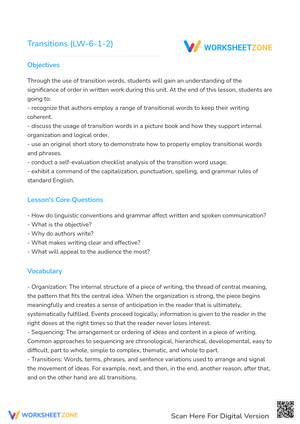
This is an educational worksheet focusing on transitions in writing. It includes objectives related to understanding the significance of order and using transition words effectively. The worksheet lists objectives, core questions for the lesson, and vocabulary definitions related to organization, sequencing, and transitions.
Grade Level Suitability:
Based on the worksheet's title (LW-6-1-2) and content, it appears suitable for 6th grade. The objectives and vocabulary suggest a middle school level understanding of writing and grammar concepts.
Why Use It:
This worksheet helps students understand the importance of transition words in creating coherent and organized writing. It encourages them to analyze how authors use transitions, discuss their function in picture books, and employ them effectively in their own writing. It also promotes self-evaluation of transition word usage.
How to Use It:
Begin by reviewing the objectives and core questions with students. Discuss the vocabulary definitions of organization, sequencing, and transitions. Students can then engage in activities that involve identifying and using transition words in various writing exercises, or analyzing the use of transition words in existing texts.
Target Users:
This worksheet is designed for 6th-grade students learning about writing techniques, particularly the use of transition words. It is also beneficial for teachers who want to teach students about the importance of order and coherence in writing.