


























Views
Downloads

Printable Natural Selection Types Worksheet | Grades 7-12
Paste this activity's link or code into your existing LMS (Google Classroom, Canvas, Teams, Schoology, Moodle, etc.).
Students can open and work on the activity right away, with no student login required.
You'll still be able to track student progress and results from your teacher account.
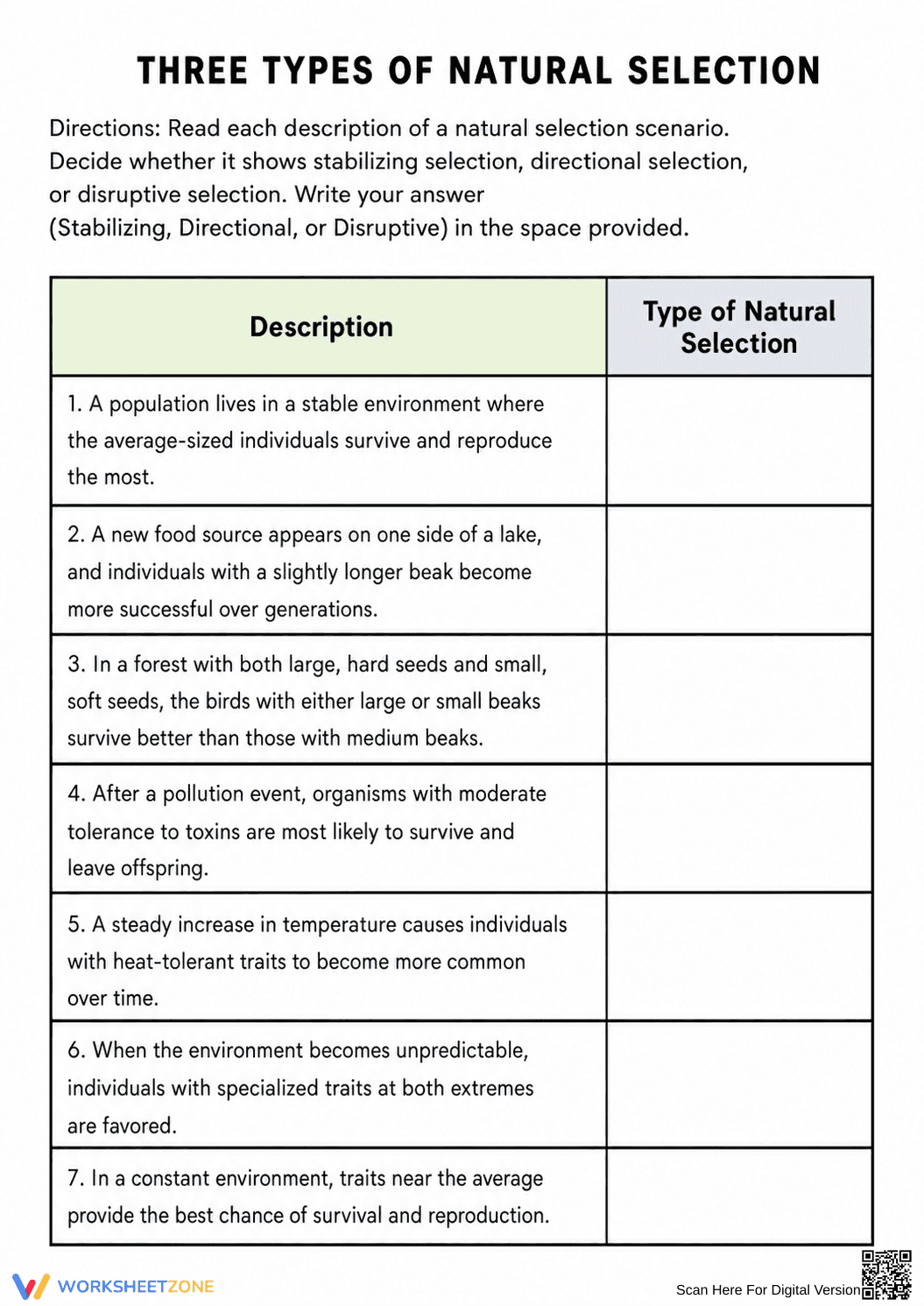
This biology worksheet provides students with targeted practice classifying the three main types of natural selection. By analyzing real-world evolutionary scenarios, learners will identify stabilizing, directional, and disruptive selection patterns. This focused activity reinforces core population genetics concepts and builds critical scientific reasoning skills.
At a Glance
- Grade: 9 · Subject: Biology
- Standard:
HS-LS4-4— Explain how natural selection leads to population adaptation- Skill Focus: Classifying natural selection types
- Format: 1 page · 7 problems · Answer key included · PDF
- Best For: Independent practice and review
- Time: 10–15 minutes
This single-page resource features a clear, structured table containing seven distinct descriptions of environmental pressures and trait survival. Students read each scenario and write the corresponding selection type in the provided column. The straightforward layout minimizes confusion, while the included full answer key ensures accurate grading and immediate feedback.
Zero-Prep Workflow
- Print (1 minute): Download the PDF and print a class set. The black-and-white design is ink-friendly and copies perfectly.
- Distribute (1 minute): Hand out the single-page assignment as a warm-up, exit ticket, or independent practice task.
- Review (3 minutes): Use the provided answer key to quickly check student responses or project it for self-grading.
With under two minutes of total teacher prep time required, this resource is highly effective for busy educators and makes an excellent, self-explanatory addition to any emergency sub plan.
Standards Alignment
This activity aligns with HS-LS4-4: Construct an explanation based on evidence for how natural selection leads to adaptation of populations. It also supports middle school life science standards regarding environmental shifts and trait distribution. Both standard codes can be copied directly into lesson plans, IEP goals, or district curriculum mapping tools.
How to Use It
Assign this worksheet immediately following direct instruction on evolutionary patterns to solidify new vocabulary. Alternatively, use it as a quick formative assessment at the beginning of a class period to check retention from the previous day. As students work through the seven scenarios, observe whether they struggle to differentiate between disruptive and directional selection, which often indicates a need to review graphing models. Expected completion time ranges from 10 to 15 minutes.
Who It's For
This resource is designed for middle and high school biology students learning about population genetics and evolution. To support learners who need additional scaffolding, allow them to reference visual graphs of the three selection types while completing the table. It pairs perfectly with a natural selection graphing activity or a direct instruction lesson on evolutionary mechanisms.
Mastering the ability to classify natural selection types is a fundamental component of high school biology and population genetics. According to EdReports 2024, instructional materials that require students to analyze specific environmental scenarios and connect them to evolutionary outcomes significantly improve long-term retention of core scientific principles. This worksheet directly supports HS-LS4-4 by asking students to explain how natural selection leads to population adaptation through the identification of stabilizing, directional, and disruptive patterns. When learners actively evaluate how shifting environmental pressures influence trait survival, they develop a more robust understanding of biological mechanisms. Providing structured, scenario-based practice ensures that students move beyond rote memorization and learn to apply evolutionary theory to diverse ecological situations, ultimately strengthening their analytical reasoning skills in the science classroom.


