




























Views
Downloads

Printable Six Kingdoms of Life Worksheet | Grade 10-12

Paste this activity's link or code into your existing LMS (Google Classroom, Canvas, Teams, Schoology, Moodle, etc.).
Students can open and work on the activity right away, with no student login required.
You'll still be able to track student progress and results from your teacher account.
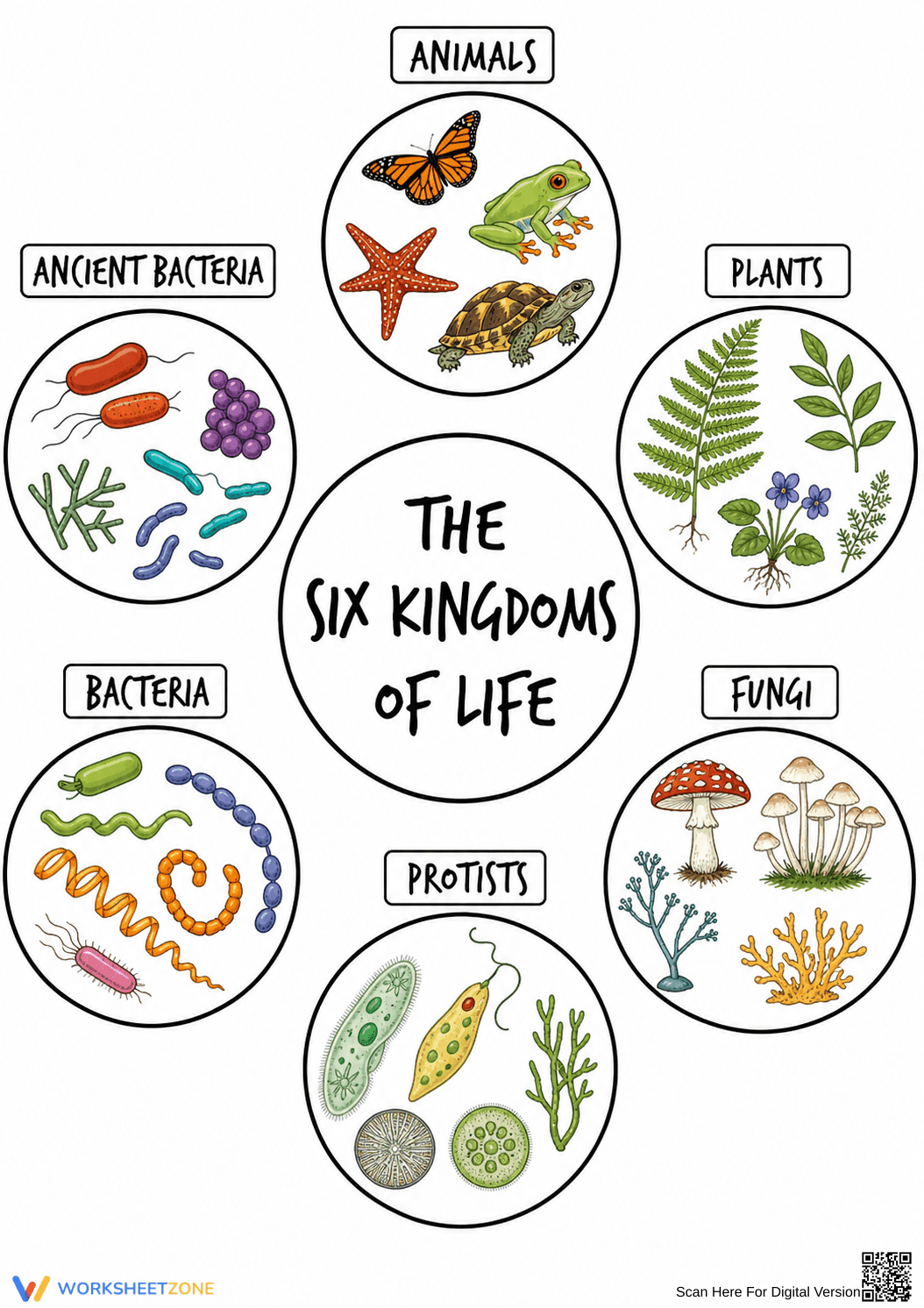
This visual reference worksheet introduces high school students to the six kingdoms of life, providing clear illustrations of organisms within each category. By examining these distinct groups, students build a foundational understanding of biological classification and taxonomy, allowing them to categorize living things based on shared traits.
At a Glance
- Grade: 10, 11, 12 · Subject: High School Biology
- Standard:
HS-LS4-1— Classify organisms based on structural evidence- Skill Focus: Biological Classification and Taxonomy
- Format: 1 printable page · 6 distinct visual categories · No answer key needed · PDF download
- Best For: Visual reference, interactive notebooks, and quick study guide
- Time: 10–15 minutes for review
This single-page printable features a central hub branching out into the six recognized kingdoms of life: Animals, Plants, Fungi, Protists, Bacteria, and Ancient Bacteria (Archaea). Each section includes high-quality, full-color illustrations of representative organisms, such as ferns for plants, paramecia for protists, and distinct cellular shapes for bacteria. The clear layout serves as an excellent visual anchor, functioning perfectly as a standalone study guide or interactive notebook insert.
This resource requires zero teacher preparation. Follow this simple workflow:
- Print (1 minute): Generate full-color or grayscale copies for each student, or project the PDF directly onto your smartboard.
- Distribute (1 minute): Hand out the diagrams as students enter the room to serve as an immediate visual hook for the day's lesson.
- Review (5 minutes): Briefly walk through each kingdom, asking students to identify the illustrated examples and brainstorm additional organisms that fit each category.
With under two minutes of total prep time, this sheet is an excellent addition to any biology sub plan or emergency lesson folder.
This resource aligns with HS-LS4-1 by helping students communicate scientific information about how common ancestry and biological evolution are supported by multiple lines of empirical evidence, specifically focusing on the structural similarities used in taxonomy. Both standard codes can be copied directly into lesson plans, IEP goals, or district curriculum mapping tools.
Integrate this diagram before direct instruction as an exploratory hook, asking students to observe the images and hypothesize the defining traits of each kingdom. Alternatively, use it during a lecture as a guided notes companion where students can annotate the margins with specific characteristics like "prokaryotic" or "multicellular." As a formative assessment tip, cover the kingdom labels and ask students to identify the group based solely on the provided illustrations. Expect 10 to 15 minutes of active annotation.
This visual guide is ideal for high school biology students, particularly visual learners and English Language Learners (ELLs) who benefit from clear imagery over dense text. It pairs perfectly with an introductory lesson on dichotomous keys or a broader unit on evolutionary biology and cladograms.
Effectively teaching biological classification requires resources that bridge the gap between abstract taxonomic ranks and concrete, observable organism traits. Aligned with HS-LS4-1, this tool helps students classify organisms based on structural evidence by providing clear visual anchors for the six kingdoms of life. According to a recent ScienceDirect TpT Analysis, integrating highly visual, diagrammatic reference materials significantly improves vocabulary retention and conceptual mapping in secondary science classrooms. By organizing complex biological diversity into an accessible, single-page format, educators can reduce cognitive load and facilitate deeper discussions about evolutionary relationships and cellular structures. This printable reference sheet ensures that foundational taxonomy concepts remain visible and accessible throughout the unit, supporting both direct instruction and independent review while fostering a more inclusive learning environment for diverse student populations.


