Students will learn about the applications of the Pythagorean theorem and its converse through the use of mathematical and practical problems in this lesson. Students will:
- use the Pythagorean theorem to calculate unknown side lengths in right triangles.
- learn how to prove that a triangle with given side lengths is a right triangle by using the Pythagorean theorem's converse.
- How are relationships expressed mathematically?
- What are some applications for expressions, equations, and inequalities in the quantification, modeling, solving, and/or analysis of mathematical situations?
- In what ways might mathematics facilitate efficient communication?
- In what ways can patterns describe interactions in mathematical contexts?
- In what ways might the recognition of pattern or recurrence help with problem-solving efficiency?
- In what ways might the characteristics of geometric forms be applied to aid in mathematical reasoning and problem-solving?
- How can we represent, compare, quantify, and model numbers using mathematics?
- What does it mean to analyze or estimate a numerical quantity?
- What qualifies a tool or method as suitable for a certain task?
- How are spatial relationships, such as shapes and dimensions, utilized to create, model, and portray real-world situations or solve problems?
- How may mathematical reasoning and problem-solving be aided by applying the properties of geometric shapes?
- What scenarios can be modeled, described, and analyzed using geometric characteristics and theorems?
- Pythagorean Theorem: A theorem that states the relationship between the lengths of the legs, a and b, in a right triangle and the length of the hypotenuse of the right triangle, c, is a² + b² = c².
- Square Root: One of two equal factors of a number.
- sticks cut into lengths of 3, 4, 5, 12, and 13 inches (use wooden kitchen skewers)
- length of string that can be measured (the string should be at least 13 feet long)
ruler for each group of 2 or 3 students
- yardstick or other tool to measure long distances (tape measure, etc.)
- Finding Missing Lengths in Right Triangles worksheet (M-8-6-1_Finding Missing Lengths)
- Assess students' understanding with the Finding Missing Lengths in Right Triangles worksheet (M-8-6-1_Finding Missing Lengths), which is about missing lengths in right triangles.
- To track students' understanding, measure the level of debate in the class for both tasks.
Active Participation, Modeling
W: The purpose of this lesson is to help you grasp the two-way relationship that exists between a triangle's side lengths and its angle measurements.
H: Students will create triangles and anticipate whether they are right triangles depending on side lengths. Students will get to act as "detectives," deducing further information about a triangle based on hints regarding its measurements.
E: By letting students build real triangles rather than just drawings on paper, Activity 1 piques students' interest. Meanwhile, Activity 2 lets them put themselves at the vertices of right triangles and estimate distances without really measuring them.
R: Using real physical measurements, students will be able to rethink their understanding of the Pythagorean theorem and the connection between triangles' side lengths and angles.
E: Students will demonstrate their understanding of the Pythagorean theorem by completing the Finding Missing Lengths in Right Triangles worksheet.
T: Students can practice the topic in several ways during the class. By building different triangles out of wood pieces, students will be able to engage with the idea of a small size. Alternatively, they can engage on a bigger scale by assuming the roles of triangle vertices and measuring distances. Throughout the class, students will be required to record their observations and take notes in writing.
O: Students can investigate triangles on their own and with a partner in this lesson's small-scale exploration phase. A group discussion follows, and the lesson ends with an activity that can be done in a small or big group that will keep students actively involved.
Activity 1
Give each student or small group of students a collection of sticks cut to various lengths. Each group must create triangles with sides of varying lengths so that the sticks touch one another at the ends. Each group's purpose is to construct right triangles, with students visually estimating the angle measurements.
Once students have created a right triangle, they should note the lengths of the legs and the hypotenuse of the triangle they created.
After the groups have had the opportunity to create a variety of triangles, request the measurements of the triangles that the groups believed to be right triangles.
"How do you know the triangles with these angle measures are right triangles?" Students' responses may include, "Because it looks like it," or they may have measured the angle with a protractor or something with a known right angle, such as the corner of a sheet of paper or notecard. If students do not bring up the Pythagorean theorem, ask if they can explain it. Make sure it is expressed in the right "order," i.e., "If a triangle is a right triangle with legs of lengths a and b and a hypotenuse of length c, then a² + b² = c²."
"To use the Pythagorean theorem, what do we need to know?" Help students understand that the Pythagorean theorem "starts" with a right triangle and "ends" with knowing the lengths of the sides of the right triangle.
"Can we use the Pythagorean theorem to show that a triangle is a right triangle?" Make sure that students understand that the Pythagorean theorem, as stated, cannot be used to prove that a triangle is a right triangle; but, the converse of the theorem can.
Write the converse of the Pythagorean theorem on the board: "If a triangle has sides with lengths a, b, and c, and a² + b² = c², then the triangle is a right triangle."
"In order to use this theorem, what do we need to know?" Help students understand that the lengths of the triangle's sides must be so that a² + b² = c².
"And if we know the lengths satisfy our equation, what do we know about our triangle based on this theorem?"
Make sure students understand that the Pythagorean theorem tells us something about the relationship between a triangle's side lengths, while its converse tells us something about the triangle's angles (specifically, that one is a right angle).
Activity 2
Using a 3-4-5 triangle from Activity 1 as an example, ask students, "If you know the legs of a right triangle are 3 inches and 4 inches, how long is the hypotenuse?" Make sure that students explain their reasoning using the Pythagorean theorem.
"If you know that one leg of a right triangle is 3 inches and the hypotenuse is 5 inches, how long is the other leg?" Make sure that you emphasize the importance of representing the length of the hypotenuse as c in the equation a² + b² = c². Also, in both instances, you indicated that the triangle is a right triangle, which is required for using the Pythagorean theorem.
Have students form groups of 4 or 5. Give each group a piece of string and a yardstick.
This activity works best on floors with straight angles. Possible locations include the classroom or hallway, where floor tiles are located at right angles; outdoors in a parking lot using painted parking lot lines; or indoors in a gymnasium using the lines painted to mark basketball or volleyball courts.
Three students from each group should position themselves at the vertices of a right triangle, using the right angles on the floor as a guide to ensure that the triangle is formed correctly. Each group should identify the right triangle's legs and hypotenuse. (For instance, "The hypotenuse is the side of the triangle between Bob and Susan." )
Students who do not indicate the triangle's vertices should measure two of its three sides. Make sure students do not always measure the same two sides of each triangle (i.e., in some triangles, students should measure both legs, while in others they should measure a leg and the hypotenuse). Students can use a yardstick to measure, although it may be easier to measure a length of string first and then the string. If they use a single piece of string, the length should be more precise because the string can be pulled in a straight line.
After measuring two sides, students can use the equation a² + b² = c² to predict the length of the remaining side before measuring.
After students have recorded their predictions, each group should measure the remaining side and compare it to their expectations.
Each group should complete a sufficient number of triangles to allow each student to measure and predict.
After each group has done, ask the students:
"How accurate were your predictions?"
"What are some reasons your predictions may not have been accurate?" (Inaccuracy in measurements, the triangles were not right triangles, etc.)
"What difficulties did you encounter?"
"What were some things you had to keep in mind during the activity?" (Ideally, students will add that they had to remember to represent the length of the hypotenuse as c in the equation a² + b² = c²; if not, remind students.)
Extension:
Depending on the class, it may be important to investigate the connection between true if-then statements and their converse. Students frequently assume that the converse of each true if-then statement is also true. Ask students to come up with true if-then statements containing converses that are not always true, such as "If it is raining, then there is water landing on the sidewalk." Encourage students to come up with scenarios that contradict the converse, such as a sprinkler near the sidewalk. Point out to students that, while the converse of the Pythagorean theorem may appear to be a trivial and obvious result, the truth of a statement does not imply that its converse is necessarily true and that it is important to distinguish between a theorem and its converse.

Applying the Pythagorean Theorem
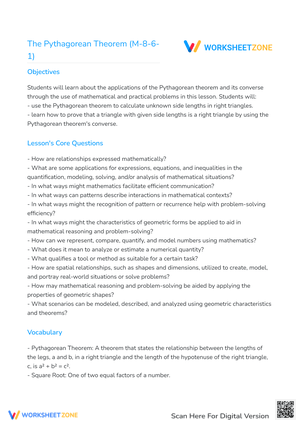
This is an educational worksheet titled 'The Pythagorean Theorem (M-8-6-1)'. It includes objectives for students to learn about the applications of the Pythagorean theorem and its converse. It presents core questions related to mathematical relationships, expressions, equations, inequalities, patterns, geometric forms, spatial relationships, and modeling. It also provides vocabulary definitions for 'Pythagorean Theorem' including the formula a²+b²=c², and 'Square Root'.
Grade Level Suitability:
This worksheet is suitable for grades 8-9. The content covers the Pythagorean theorem, its converse, and related mathematical concepts, which are typically introduced in middle and early high school. The vocabulary and core questions are geared towards a more advanced understanding of mathematical principles.
Why Use It:
This worksheet helps students understand the Pythagorean theorem and its applications in real-world scenarios. It encourages critical thinking through core questions that prompt students to analyze mathematical relationships and problem-solving strategies. The vocabulary section builds a strong foundation in mathematical terminology.
How to Use It:
Use this worksheet as an introduction or review of the Pythagorean theorem. Start by discussing the objectives and vocabulary. Then, use the core questions to guide classroom discussions or individual reflection. The worksheet can be used as a pre-lesson activity to stimulate thought or as a post-lesson review to consolidate learning.
Target Users:
This worksheet is designed for middle school and early high school students learning about the Pythagorean theorem. It can be used by teachers as a classroom resource or by students for self-study and review. It's also beneficial for students who need a refresher on basic geometric concepts and mathematical reasoning.