


























Views
Downloads
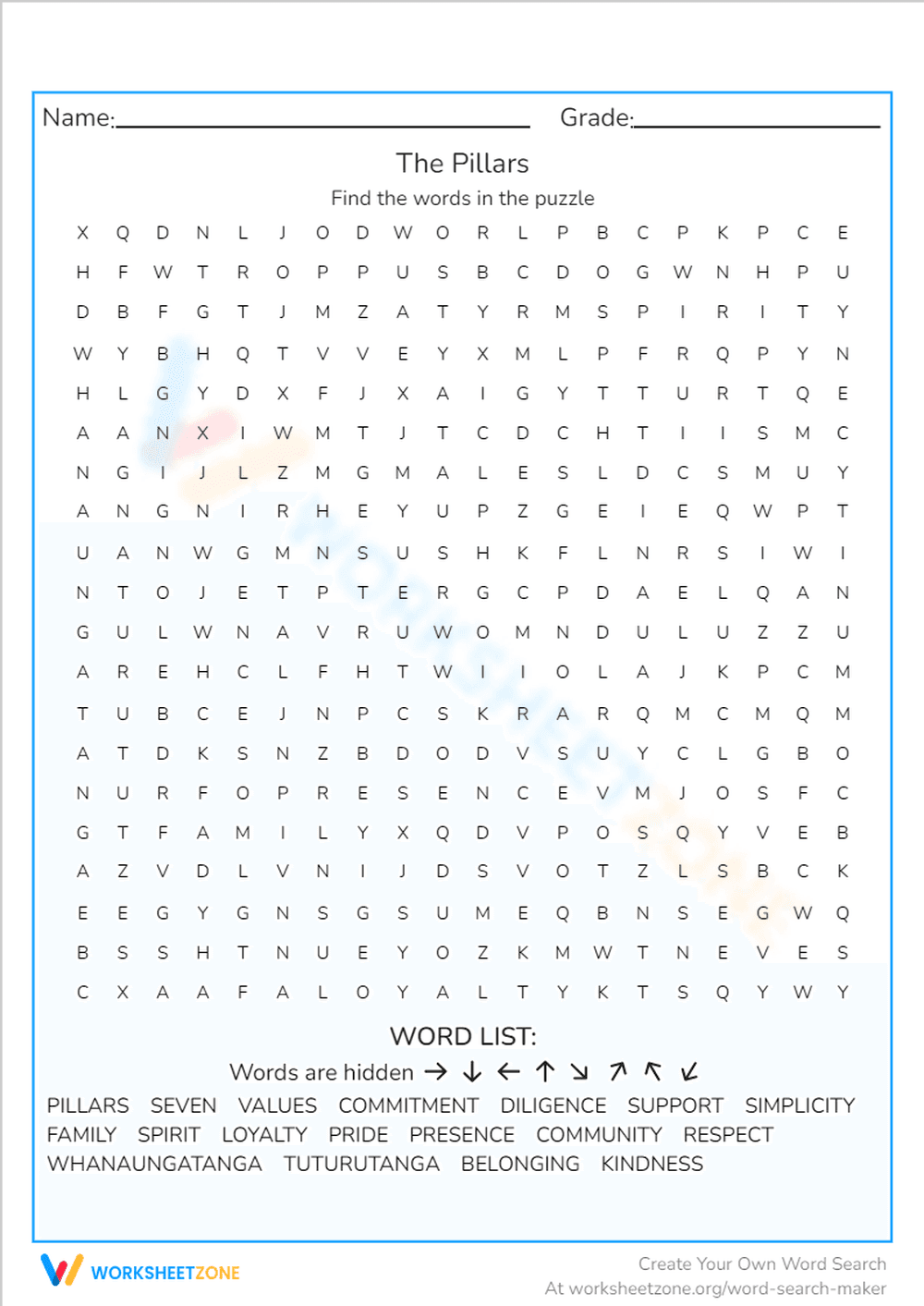

Grade 7 Core Values — Printable No-Prep Worksheet
Paste this activity's link or code into your existing LMS (Google Classroom, Canvas, Teams, Schoology, Moodle, etc.).
Students can open and work on the activity right away, with no student login required.
You'll still be able to track student progress and results from your teacher account.
This Grade 7 vocabulary word search helps students build familiarity with core character values and community-building terms. By actively scanning for 18 specific domain words, learners reinforce spelling patterns and visual recognition skills. It serves as an excellent introductory activity for advisory periods or character education units.
At a Glance
- Grade: 7 · Subject: ELA
- Standard:
CCSS.ELA-LITERACY.L.7.6— Acquire and use grade-appropriate academic words- Skill Focus: Vocabulary Recognition
- Format: 1 page · 18 problems · Answer key included · PDF
- Best For: Independent practice and sub plans
- Time: 10–15 minutes
This single-page resource features a classic word search grid containing 18 hidden terms related to community pillars, such as diligence and respect. The words are hidden horizontally, vertically, and diagonally to provide an appropriate challenge for middle schoolers. A complete word bank is provided at the bottom, alongside a full answer key for quick grading.
This resource is designed for immediate classroom implementation with a streamlined zero-prep workflow:
- Print (1 minute): Simply download the PDF and print a class set. The black-and-white design ensures crisp copies without draining school ink supplies.
- Distribute (1 minute): Hand out the sheets at the beginning of class as a bell-ringer or leave them in a visible folder for substitute teachers.
- Review (1 minute): Use the included answer key to quickly verify completion or project it on the smartboard for self-correction.
Total teacher preparation requires under two minutes, making this an ideal emergency sub plan or transition activity.
This activity aligns with CCSS.ELA-LITERACY.L.7.6: Acquire and use accurately grade-appropriate general academic and domain-specific words and phrases. By engaging with these specific terms, students build the foundational recognition required for deeper semantic mapping. Both standard codes can be copied directly into lesson plans, IEP goals, or district curriculum mapping tools.
Teachers can deploy this worksheet before direct instruction as a thematic hook for a new unit on community values or character development. Alternatively, it functions perfectly as a quiet, independent activity after a testing session when students need a low-stakes cognitive task. While students work, teachers can use formative assessment by observing which directional patterns cause frustration, indicating a need for visual tracking support. Expected completion time ranges from 10 to 15 minutes.
This resource is primarily designed for seventh-grade general education students, though it easily adapts to advisory groups or homeroom periods focused on social-emotional learning. For differentiation, teachers can highlight the first letter of each word on the grid for students requiring visual accommodations. It pairs naturally with a direct instruction lesson on school expectations or an anchor chart defining each of the core pillars.
Integrating targeted vocabulary exercises like this word search supports broader literacy goals by reinforcing visual word recognition and spelling automaticity. Aligned with CCSS.ELA-LITERACY.L.7.6, the task requires students to acquire and use grade-appropriate academic words within a specific thematic context. According to Fisher & Frey (2014), repeated visual exposure to domain-specific vocabulary significantly improves students' ability to retrieve and apply these terms during complex reading and writing tasks. Structured word searches demand sustained attention and pattern recognition, which are critical cognitive skills for middle school learners. By embedding character-focused terminology into a familiar puzzle format, educators can lower the affective filter, allowing students to interact with new academic language in a low-stress environment. This approach ensures that foundational vocabulary acquisition remains both accessible and instructionally sound.


