


























Views
Downloads

Essential Ch. 9-11 Vocabulary: Lion, Witch, Wardrobe
Paste this activity's link or code into your existing LMS (Google Classroom, Canvas, Teams, Schoology, Moodle, etc.).
Students can open and work on the activity right away, with no student login required.
You'll still be able to track student progress and results from your teacher account.
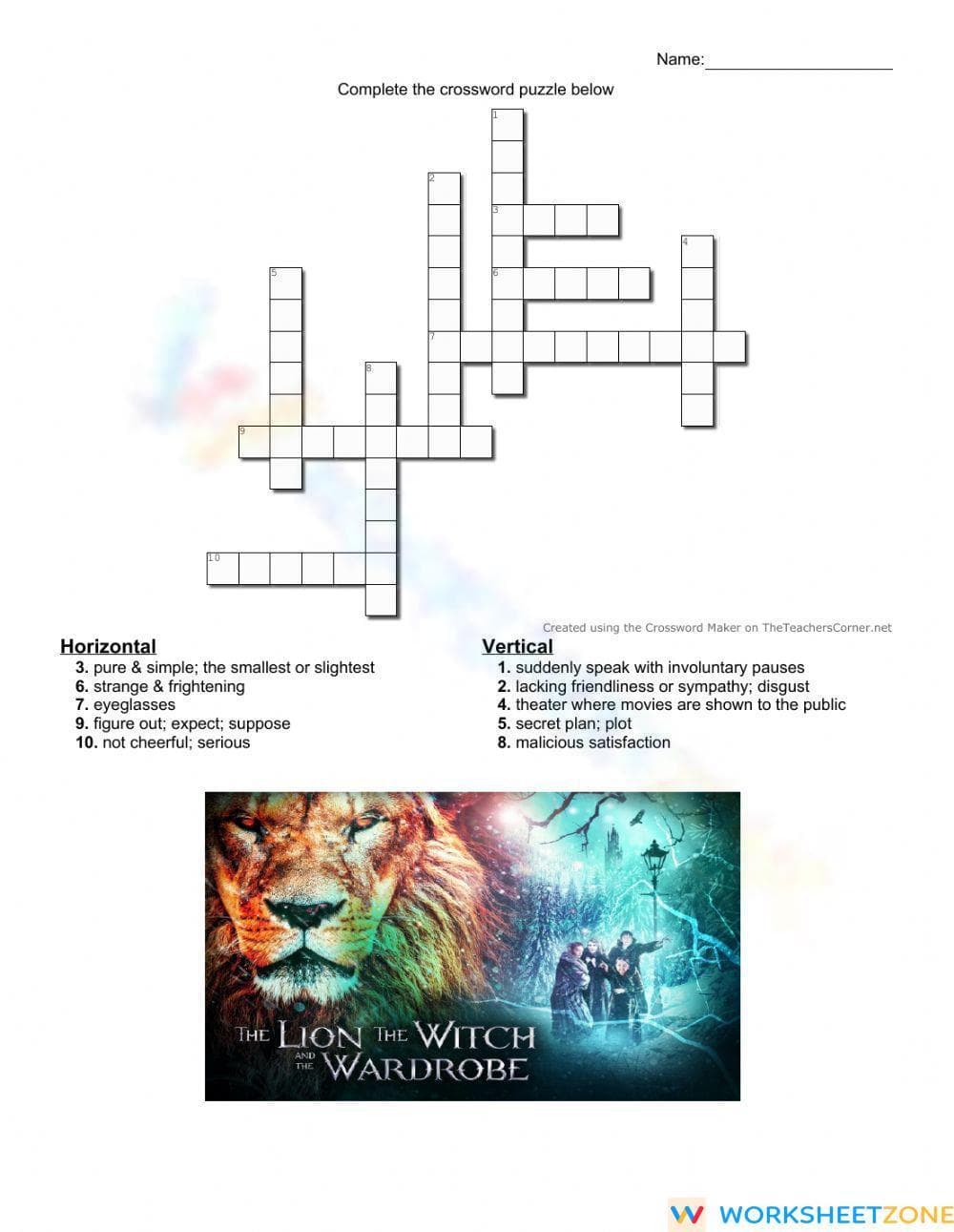
This Grade 5 vocabulary worksheet provides a targeted review of Chapters 9-11 from The Lion, the Witch, and the Wardrobe. Students engage with 10 critical terms through a crossword format to reinforce contextual word-meaning relationships. Solving these clues helps learners solidify their grasp of the novel's lexicon, ensuring they are prepared for deeper thematic analysis.
At a Glance
- Grade: 5 · Subject: English Language Arts
- Standard:
CCSS.ELA-LITERACY.RL.5.4— Determine the meaning of words and phrases as they are used in a text- Skill Focus: Literary Vocabulary
- Format: 1 page · 10 problems · Answer key included · PDF
- Best For: Literary unit vocabulary review
- Time: 15–20 minutes
This single-page resource features a 10-clue crossword puzzle covering five horizontal and five vertical vocabulary terms. Clues are based on definitions and synonyms for words like "spectacles," "scheme," and "solemn" that appear in the middle section of the novel. The layout includes themed imagery to maintain student engagement and an organized space for student identification. A comprehensive answer key is included for rapid grading.
The zero-prep workflow for this resource is designed for maximum teacher efficiency. First, print the single-page PDF in under 30 seconds. Second, distribute it to students as a bell-ringer or transition activity. Third, review the answers as a whole group or use the provided key for independent checking. Total preparation time is under two minutes, making it ideal for unexpected sub plans or quick lesson transitions.
This resource is specifically aligned to `CCSS.ELA-LITERACY.RL.5.4`, which requires students to determine the meaning of words and phrases as they are used in a text, including figurative and connotative meanings. By matching definitions to crossword slots, students demonstrate their ability to interpret literary vocabulary. This standard code can be copied directly into lesson plans, IEP goals, or district curriculum mapping tools to track student progress.
Use this crossword as a formative assessment after students finish reading Chapter 11 to check their comprehension of the text's vocabulary. Alternatively, assign it as a collaborative partner activity where students search back through the chapters to find the context for each clue. Observe if students struggle with specific parts of speech, which can inform your next direct instruction mini-lesson on word roots or affixes.
This worksheet is designed for fifth-grade students studying C.S. Lewis, but it is also suitable for sixth-grade remediation or fourth-grade enrichment. It pairs naturally with a novel study guide or an interactive notebook entry. For English Language Learners, providing the page numbers where the words appear can offer additional scaffolding without changing the core cognitive task of the assignment.
According to the RAND AIRS 2024 report on literacy instruction, consistent engagement with academic and literary vocabulary is a primary predictor of long-term reading comprehension success. This worksheet leverages the crossword format to provide low-stakes, high-impact practice with the specific standard `CCSS.ELA-LITERACY.RL.5.4`. Fisher & Frey (2014) emphasize that vocabulary acquisition is most effective when students encounter words multiple times within the context of a shared text. By requiring students to recall and apply terms from The Lion, the Witch, and the Wardrobe, this activity builds the necessary cognitive bridges between word recognition and conceptual mastery. The inclusion of a clear answer key ensures that feedback is immediate, which is a critical component of the gradual release of responsibility model in ELA classrooms. This resource serves as a vital tool in any comprehensive literacy unit, providing the structured practice required for mastery.


