


























Views
Downloads
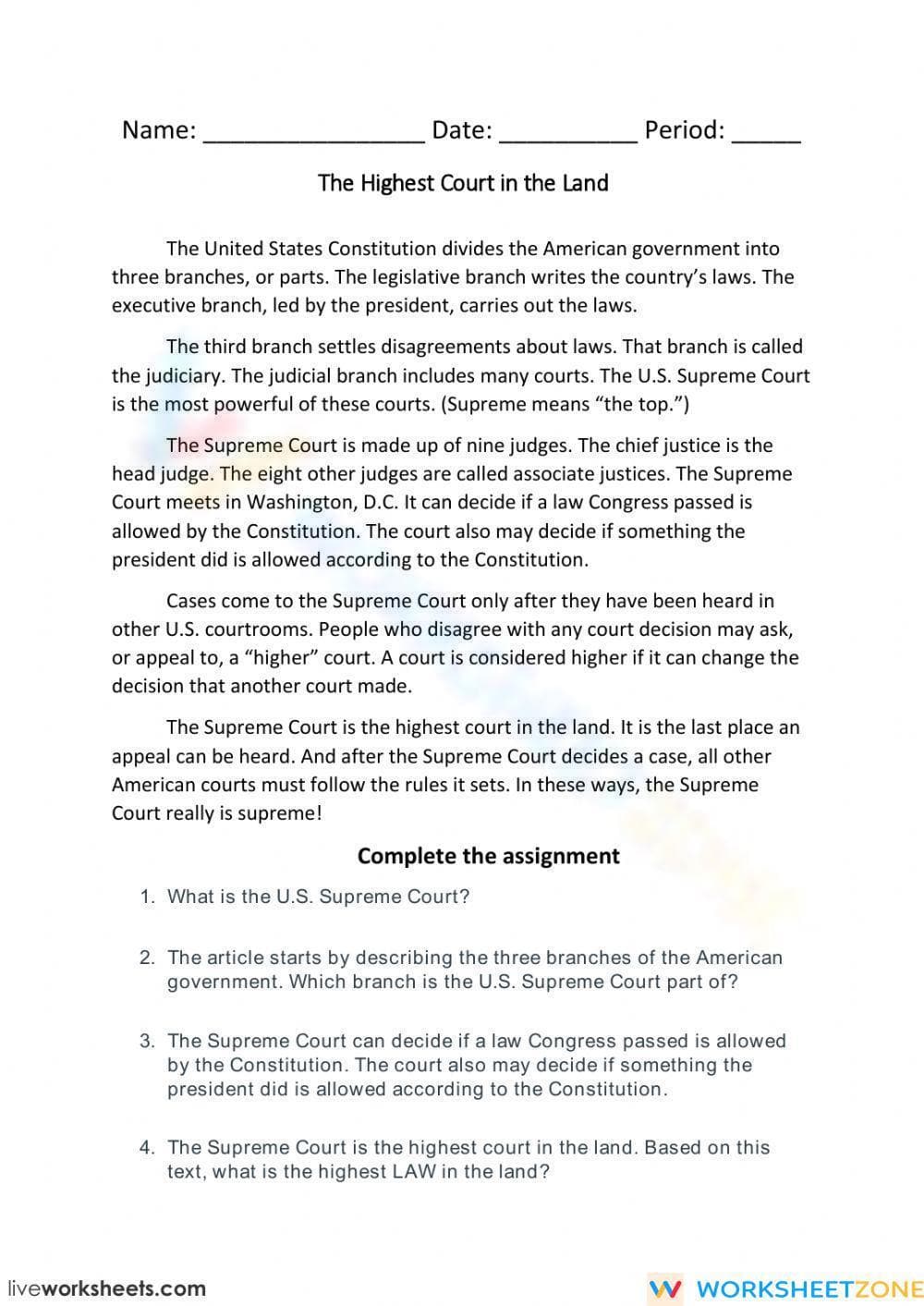


The Highest Court in the Land: Printable ELA Worksheet
Paste this activity's link or code into your existing LMS (Google Classroom, Canvas, Teams, Schoology, Moodle, etc.).
Students can open and work on the activity right away, with no student login required.
You'll still be able to track student progress and results from your teacher account.
Equip your students with a fundamental understanding of the judicial branch with this comprehensive reading comprehension worksheet. This resource explains the role of the U.S. Supreme Court, its composition, and its unique power within the American government. Students analyze the informational text to answer ten questions, focusing on evidence-based reading and main idea identification.
At a Glance
- Grade: 7 · Subject: ELA / Civics
- Standard:
CCSS.ELA-LITERACY.RI.7.1— Cite several pieces of textual evidence to support analysis of informational text- Skill Focus: Reading comprehension and main idea identification
- Format: 2 pages · 10 problems · Answer key included · PDF
- Best For: Middle school civics and ELA reading practice
- Time: 15–20 minutes
This two-page PDF includes a concise reading passage titled 'The Highest Court in the Land' followed by ten comprehension questions. The tasks include identifying the central idea, vocabulary in context, and short-answer questions requiring specific textual evidence. A full answer key is provided to facilitate quick grading or student self-correction.
Designed for immediate implementation, this worksheet follows a simple three-step workflow. First, print the two-page document for each student (30 seconds). Second, distribute the materials as a warm-up or independent practice activity (1 minute). Finally, review the answers using the included key to provide instant feedback (5 minutes). Total teacher preparation time is under two minutes, making this highly suitable for emergency sub plans.
Standards Alignment
This worksheet is primarily aligned with CCSS.ELA-LITERACY.RI.7.1, which requires students to cite several pieces of textual evidence to support analysis of what the text says explicitly. It also supports RI.7.2 through its focus on determining central ideas. Both standard codes can be copied directly into lesson plans, IEP goals, or district curriculum mapping tools.
How to Use It
Use this worksheet during a civics unit or as a focused informational text lesson. It is effective as a formative assessment after initial instruction on the branches of government. A key observation tip: check if students quote directly from the text for question ten to gauge mastery of evidence-based writing. Expected completion time is 15-20 minutes.
Who It's For
This resource is ideal for Grade 6-10 students, including those in general education who benefit from structured reading passages. It pairs naturally with a primary source passage from the Constitution or an anchor chart detailing the separation of powers. Differentiation is supported through the clear, accessible language of the text.
According to the ScienceDirect TpT Analysis, structured reading comprehension materials that integrate civics content significantly improve both domain-specific knowledge and general literacy outcomes for middle school learners. This worksheet, aligned to CCSS.ELA-LITERACY.RI.7.1, requires students to cite specific textual evidence to support their analysis of the United States Supreme Court's role and power. By engaging with 10 targeted questions, students develop a clear understanding of the judiciary branch's hierarchy and the concept of legal 'supremacy' as defined by the Constitution. The text-dependent nature of the tasks ensures that learners are not merely recalling facts but are actively interpreting the passage's structure and authorial intent. This resource serves as a vital tool for educators seeking to bridge the gap between social studies content and rigorous ELA standards, providing a focused environment for mastering main idea identification and evidence-based writing. It is an essential component for any curriculum emphasizing the intersection of law, government, and complex informational text analysis.


