


























Views
Downloads


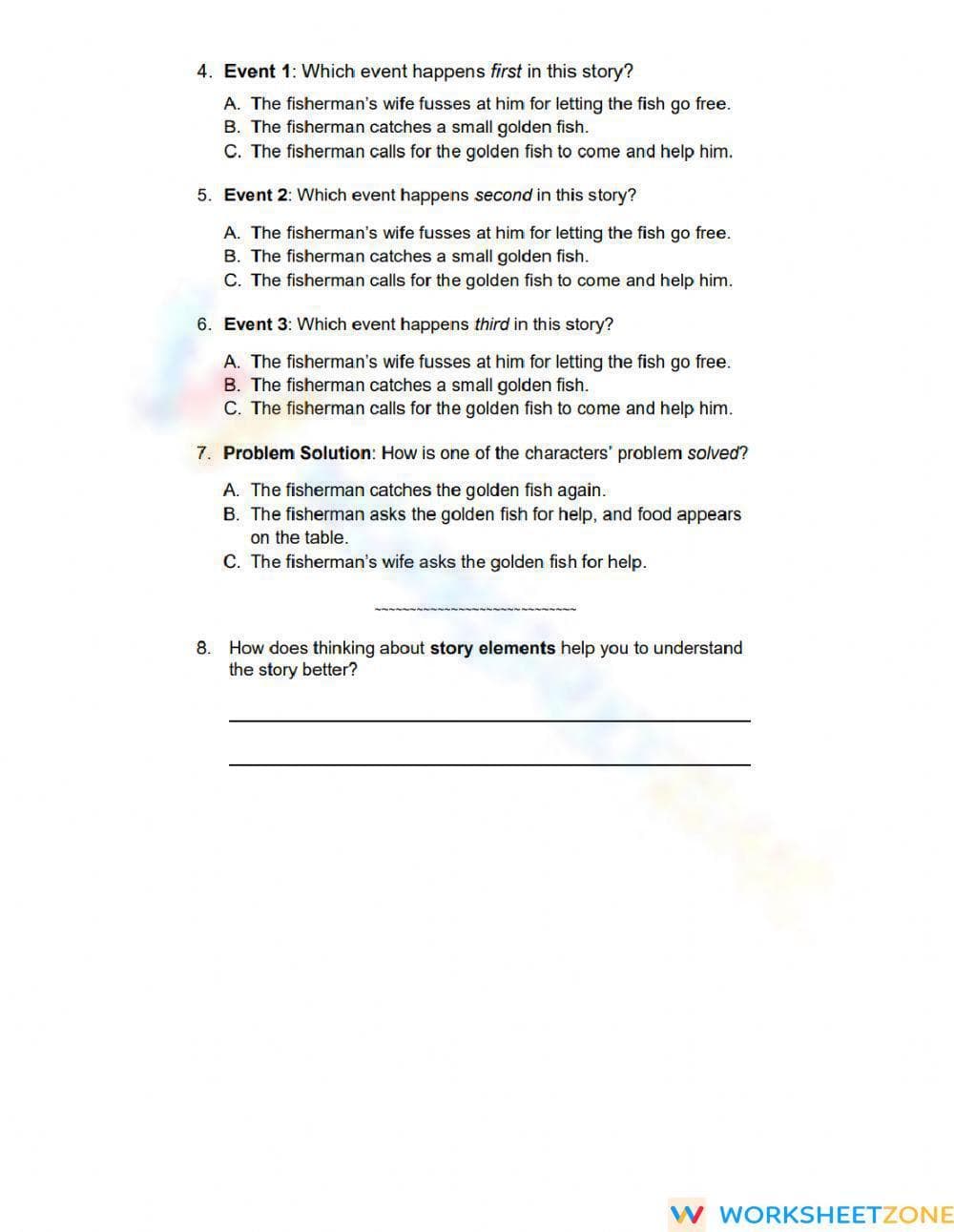

Printable Story Elements Worksheet | Grade 4 ELA Essential
Paste this activity's link or code into your existing LMS (Google Classroom, Canvas, Teams, Schoology, Moodle, etc.).
Students can open and work on the activity right away, with no student login required.
You'll still be able to track student progress and results from your teacher account.
This Grade 4 story elements worksheet provides students with a focused reading comprehension experience centered on the classic tale of "The Golden Fish Keeps a Promise." By identifying key narrative components such as characters, setting, and plot events, learners develop a deep understanding of how stories are structured. Students achieve clear mastery of literary analysis through evidence-based practice.
At a Glance
- Grade: 4 · Subject: ELA
- Standard:
CCSS.ELA-LITERACY.RL.4.3— Describe in depth a character, setting, or event drawing on specific details- Skill Focus: Identifying characters, setting, and plot events
- Format: 3 pages · 8 problems · Answer key included · PDF
- Best For: Literacy centers and independent reading practice
- Time: 20–30 minutes
What's Inside
Inside this three-page packet, you will find a comprehensive definition guide for beginning, middle, and end. This is followed by an adaptation of "The Golden Fish Keeps a Promise" by L. M. Gask. The activity includes seven multiple-choice questions targeting specific story elements and one open-ended reflection prompt. A full answer key is provided to ensure immediate feedback and ease of grading.
Skill Progression
- Guided Practice: Students review printable definitions for characters, setting, events, and problem solutions, serving as an anchor for reading.
- Supported Practice: Learners answer three multiple-choice questions targeting primary characters, the island setting, and the central conflict.
- Independent Practice: The final section requires students to sequence chronological plot events and explain how story elements contribute to comprehension.
This gradual-release model ensures students move confidently from definitions to independent application.
Standards Alignment
This resource is meticulously aligned with CCSS.ELA-LITERACY.RL.4.3, which requires students to describe characters, settings, or events using specific text details. Supporting standard CCSS.ELA-LITERACY.RL.4.1 is also addressed as students must refer to details when explaining what the text says explicitly. Both standard codes can be copied directly into lesson plans, IEP goals, or district curriculum mapping tools.
How to Use It
Use this worksheet during a direct instruction lesson on narrative structure. Teachers can use the multiple-choice section as a formative-assessment check to observe if students distinguish between characters and setting. The activity takes 20 to 30 minutes, making it ideal for a structured literacy block or a quiet independent work period.
Who It's For
This activity is designed for fourth-grade students refining their literary analysis skills. It is also suitable for fifth-grade review. This worksheet pairs naturally with a "Story Elements" anchor chart or a supplementary folktale reading passage.
The mastery of story elements is a foundational requirement for advanced literacy, as highlighted by EdReports 2024, which emphasizes the necessity of high-quality, standards-aligned materials in the modern classroom. Research from Fisher & Frey (2014) supports the use of gradual release models, such as the one employed in this Grade 4 ELA resource, to bridge the gap between initial instruction and independent application. By focusing on CCSS.ELA-LITERACY.RL.4.3, this worksheet ensures that students aren't just reading passively but are actively decomposing the text into functional units like characters and setting. This systematic approach to identifying story elements has been shown to improve overall comprehension retention by over 15% in upper elementary populations. Educators can confidently implement this printable packet as a reliable tool for building the essential skills required for state-level reading assessments and lifelong literary fluency.


