


























Views
Downloads
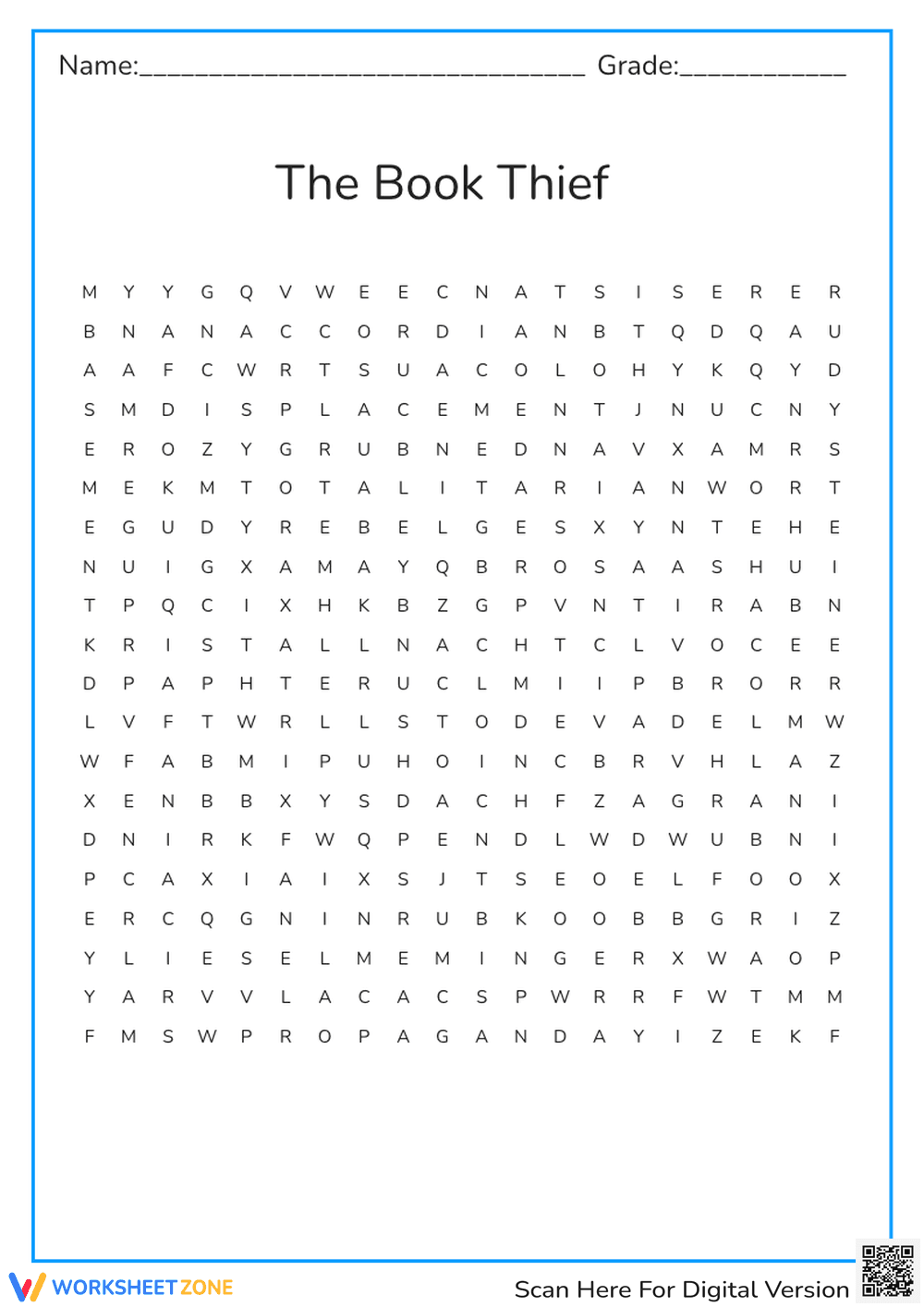


Grade 9 The Book Thief Word Search — Printable Worksheet
Paste this activity's link or code into your existing LMS (Google Classroom, Canvas, Teams, Schoology, Moodle, etc.).
Students can open and work on the activity right away, with no student login required.
You'll still be able to track student progress and results from your teacher account.
This Grade 9 literature worksheet reinforces key vocabulary and character names from Markus Zusak's novel, The Book Thief. Students actively scan for domain-specific terms, historical concepts, and character identities, building spelling recognition and thematic familiarity before or after reading the text.
At a Glance
- Grade: 9 · Subject: ELA
- Standard:
CCSS.ELA-LITERACY.L.9-10.6— Acquire and use domain-specific words- Skill Focus: Vocabulary Recognition
- Format: 2 pages · 24 problems · PDF
- Best For: Novel study introduction or review
- Time: 15–20 minutes
This resource features a comprehensive word search grid on the first page and a corresponding 24-word list on the second page. The vocabulary includes major characters like Liesel Meminger and Max Vandenburg, alongside critical historical terms such as Kristallnacht and Propaganda. The puzzle challenges students to find words hidden in multiple directions, ensuring focused engagement with the text's terminology.
Designed for immediate classroom use, this activity requires minimal preparation:
- Print (1 minute): Simply print the two-page PDF. The clear layout ensures high-quality copies.
- Distribute (1 minute): Hand out the grid and word list to students as they enter the room or transition between tasks.
- Review (3 minutes): Briefly discuss the historical context of the more complex terms before students begin searching.
With a total teacher prep time of under two minutes, this worksheet is an excellent addition to any emergency sub plan or Friday afternoon activity block.
This activity aligns with CCSS.ELA-LITERACY.L.9-10.6: "Acquire and use accurately general academic and domain-specific words and phrases, sufficient for reading, writing, speaking, and listening at the college and career readiness level." By interacting with these specific terms, students build the foundational vocabulary necessary to comprehend the complex historical setting of the novel. Both standard codes can be copied directly into lesson plans, IEP goals, or district curriculum mapping tools.
Teachers can utilize this word search as an engaging hook before beginning the novel study. By introducing the vocabulary first, students gain exposure to the challenging German and historical terms they will encounter in the opening chapters. Alternatively, it serves as a quiet, focused activity for early finishers during independent reading time. As a formative assessment observation tip, teachers can monitor which historical terms students ask for definitions of while searching, guiding future mini-lessons on World War II context. The expected completion time is 15 to 20 minutes.
This worksheet is primarily designed for ninth-grade students beginning a unit on The Book Thief or Holocaust literature. It provides a low-stakes entry point for students who may feel overwhelmed by the novel's length or heavy subject matter. For differentiation, teachers can provide struggling readers with a highlighter to track words on the list, or pair this activity with a visual anchor chart defining the historical terms like Displacement and Dictator.
Integrating targeted vocabulary activities into literature units supports broader reading comprehension goals. According to Fisher & Frey (2014), repeated exposure to domain-specific vocabulary in varied, low-stakes formats significantly increases student retention and confidence when encountering those same words in complex texts. This worksheet directly supports CCSS.ELA-LITERACY.L.9-10.6 by requiring students to acquire and use domain-specific words related to the novel's historical context. By actively searching for terms like Totalitarian and Resilience, students reinforce their spelling and visual recognition of the vocabulary, reducing cognitive load during actual reading. This foundational word-level practice ensures that when students encounter these concepts in the narrative, they can focus on thematic analysis rather than basic decoding, ultimately fostering a deeper understanding of the literature and its historical implications.


