


























Views
Downloads




Grade 5 Math Essential Review: Printable Fractions
Paste this activity's link or code into your existing LMS (Google Classroom, Canvas, Teams, Schoology, Moodle, etc.).
Students can open and work on the activity right away, with no student login required.
You'll still be able to track student progress and results from your teacher account.
This comprehensive Grade 5 mathematics assessment provides students with a targeted review of core curriculum standards. Covering multi-digit division, complex fraction operations, and real-world word problems, it helps learners solidify their procedural fluency and conceptual understanding. Students will solve 15 structured problems that bridge basic computation with applied mathematical reasoning for classroom success.
At a Glance
- Grade: 5 · Subject: Mathematics
- Standard:
CCSS.MATH.CONTENT.5.NBT.B.6— Find whole-number quotients of whole numbers with up to four-digit dividends- Skill Focus: Operations, Fractions, and Word Problems
- Format: 5 pages · 15 problems · Answer key included · PDF
- Best For: End-of-unit assessment and spiral review
- Time: 45–60 minutes
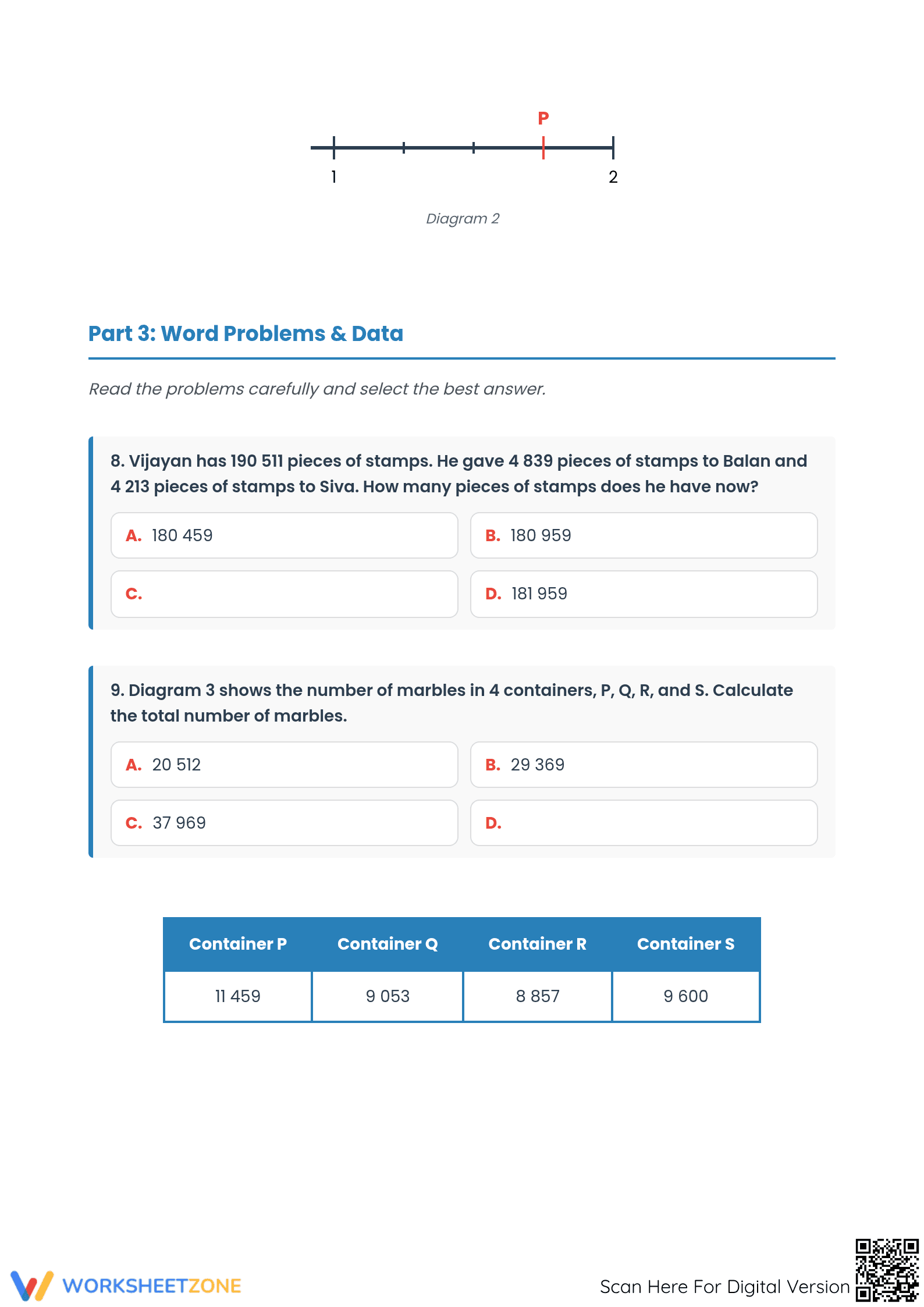
This five-page PDF includes four distinct sections: Basic Operations & Fractions, Diagrams & Fractions, Word Problems & Data, and Additional Practice. It features 15 multiple-choice questions ranging from long division with remainders to interpreting shaded fraction diagrams and calculating perimeters. A complete answer key is provided at the end for immediate feedback and easy grading.
Skill Progression
- Guided Practice: The first part provides five problems on basic operations and improper fractions, allowing students to recall essential procedures with direct computational prompts.
- Supported Practice: Questions 6 through 10 use visual diagrams and number lines to scaffold the transition from abstract symbols to concrete mathematical representations.
- Independent Practice: The final sections present multi-step word problems and geometry applications, requiring students to apply their knowledge independently in varied contexts.
This "I Do, We Do, You Do" approach ensures students are ready for the rigor of the Additional Practice section.
Standards Alignment
The primary focus of this worksheet is CCSS.MATH.CONTENT.5.NBT.B.6, which requires students to find whole-number quotients of whole numbers with up to four-digit dividends and two-digit divisors. Additionally, it supports CCSS.MATH.CONTENT.5.NF.A.1 through exercises on adding and subtracting fractions with unlike denominators. Both standard codes can be copied directly into lesson plans, IEP goals, or district curriculum mapping tools.
How to Use It
Use this worksheet as a summative assessment after completing units on multi-digit division and fraction operations. Alternatively, assign specific sections as formative checks during direct instruction to gauge student progress. During administration, observe how students handle the transition from Part 1 to Part 2 to identify if they struggle more with computation or visual interpretation. Completion time is approximately 45-60 minutes.
Who It's For
This resource is designed for Grade 5 students mastering the CCSS curriculum, but it also serves as a robust intervention tool for Grade 6 learners needing refresher practice. It pairs naturally with anchor charts on division steps or fraction number lines to support diverse learner needs.
Aligned with the rigorous demands of CCSS.MATH.CONTENT.5.NBT.B.6, this assessment targets the critical transition from basic arithmetic to advanced algebraic thinking. By integrating multi-digit quotients with fraction operations, the worksheet addresses the procedural fluency gaps often identified in mid-elementary mathematics. Research from Fisher & Frey (2014) emphasizes that gradual release models—mirroring the structured progression from computation to word problems seen here—significantly improve long-term retention of mathematical concepts. The inclusion of visual models for fraction interpretation directly supports the NAEP framework's recommendation for multi-representational learning. This 15-task set serves as a high-quality instrument for identifying specific student misconceptions before high-stakes testing. Educators can utilize the provided data sections to drive small-group instruction or document mastery of Grade 5 Number and Operations in Base Ten standards for district-wide reporting and individual student growth tracking across the academic year.


