


























Views
Downloads

Systems, Back, and Shoulders Assessment | Essential Anatomy
Paste this activity's link or code into your existing LMS (Google Classroom, Canvas, Teams, Schoology, Moodle, etc.).
Students can open and work on the activity right away, with no student login required.
You'll still be able to track student progress and results from your teacher account.
This advanced anatomy assessment provides a rigorous review of the structural organization and terminology associated with the human back and shoulder regions. By engaging with complex clues regarding the brachial plexus, vertebral structures, and muscular contractions, students demonstrate their mastery of physiological systems. This resource ensures students can accurately identify and relate anatomical features within a clinical or academic context.
At a Glance
- Grade: College · Subject: Anatomy & Physiology
- Standard:
HS-LS1-2— Multicellular organisms have hierarchical structural organization of interacting systems- Skill Focus: Anatomical Terminology
- Format: 2 pages · 18 problems · Word bank included · PDF
- Best For: Post-lecture review or short assessment
- Time: 15–20 minutes
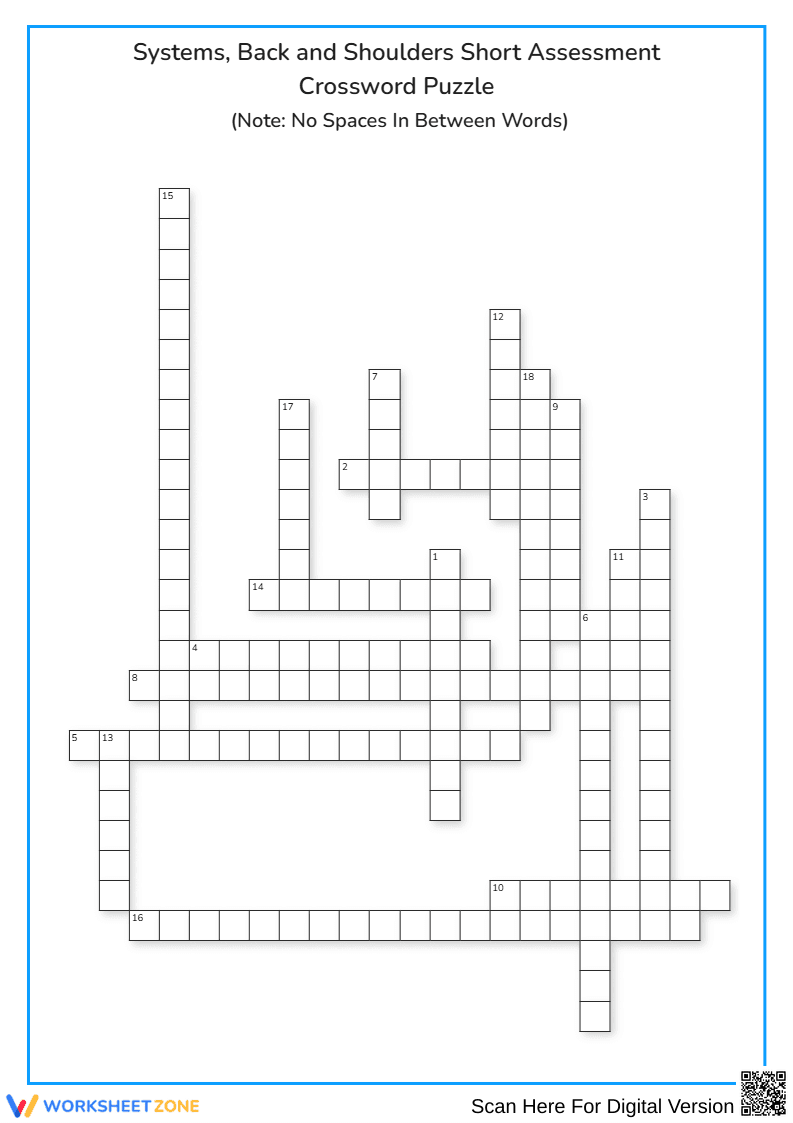
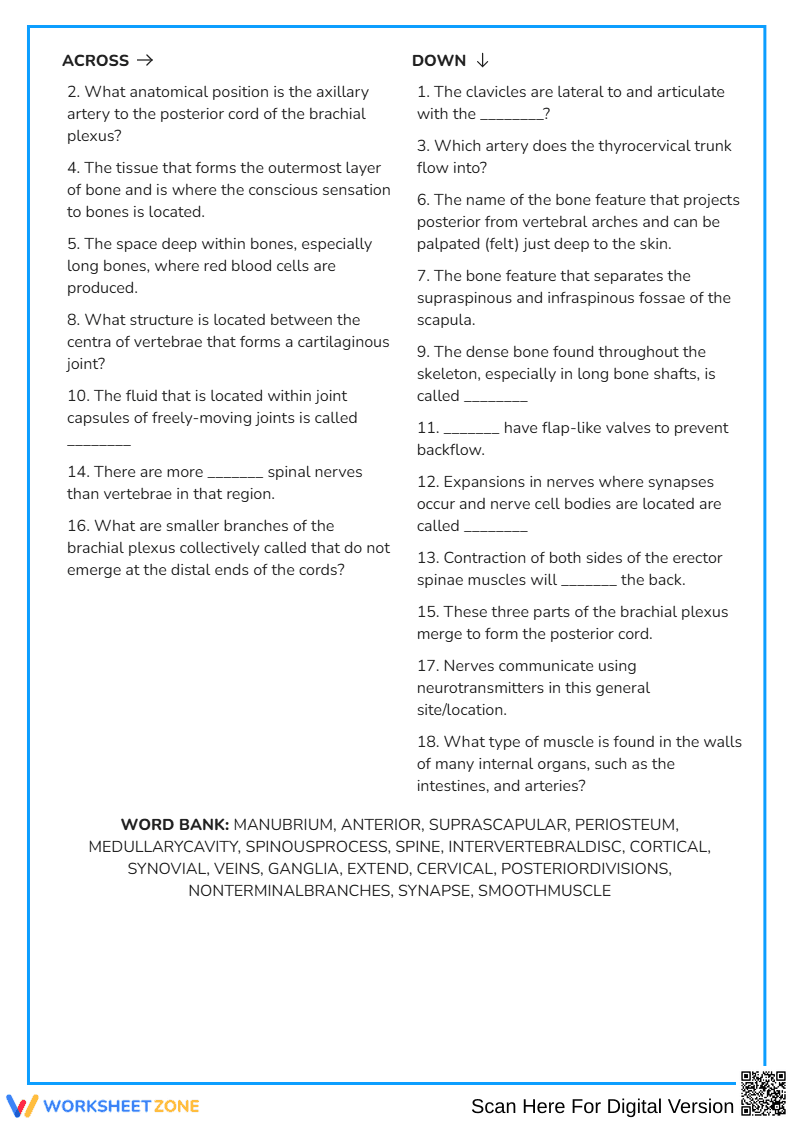
What's Inside: This two-page PDF includes a comprehensive crossword puzzle featuring 18 high-level anatomical clues. The first page contains the puzzle grid, while the second page provides the detailed Across and Down clues alongside a specialized word bank. The word bank includes technical terms such as periosteum, medullary cavity, and suprascapular to support student recall while maintaining academic rigor.
Zero-Prep Workflow
- Print (30 seconds): Select the two-page PDF and print enough copies for your cohort or lab group.
- Distribute (1 minute): Hand out the assessment as a quiet warm-up activity or a concluding exit ticket to gauge comprehension.
- Review (5 minutes): Use the provided word bank to facilitate peer-grading or a whole-class discussion on the more challenging neurological and skeletal clues.
This workflow is designed for immediate implementation, making it an ideal resource for substitute lesson plans or unexpected schedule shifts in a medical or kinesiology program.
Standards Alignment: This resource is aligned with `HS-LS1-2`, which requires students to explain how the hierarchical organization of interacting systems provides specific functions within multicellular organisms. By identifying the relationship between the brachial plexus and the posterior cord, or the articulation of the clavicles with the manubrium, students provide evidence of this systemic interaction. Both standard codes can be copied directly into lesson plans, IEP goals, or district curriculum mapping tools.
How to Use It: Assign this worksheet during the "elaborate" or "evaluate" phase of the 5E instructional model. It serves as an excellent formative assessment tool after a lecture on the musculoskeletal or nervous systems. For a more collaborative approach, have students work in pairs to solve the puzzle without the word bank first, then provide the bank as a scaffold after 10 minutes to observe which terms require further direct instruction.
Who It's For: This assessment is specifically designed for college-level students in pre-med, nursing, or physical therapy programs. It provides the necessary depth for advanced learners while offering a structured format. It pairs naturally with a skeletal system anchor chart or a cadaver lab session focusing on the upper extremities and spinal column.
The use of crossword puzzles in higher education serves as a powerful retrieval practice mechanism, particularly for the dense vocabulary required in the medical sciences. According to Fisher & Frey (2014), structured vocabulary tasks that require students to map definitions to specific terminology reinforce the neural pathways necessary for long-term retention. This 18-clue assessment specifically targets the `HS-LS1-2` standard by forcing students to reconcile the spatial and functional relationships of the back and shoulder systems. By requiring the identification of the periosteum as the outermost layer of bone or the synovial fluid within joint capsules, the worksheet moves beyond simple memorization into conceptual organization. Research from the NAEP suggests that students who engage in frequent, low-stakes retrieval of technical terms show significantly higher mastery on summative clinical examinations. This resource provides that essential bridge between initial exposure and professional fluency in anatomical nomenclature.


