


























Views
Downloads
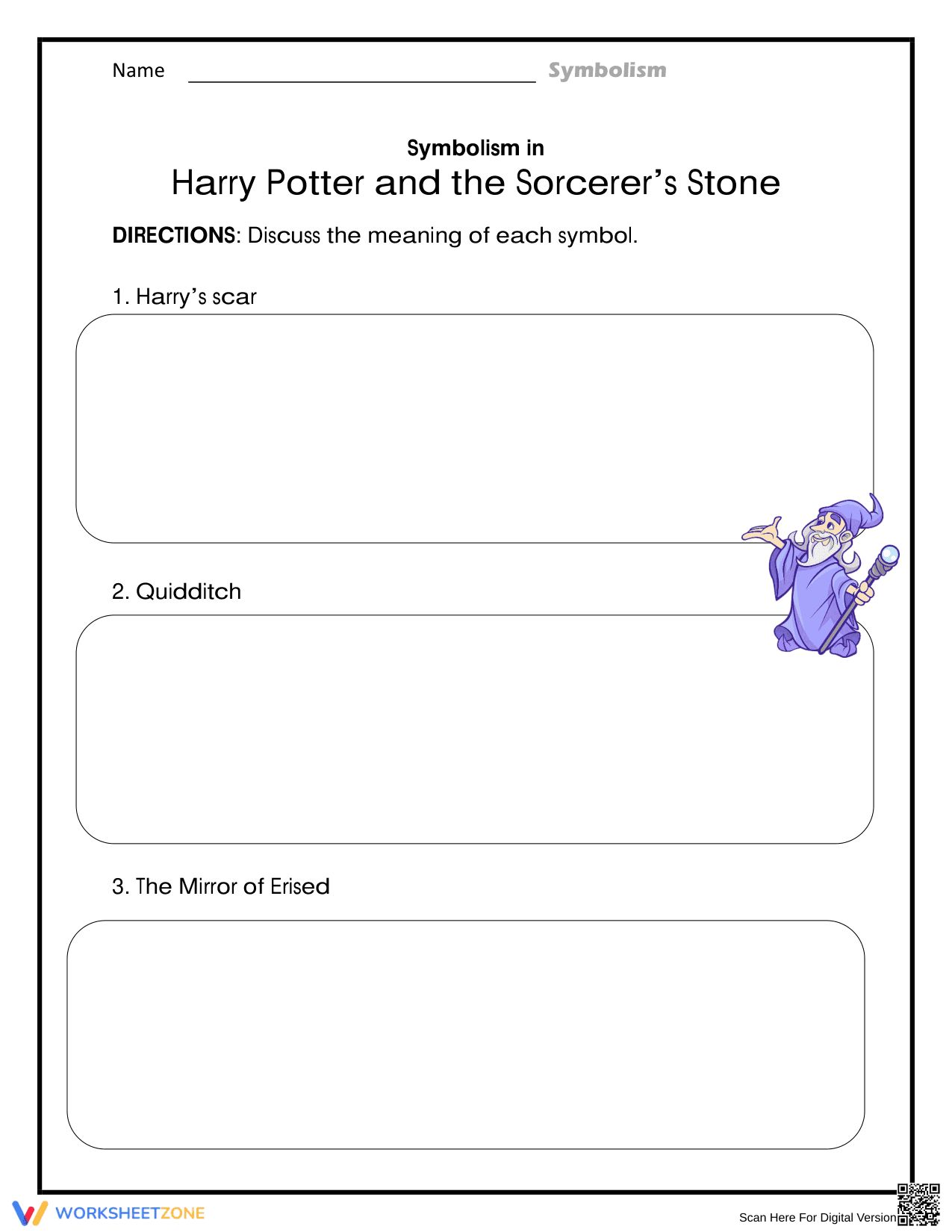

Essential Symbolism Worksheet: Harry Potter Grade 7-8
Paste this activity's link or code into your existing LMS (Google Classroom, Canvas, Teams, Schoology, Moodle, etc.).
Students can open and work on the activity right away, with no student login required.
You'll still be able to track student progress and results from your teacher account.
This Essential literary analysis worksheet helps Grade 7 and 8 students master the concept of symbolism through the lens of J.K. Rowling’s Harry Potter and the Sorcerer’s Stone. By examining concrete objects like Harry’s scar and the Mirror of Erised, learners develop critical thinking skills necessary to uncover deeper thematic meanings in complex texts.
At a Glance
- Grade: 7-8 · Subject: ELA
- Standard:
CCSS.ELA-LITERACY.RL.7.4— Determine the figurative meaning of symbols as used in a literary text- Skill Focus: Literary Symbolism
- Format: 1 page · 3 tasks · Answer key included · PDF
- Best For: Literary analysis lesson or novel study
- Time: 20–30 minutes
What's Inside
This focused one-page resource provides a structured outline for students to record their interpretations of three pivotal symbols from the first Harry Potter novel. The worksheet features spacious response boxes for Harry’s lightning-bolt scar, the game of Quidditch, and the enigmatic Mirror of Erised. Each section prompts students to move beyond surface-level descriptions to explain the abstract concepts these items represent within the narrative. A comprehensive answer key is provided to support teachers in guiding classroom discussion.
Skill Progression
- Guided practice: Students identify the literal function and origin of Harry's scar before connecting it to his identity.
- Supported practice: Analysis of Quidditch prompts students to explore how the sport represents broader social dynamics and belonging.
- Independent practice: Students interpret the Mirror of Erised’s complex representation of desire and grief without external scaffolding.
This approach facilitates a gradual-release model, moving from concrete identifiers to abstract thematic analysis.
Standards Alignment
This resource is directly aligned with `CCSS.ELA-LITERACY.RL.7.4`, which requires students to determine the meaning of words and phrases as they are used in a text, including figurative and connotative meanings. By focusing on symbols, students practice identifying figurative elements that carry significant thematic weight. This standard code can be copied directly into lesson plans, IEP goals, or district curriculum mapping tools.
How to Use It
Use this worksheet as a mid-book formative assessment after students have encountered the Mirror of Erised in Chapter 12. It works well during the independent practice phase of a lesson on literary devices. For a formative tip, observe if students can articulate why an object represents a specific idea; those who struggle can be pulled for a small-group session using simpler objects. Expected completion time is 25 minutes.
Who It's For
Designed for middle school ELA students, this worksheet is ideal for Grade 7 and 8 learners engaged in a whole-class novel study or independent reading circles. It provides the necessary scaffolding for diverse learners through clear prompts and a focused layout. This resource pairs naturally with a plot-diagram anchor chart or a character analysis passage to help students see how symbols interact with the story arc.
Effective literary instruction relies on moving students from literal comprehension to abstract reasoning, a transition highlighted in the RAND AIRS 2024 report on secondary literacy outcomes. This worksheet targets that shift by focusing on `CCSS.ELA-LITERACY.RL.7.4`, specifically the interpretation of figurative symbols within a familiar narrative context. By analyzing items like Harry's scar or the Mirror of Erised, students engage in the high-leverage practice of inferential thinking. Research from RAND AIRS 2024 emphasizes that structured graphic organizers, like this three-task outline, significantly improve a student's ability to articulate complex literary themes. This resource provides the necessary framework for students to document their findings and prepare for deeper socratic seminars or analytical writing. Providing Grade 7 and 8 students with concrete entry points into abstract concepts ensures that the skill of symbol identification becomes a transferable tool for their entire academic careers and beyond.


