




























0
Views
0
Downloads

0.0
0
Save
0 Likes
Share
Supply and Demand: Market Analysis Practice
0 Views
0 Downloads

Paste this activity's link or code into your existing LMS (Google Classroom, Canvas, Teams, Schoology, Moodle, etc.).
Students can open and work on the activity right away, with no student login required.
You'll still be able to track student progress and results from your teacher account.
Information
Description
What It Is:
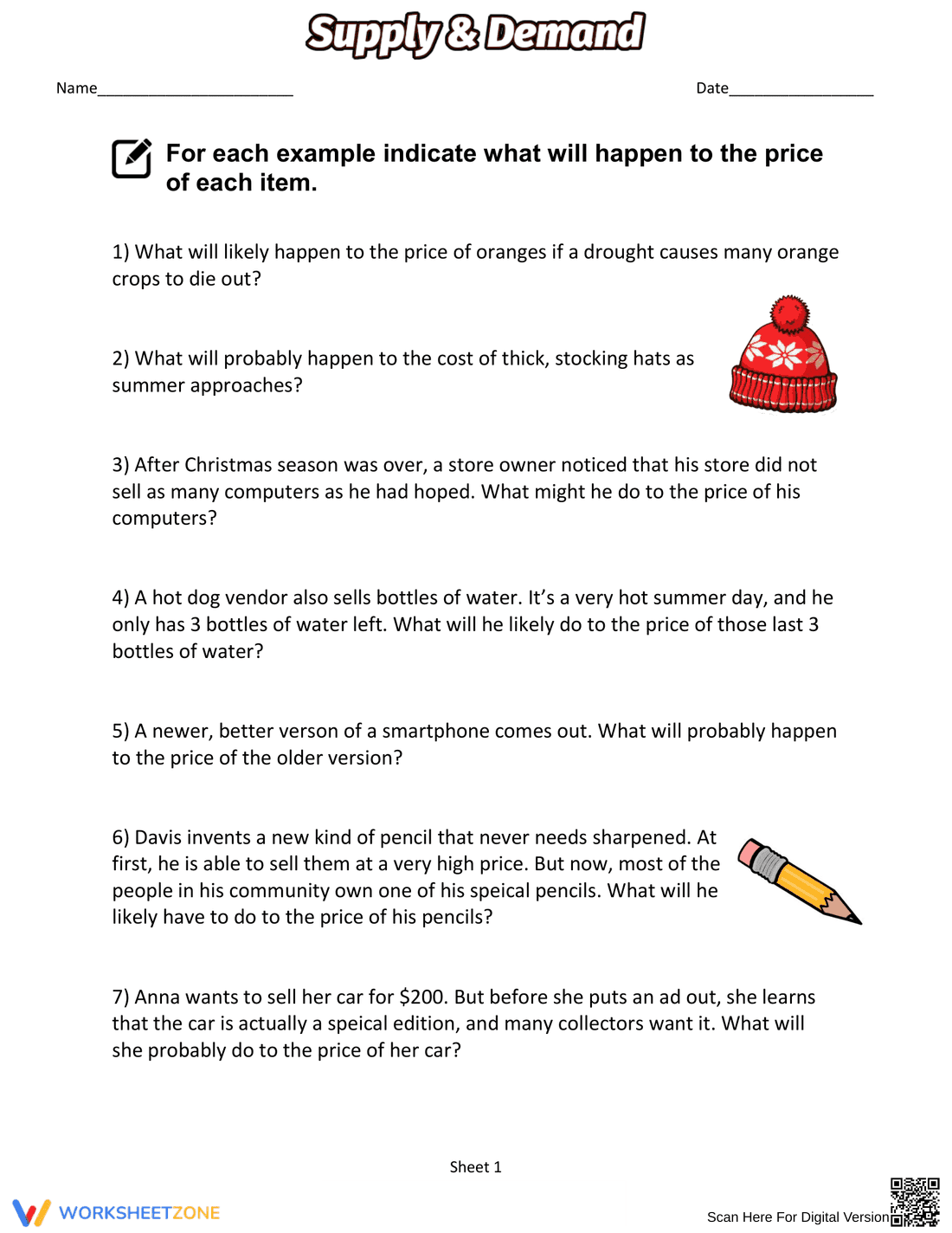
This is a worksheet titled 'Supply & Demand.' It presents seven different scenarios and asks the student to predict what will happen to the price of a specific item in each scenario. Examples include the price of oranges after a drought, the cost of stocking hats in summer, the price of computers after Christmas, and the price of water on a hot day. There are also questions about the price of an older smartphone after a new one is released, the price of a new type of pencil, and the price of a car that turns out to be a special edition.
Grade Level Suitability:
This worksheet is suitable for grades 6-9. The scenarios require students to understand basic economic principles of supply and demand and apply them to real-world situations. The reading level is appropriate for middle school students.
Why Use It:
This worksheet helps students learn and apply the concepts of supply and demand by analyzing realistic examples. It encourages critical thinking and problem-solving skills by asking students to predict price changes based on given circumstances. It can be used to introduce, reinforce, or assess understanding of supply and demand principles.
How to Use It:
Students should read each scenario carefully and then determine whether the supply or demand is changing, and in what direction. Based on these changes, they should predict whether the price of the item will increase, decrease, or stay the same, and explain their reasoning. The worksheet can be completed individually, in pairs, or as a class activity.
Target Users:
This worksheet is ideal for middle school students learning about economics, social studies, or business concepts. It is also suitable for teachers looking for engaging and practical activities to teach supply and demand. Homeschooling parents could also use this worksheet to introduce economic concepts.
This is a worksheet titled 'Supply & Demand.' It presents seven different scenarios and asks the student to predict what will happen to the price of a specific item in each scenario. Examples include the price of oranges after a drought, the cost of stocking hats in summer, the price of computers after Christmas, and the price of water on a hot day. There are also questions about the price of an older smartphone after a new one is released, the price of a new type of pencil, and the price of a car that turns out to be a special edition.
Grade Level Suitability:
This worksheet is suitable for grades 6-9. The scenarios require students to understand basic economic principles of supply and demand and apply them to real-world situations. The reading level is appropriate for middle school students.
Why Use It:
This worksheet helps students learn and apply the concepts of supply and demand by analyzing realistic examples. It encourages critical thinking and problem-solving skills by asking students to predict price changes based on given circumstances. It can be used to introduce, reinforce, or assess understanding of supply and demand principles.
How to Use It:
Students should read each scenario carefully and then determine whether the supply or demand is changing, and in what direction. Based on these changes, they should predict whether the price of the item will increase, decrease, or stay the same, and explain their reasoning. The worksheet can be completed individually, in pairs, or as a class activity.
Target Users:
This worksheet is ideal for middle school students learning about economics, social studies, or business concepts. It is also suitable for teachers looking for engaging and practical activities to teach supply and demand. Homeschooling parents could also use this worksheet to introduce economic concepts.


