


























Students refresh their knowledge of fiction text construction in this session. At the end of the lesson, students are able to:
- Enumerate the elements that make up the story, character, setting, theme, and point of view of a fiction piece.
- Identify the main concepts and specifics in a work of fiction.
- Recap fiction text.
- How can literary and factual texts become meaningful to strategic readers?
- How does interaction with text provoke thinking and response?
- What is the true purpose of this text?
- How do people know what information is reliable?-
- Text Structure: The way a text is organized.
- Fiction: Any story that is the product of imagination rather than a documentation of fact. Characters and events in such narratives may be based in real life, but their ultimate form and configuration are creations of the author.
- Story Map: A visual representation of a story that provides an overview including characters, setting, the problem, and resolution or ending.
- Summarize: To provide a short, concise explanation of a text’s major ideas.
- Character: A person or an animal in a story.
- Setting: The time and place in which a story unfolds.
- Conflict/Problem: A struggle between opposing characters.
- Solution: The part of a story in which the conflict or problem is solved.
- copies of A Bicycle for Rosaura by Daniel Barbot. Kane/Miller Book Publisher, 1994.
- copies of Amelia’s Road by Linda Jacobs Altman. Lee & Low Books, 1995.
- copies of a short fictional text from a basal reading series or a magazine at students’ reading level
- Teachers may substitute other fiction books to provide a range of reading and level of text complexity.
- highlighters
- chart paper
- student copies of the Lesson 1 Story Map (L-4-3-1_Lesson 1 Story Map)
- To assess students' comprehension and help them remember key material, emphasize the value of recognizing story structure and summarizing during the class. Check pupils' understanding of how to summarize stories by monitoring them.
- Using your notes and anecdotal observations, formally evaluate pupils' ability to summarize the material.
- After the class, assign partners to read a chosen work of fiction, complete a story map, and compose a summary.
- Utilize the checklist below to assess pupils' comprehension:
+ Student shows that they can finish a plot map and recognize key details in a work of fiction.
+ The student skillfully composes a summary statement using the data from the story map.
+ Gather the story maps and use them to gauge the student's comprehension. Provide each student with detailed feedback.
Explicit instruction, modeling, and active engagement
W: Assist students in recognizing fiction text's story structure so they can utilize it to create a summary.
H: Give students practice identifying key details from a short fiction work and organizing the data to produce a summary.
E: Show students how to build a story map for the tale A Bicycle for Rosaura by outlining the protagonist, the setting, the issue, and the resolution before having them compose a synopsis.
R: Give students the chance to read a different fiction novel, create a story map and summary statement, and work alone or with a partner.
E: Use formative evaluation to find out how well students can construct a story map and recognize text structure in fiction.
T: Offer versatile groupings based on the instructional reading levels of your students. Include extension activities for every level by recommending resources for additional practice and more challenging content to push thinking beyond its current boundaries.
O: This lesson's learning goals include large-group instruction and discussion, small-group inquiry, partner work, and individual application of the material.
Topic: How might a story map be used to summarize fiction?
Give a copy of a short story from a magazine or a basic reading series to each student. Have students read the narrative and underline the key parts. Talk about the ideas that the students thought were most essential. Write down their answers on the chart paper. Put the details in the right order so that they correspond to the text. Ask students to assess if the statements accurately summarize the text after you read each one aloud in order.
Part 1
Using the interactive whiteboard or board, ask students to list the elements of a fiction story structure. Ask, "What are a story's key elements?" (Character, scene, conflict/problem, resolution, conclusion, theme) Inform the class that the main topics of this lesson will be character, setting, conflict/problem, and solution. Talk about how understanding story structure is crucial because it makes it easier to assess your comprehension of the text and retain the plot. Ask, "What does the word "summarize" mean?" (to retell the tale somewhat more succinctly, focusing solely on the most crucial details)
Part 2
On the board or interactive whiteboard, place a copy of the Lesson 1 Story Map (L-4-3-1_Lesson 1 Story Map). Say, "You must be conscious of the sections of the story when you are reading it. That will help you comprehend the story better. It will aid with your story summary as well. We will capture those significant portions using a story map so that we can be more mindful. We wrote the following elements on the board: character, place, conflict or problem, and resolution. After that, we'll use those crucial details to craft a synopsis of the narrative."
Give each student a copy of the story map.
Say, "As we read this story, consider the narrative structure and record the details in the story map. The objective is to summarize the story in brief and to remember its most significant elements." Inform pupils that a summary should consist of no more than five or six sentences.
Read aloud A Bicycle for Rosaura to the class, having them follow along. Throughout the reading, pause occasionally to ponder aloud and complete the material on the story map while students complete their story maps. Asking them to consider how the character's response to the events affects the plot will help them think more deeply.
Once the story has come to a close, go over the details on the story map. Say, "We can write a few summary sentences that will give us the main idea of the story if we look at the information on the story map." Show students how to write the sentences via modeling. (This narrative centers on a Puerto Rico chicken and her owner. Rosaura would like to ride a bike, but hens aren't supposed to ride bikes. A bike is made specifically for Rosaura by a man who arrives in town.)
Pose some questions: "What are a story's primary elements? Why is writing a summary beneficial? What details will enable you to compose a summary?"
Give your students some practice utilizing a story map and crafting summaries that are based on the data it contains. Set up small groups or individual work for the students. Give each student or group of students a copy of Amelia's Road or another work of fiction in addition to copies of the story map.
Say, "Now, you are going to read a little picture book named Amelia's Road. Complete the story map as you read. After that, go over the data on the story map and create a synopsis of the narrative at the bottom." Encourage them to collaborate with a partner on their work.
Another way to teach summarizing is to give students a short tale to read and have them complete a four-square graphic organizer called "Somebody Wanted, But, So," like the one below.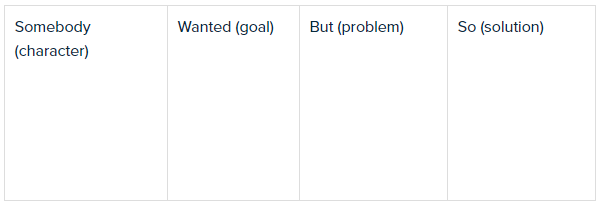
Part 3
As they finish one story map, have the pupils complete another one where they have to order the story's events. Give pupils instructions on how to write their summary using the story's events as a guide. Encourage pupils to prioritize the events in their summary by helping them identify which ones are most significant. Instruct students to explain how the character's reaction to certain events influenced the plot.
Assess students' comprehension of story mapping and summarizing through observation.
Gather the narrative maps from the students when they're done to see if reteaching is required.
Extension:
As an extra exercise, assign small groups to summarize a beloved tale using the framework of a fiction piece. Students may also use one of the books listed in the Related Resources section.
Blogging can be used as an application for summarizing skills for students who are prepared to go beyond the standard. Create a blog (by working with your technology coordinator). Start a blog conversation with your pupils by assigning them a short novel to read and asking them to blog you a summary of each chapter. Leave a comment on the synopsis as you read their blogs. (Does it have every important element found in a story map? Is it coherent and organized? Does it contain the chapter's central idea?) Instruct students to read your feedback, edit their earlier summary, and then concentrate on the following chapter. Ask students to blog a synopsis of the book once they have finished reading it. After that, you can assess the synopsis and blog any comments on students.

Summarizing Fiction by Using Key Ideas and Details (L-4-3-1)
Students refresh their knowledge of fiction text construction in this session. At the end of the lesson, students are able to:
- Enumerate the elements that make up the story, character, setting, theme, and point of view of a fiction piece.
- Identify the main concepts and specifics in a work of fiction.
- Recap fiction text.


