




























Views
Downloads
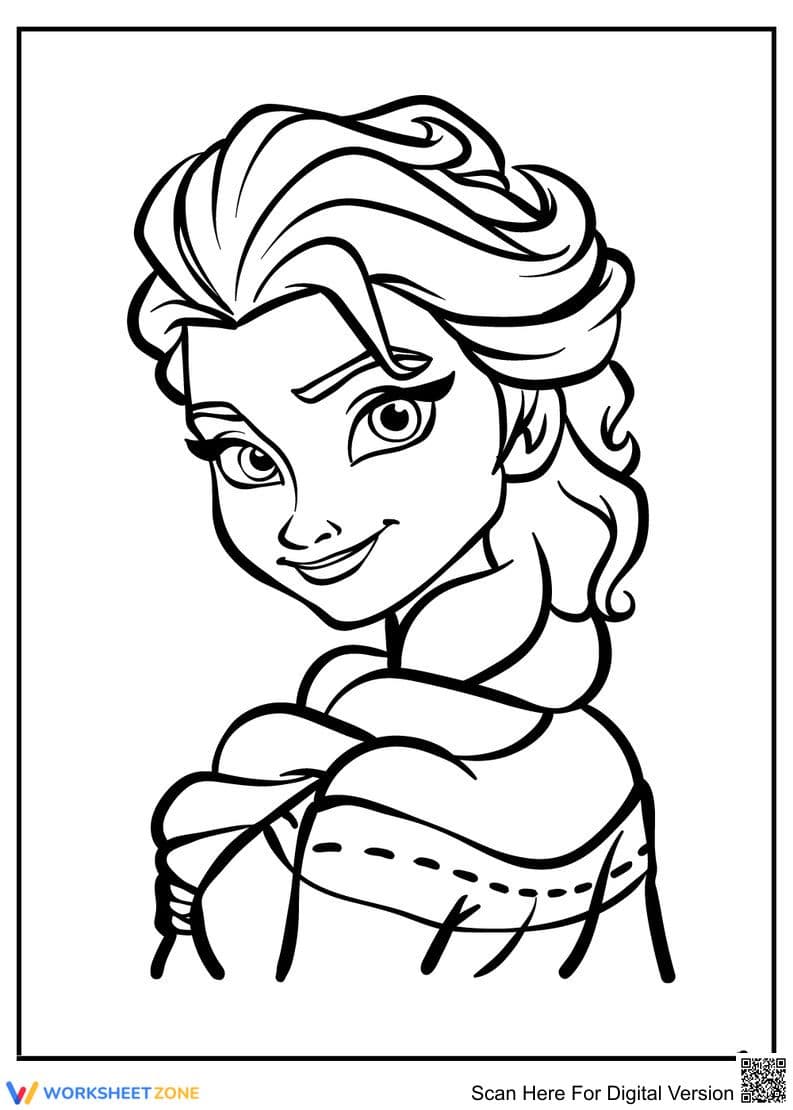

Stunning Elsa Coloring Page | Printable Kindergarten Art

Paste this activity's link or code into your existing LMS (Google Classroom, Canvas, Teams, Schoology, Moodle, etc.).
Students can open and work on the activity right away, with no student login required.
You'll still be able to track student progress and results from your teacher account.
This printable Elsa coloring worksheet provides Kindergarten students with a high-interest creative task to develop essential fine motor control. By focusing on staying within lines and selecting appropriate color palettes, learners strengthen the hand muscles necessary for early writing and letter formation. It is a simple yet effective tool for artistic expression that keeps young learners engaged through familiar characters.
At a Glance
- Grade: Kindergarten · Subject: Arts & English
- Standard:
CCSS.ELA-LITERACY.L.K.1— Demonstrate command of conventions through fine motor control and grip- Skill Focus: Fine motor development and color recognition
- Format: 1 page · 1 task · No answer key required · PDF
- Best For: Morning work or early finishers
- Time: 15–20 minutes
This resource features a single, high-quality illustration of Elsa from the popular Frozen franchise. The lines are bold and clear, making it accessible for young children who are still mastering spatial awareness. The 1-page PDF format ensures that the image prints clearly on standard letter-sized paper without any distracting borders or unnecessary text, allowing the student to focus entirely on their artistic choices and pencil control.
The zero-prep workflow for this worksheet is designed for maximum efficiency in a busy classroom. First, print the single-page PDF (30 seconds). Second, distribute the page along with crayons, colored pencils, or markers to your students (1 minute). Third, allow students to work independently while you provide verbal feedback on their grip and color choices. Total teacher preparation time is under 2 minutes, making it an ideal choice for emergency sub plans or transition periods between core subjects.
This activity aligns with CCSS.ELA-LITERACY.L.K.1, which focuses on the command of conventions. While often applied to grammar, the physical act of coloring is a prerequisite for the sub-standard involving printing letters, as it builds the pincer grasp and manual dexterity required for legible handwriting. Both standard codes can be copied directly into lesson plans, IEP goals, or district curriculum mapping tools to justify the use of creative arts in the literacy block.
Use this worksheet during a Morning Choice block to help students settle into the school day with a calming, focused activity. It also serves as an excellent formative assessment tool; observe how students hold their coloring utensils to identify those who may need additional occupational therapy support or specialized pencil grips. Expected completion time ranges from 15 to 20 minutes depending on the student's attention to detail and color complexity.
This resource is primarily designed for Kindergarten students but is suitable for any early learner needing fine motor practice. It is particularly effective for English Language Learners (ELLs) as a low-stress way to engage with classroom materials while building vocabulary related to colors and characters. Pair this worksheet with a read-aloud story about bravery or a direct instruction lesson on primary and secondary colors to extend the learning experience.
According to the RAND AIRS 2024 report, activities integrating high-interest characters with fine motor tasks increase student persistence. This Elsa coloring worksheet leverages that engagement to address CCSS.ELA-LITERACY.L.K.1 by providing a structured environment for grip refinement. Research from Fisher & Frey (2014) emphasizes that instructional frameworks benefit from independent creative outlets allowing students to apply motor skills without academic pressure. By providing a clear, high-contrast task, this worksheet ensures learners focus on the physical mechanics of coloring. This helps bridge the gap between play and formal early literacy requirements. The simple single-page design reduces cognitive load, making it a reliable tool for diverse classroom settings.


