


























Views
Downloads
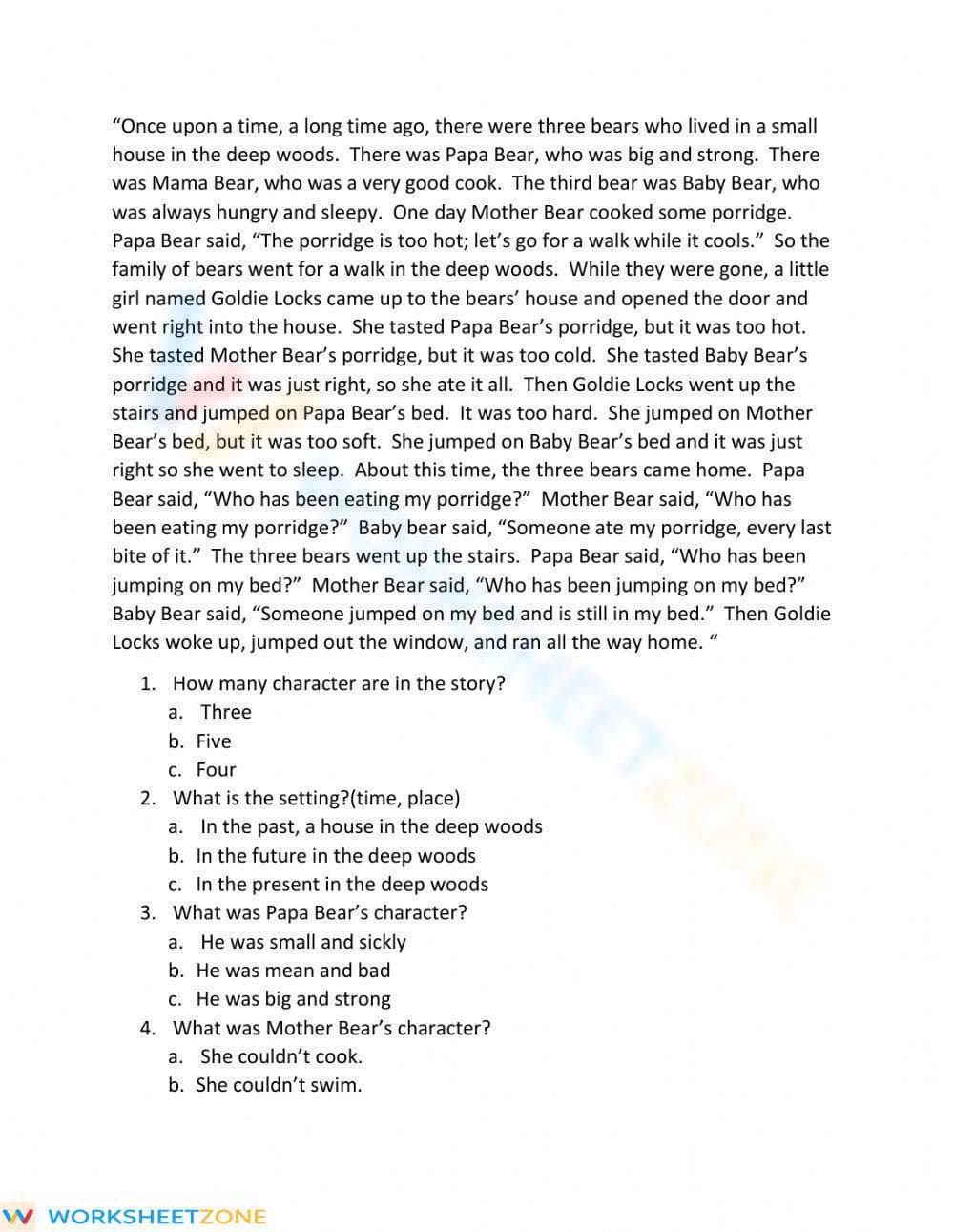


Printable Story Elements Worksheet | Grade 4 ELA
Paste this activity's link or code into your existing LMS (Google Classroom, Canvas, Teams, Schoology, Moodle, etc.).
Students can open and work on the activity right away, with no student login required.
You'll still be able to track student progress and results from your teacher account.
This worksheet provides targeted practice for Grade 4 students in identifying key story elements from a classic text. Using the familiar tale of "The Three Bears," students read a short passage and then answer a series of questions designed to assess their comprehension of character, setting, plot, conflict, and resolution.
At a Glance
- Grade: 4 · Subject: English Language Arts (ELA)
- Standard:
CCSS.ELA-LITERACY.RL.4.3— Describe a character, setting, or event in depth using details from the text.- Skill Focus: Story Elements
- Format: 2 pages · 11 problems · Answer key included · PDF
- Best For: Reading comprehension check, literature circles, substitute plan
- Time: 15–25 minutes
This two-page resource presents the text of "The Three Bears" followed by 11 questions (10 multiple-choice, 1 bonus). It guides students to analyze the story's core components. An answer key is included for easy grading, making the worksheet entirely self-contained.
Skill Progression
The worksheet uses a gradual-release model.
- Guided Practice: The first five questions focus on direct recall of characters and setting.
- Supported Practice: The next three questions ask students to infer the story's conflict and genre.
- Independent Practice: The final questions require analysis of dialogue and conflict resolution.
This structure helps students build toward mastery of story analysis.
Standards Alignment
This worksheet aligns with CCSS.ELA-LITERACY.RL.4.3, where students 'Describe in depth a character, setting, or event... drawing on specific details in the text.' It also supports CCSS.ELA-LITERACY.RL.4.2 by asking about the central message. Both standard codes can be copied directly into lesson plans or curriculum maps.
How to Use It
Use this as a formative assessment after a lesson on story elements or as independent practice during reading centers. Observe which questions students miss to identify gaps between recall and inference. Most students will complete the activity in about 20 minutes.
Who It's For
This is ideal for fourth graders but also works for advanced third graders or as a review for fifth graders. The clear format is accessible to diverse learners. Pair this with a story elements anchor chart for extra support.
Analyzing narrative components is a foundational reading skill directly supported by this worksheet, which aligns with CCSS.ELA-LITERACY.RL.4.3. By requiring students to describe characters, setting, and plot events using textual evidence, it builds critical comprehension abilities. Research consistently shows that explicit instruction in text structure improves reading outcomes. For instance, the landmark analysis by Fisher & Frey (2014) emphasizes the importance of moving students from simple recall to analyzing how story parts interact, a process this resource facilitates through its structured questioning. With 11 focused tasks, the worksheet offers a practical application of these evidence-based principles. It provides a reliable method for educators to gauge a student's ability to deconstruct a narrative, a key indicator of reading proficiency as measured by assessments like the NAEP. This targeted practice is essential for developing skilled, analytical readers.


