


























Views
Downloads
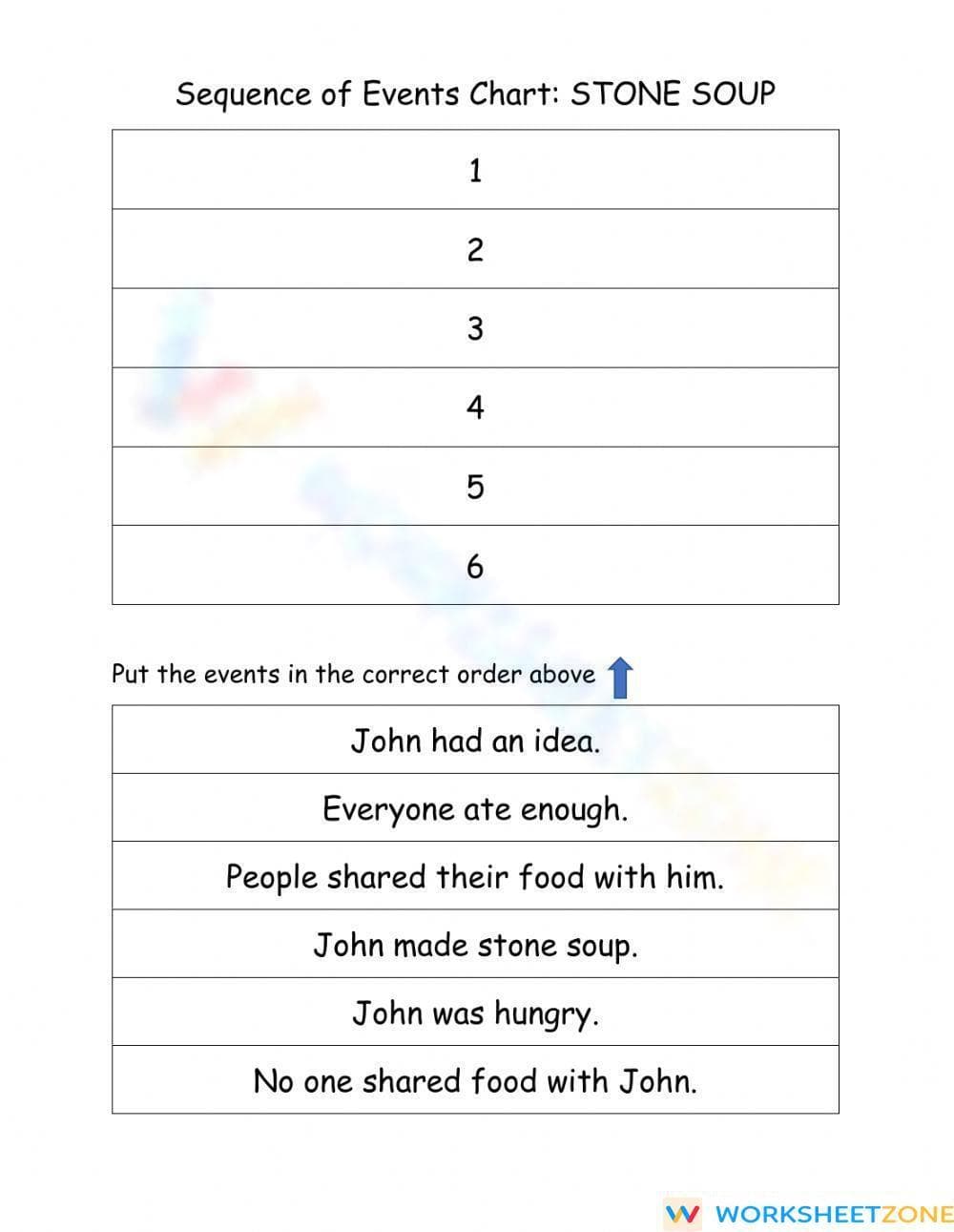


Grade 5 Story Sequencing — Printable No-Prep Worksheet
Paste this activity's link or code into your existing LMS (Google Classroom, Canvas, Teams, Schoology, Moodle, etc.).
Students can open and work on the activity right away, with no student login required.
You'll still be able to track student progress and results from your teacher account.
Mastering Plot with a Classic Tale
This worksheet offers 5th-grade students practice in the essential reading skill of sequencing events. Students read six key events from the classic folktale 'Stone Soup' and arrange them in the correct chronological order, reinforcing their grasp of plot structure and narrative flow. It's a direct and effective tool for building comprehension and preparing students to summarize texts.
At a Glance
- Grade: 5 (adaptable for 4-6) · Subject: ELA / Reading
- Standard:
CCSS.ELA-LITERACY.RL.5.2— Summarize a story by ordering key events.- Skill Focus: Sequencing Events, Plot Structure
- Format: 2 pages · 1 primary task · Answer key included · PDF
- Best For: Reading centers, homework, sub plans
- Time: 10–15 minutes
What's Inside
This two-page PDF contains the student worksheet and an answer key. The worksheet has a clear 'Sequence of Events Chart' with six slots and a list of six jumbled story events from 'Stone Soup' for students to order. The second page provides a complete answer key for fast and objective grading, making the review process straightforward for teachers, aides, or substitutes.
A Zero-Prep Resource for Busy Teachers
This worksheet is a true print-and-go activity, designed to save valuable preparation time. Here’s the typical workflow:
- Print (1 min): Print one copy for each student from the simple, ink-friendly PDF.
- Distribute (1 min): The self-contained instructions require no lengthy explanation from the teacher.
- Review (5 min): Use the included answer key to review the correct sequence as a class or to grade individual work efficiently.
Total prep time is under two minutes, making this an ideal resource for substitute plans, independent work stations, or a quick formative assessment after a read-aloud.
Standards Alignment
This activity directly supports Common Core standard CCSS.ELA-LITERACY.RL.5.2, which requires students to determine a theme and summarize a text; correctly sequencing events is a foundational skill for effective summarization. It also reinforces CCSS.ELA-LITERACY.RL.5.5 by helping students recognize the overall structure of a story. Both standard codes can be copied directly into lesson plans, IEP goals, or district curriculum maps.
How to Use It
Use this worksheet for independent practice after a class reading of 'Stone Soup.' It is highly effective for reading centers or as a homework assignment to reinforce the concept of plot. As a formative check, observe which students can quickly identify the beginning, middle, and end events to see who needs more support with narrative structure. The activity should take most students between 10 and 15 minutes to complete.
Who It's For
Primarily for 5th-grade students, this worksheet also suits 4th graders needing practice or 6th graders for review. To scaffold for students who struggle, pre-highlight the first and last events. Pair this with an anchor chart that defines key plot terms (e.g., beginning, middle, end, conflict, resolution) to provide visual support during the activity.
This sequencing task provides structured practice aligned with CCSS.ELA-LITERACY.RL.5.2, targeting a key component of reading comprehension. By requiring students to reconstruct a narrative's logical order, the activity moves beyond simple recall to analysis of plot structure. This approach is consistent with findings from the RAND AIRS 2024 report, which emphasizes the need for explicit instruction in the strategies readers use to build a coherent mental model of a text. The worksheet serves as a focused tool for developing this strategic skill. Its single-page format and clear task demand make it an accessible entry point for students learning to deconstruct and summarize literary texts, a critical precursor to more complex analysis of theme and author's craft. The exercise allows teachers to quickly assess a student's grasp of narrative causality and temporal order.


