


























Views
Downloads


TEKS 7.11A Worksheet: Solving Equations — Grade 7 Aligned
Paste this activity's link or code into your existing LMS (Google Classroom, Canvas, Teams, Schoology, Moodle, etc.).
Students can open and work on the activity right away, with no student login required.
You'll still be able to track student progress and results from your teacher account.
Mastering equations is the cornerstone of middle school algebra. This STAAR-aligned worksheet provides a structured path for solving one-step and two-step linear equations. By moving from isolated practice to real-world applications, learners build the procedural fluency and conceptual understanding required for success on high-stakes state assessments.
At a Glance
- Grade: 7 · Subject: Math / Algebra
- Standard:
TEKS 7.11A— Model and solve one-variable, two-step equations and inequalities that represent problems- Skill Focus: Solving and Modeling Multi-part Linear Equations
- Format: 3 pages · 22 problems · Answer key included · PDF
- Best For: Comprehensive STAAR Test Prep and Targeted Algebra Readiness Practice
- Time: 35–45 minutes of intensive practice
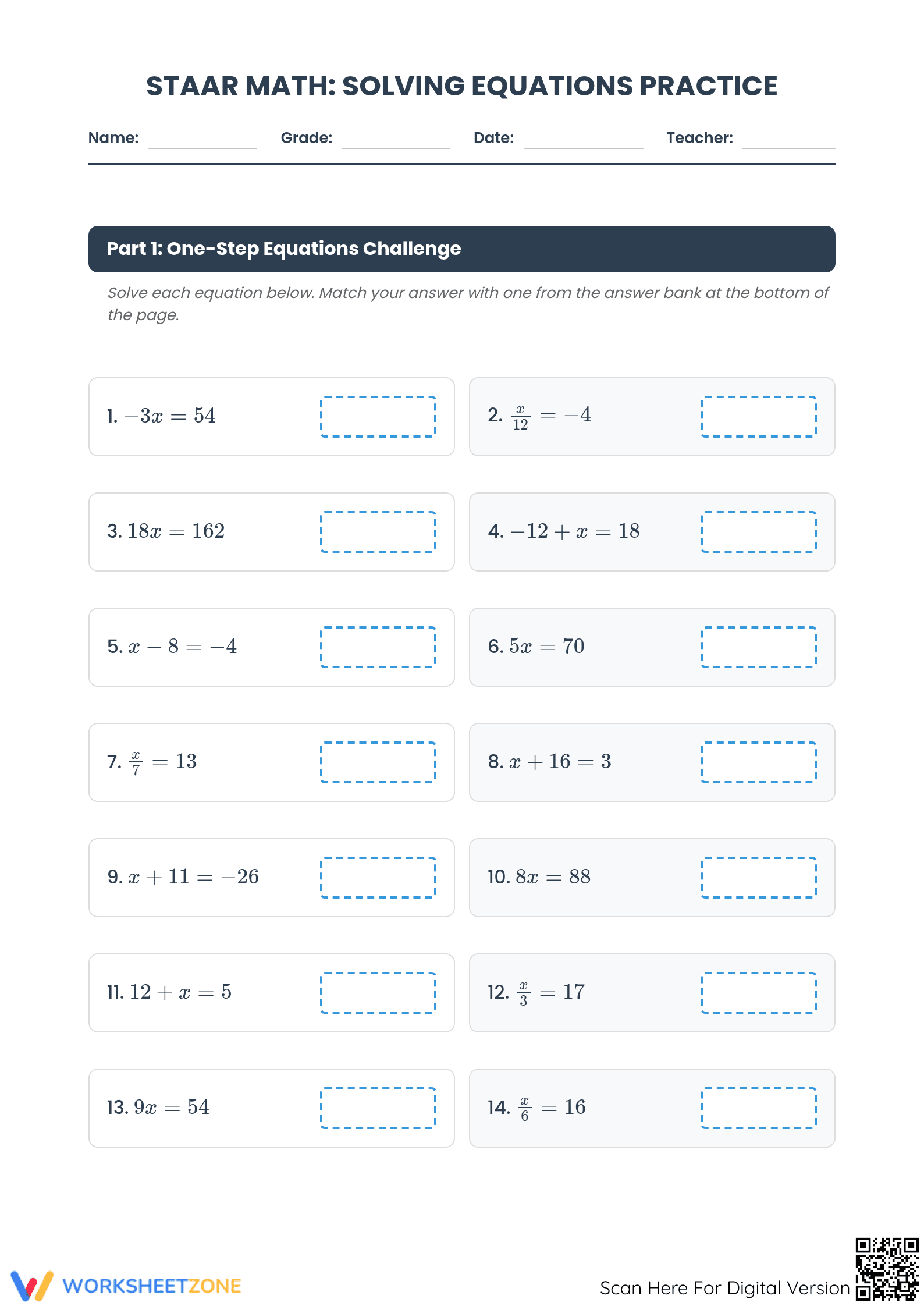
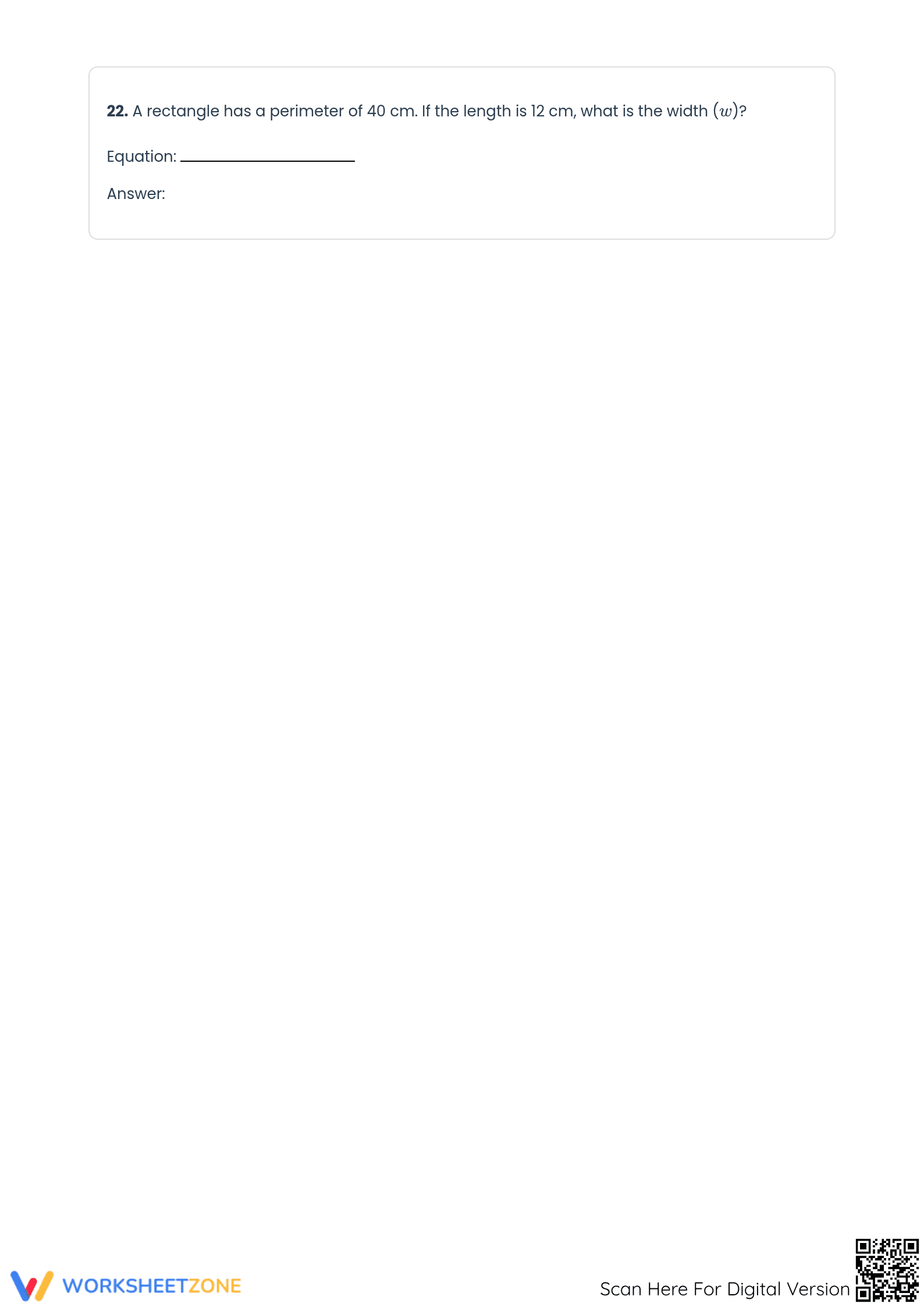
This 3-page PDF features a tiered instructional design. It begins with 16 one-step equations to establish core computational habits, followed by 4 two-step equations for mastery. The final section presents 2 complex real-world word problems involving saving scenarios and geometric perimeters. An integrated answer bank on the second page allows for immediate self-correction, while the third page provides ample workspace for multi-step calculations.
Mastery Evidence
This worksheet acts as a diagnostic tool for identifying student proficiency tiers. Tasks 1 through 16 represent the "Approaching" tier, focusing on inverse operations with single variables. Tasks 17 through 20 map to "Meeting" standards by requiring two-step logic and distributive properties. The final "Exceeding" tasks (21 and 22) require students to translate narrative text into formal algebraic expressions. Scores from each section can be entered directly into gradebooks or IEP progress notes to document specific growth toward TEKS and STAAR readiness goals.
Standards Alignment
The primary focus is TEKS 7.11A, which requires students to model and solve one-variable, two-step equations. Supporting standards include TEKS 6.10A for foundational one-step operations and TEKS 8.8C for modeling real-world problems. The progression ensures that students are not merely memorizing steps but are applying algebraic principles to solve for unknown values in varied contexts. Both standard codes can be copied directly into lesson plans, IEP goals, or district curriculum mapping tools.
How to Use It
Use this resource during the "independent practice" phase of a lesson or as a focused STAAR review session. For formative assessment, observe students during the transition from one-step to two-step problems (Tasks 16 to 17) to identify common misconceptions about the order of operations. This worksheet serves as an excellent sub plan or homework assignment, typically requiring 40 minutes for completion. The answer bank facilitates a peer-review cycle where students justify their solutions to classmates.
Who It's For
This practice set is designed for Grade 6-8 students preparing for Texas state assessments or any learner beginning an introductory Algebra course. It provides essential scaffolding for students on IEPs through the answer bank and clear section breaks. Pair this worksheet with a coordinate plane anchor chart or a direct instruction lesson for a complete instructional unit.
According to the RAND AIRS 2024 report on mathematics instructional materials, resources that align task complexity with state-specific assessment frameworks, such as STAAR, significantly improve student outcomes in procedural fluency. This worksheet addresses TEKS 7.11A by requiring students to decode linguistic cues in real-world problems and translate them into solvable linear equations. By providing 22 distinct tasks that bridge the gap between abstract calculation and contextual application, the resource ensures that Grade 7 students develop the cognitive flexibility required for higher-order mathematics. The inclusion of an answer bank supports self-regulated learning, a key indicator of mathematical persistence. Educational researchers consistently highlight the importance of providing students with frequent opportunities to practice "translation" tasks, where narrative scenarios are converted into formal mathematical notation to solve for unknown variables.


