


























Views
Downloads

Printable Kindergarten Square Worksheet | Essential Math
Paste this activity's link or code into your existing LMS (Google Classroom, Canvas, Teams, Schoology, Moodle, etc.).
Students can open and work on the activity right away, with no student login required.
You'll still be able to track student progress and results from your teacher account.
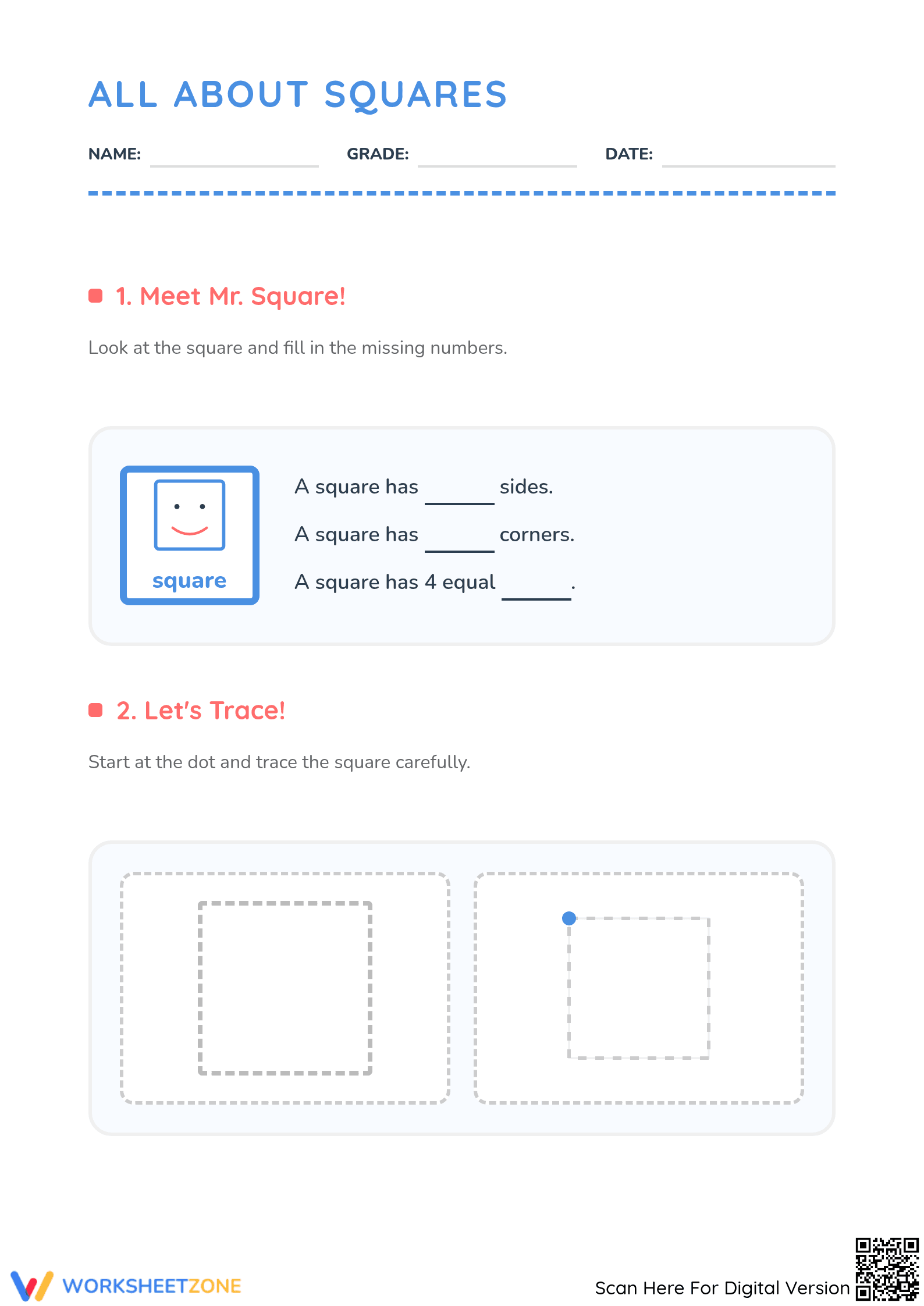
This printable Kindergarten worksheet provides a complete introduction to the geometry of squares. Students move beyond simple recognition to analyze the defining attributes of a square, including its four equal sides and four corners. By the end of these activities, learners will confidently identify and describe square shapes in various contexts and orientations.
At a Glance
- Grade: Kindergarten · Subject: Math
- Standard:
CCSS.MATH.CONTENT.K.G.B.4— Analyze and describe two-dimensional shapes to identify their unique functional attributes- Skill Focus: Square Recognition & Attribute Analysis
- Format: 3 comprehensive pages · 5 interactive problems · Answer key included · PDF
- Best For: Initial Geometry Instruction and Independent Shape Practice
- Time: 15–20 minutes of instructional engagement
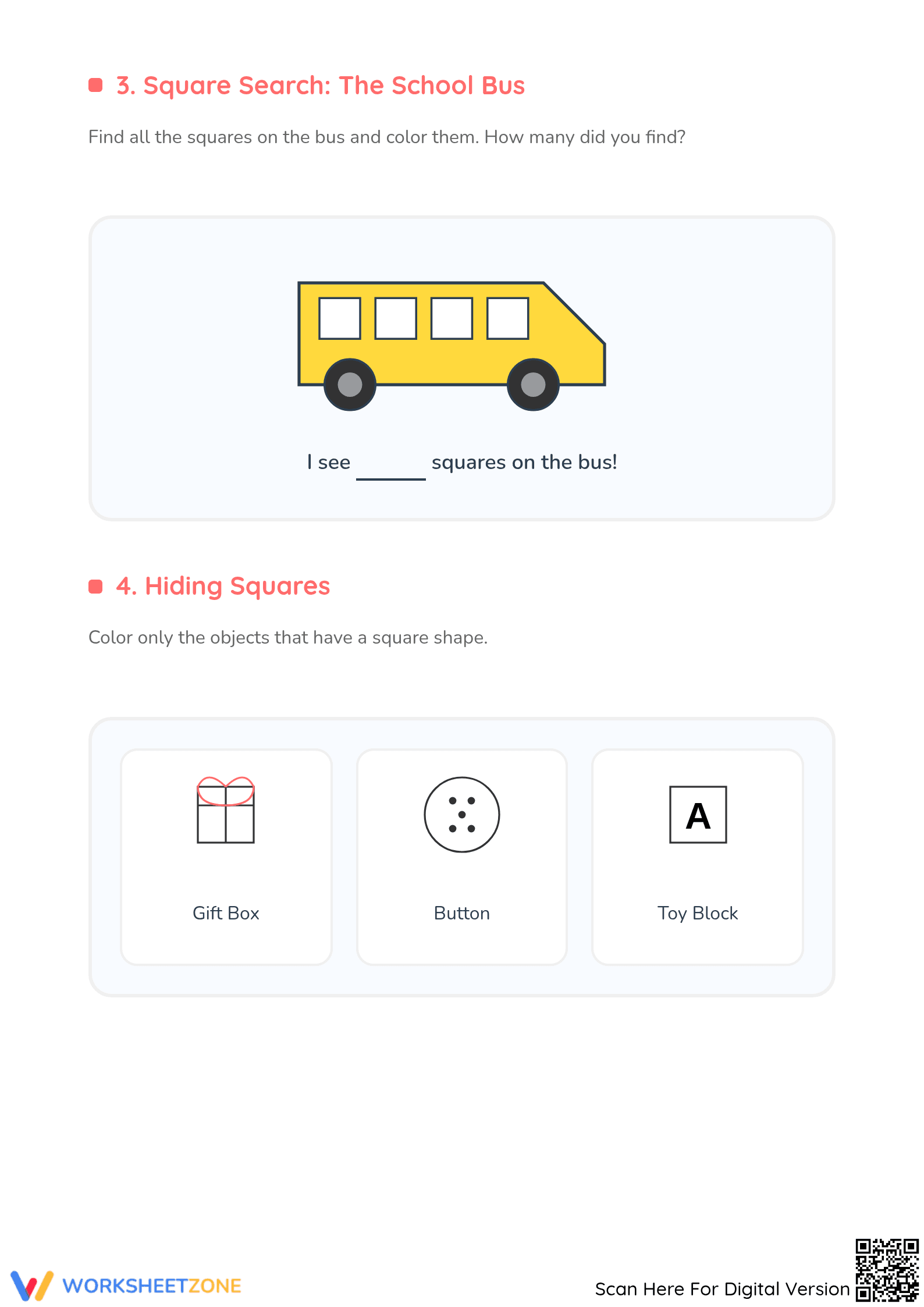
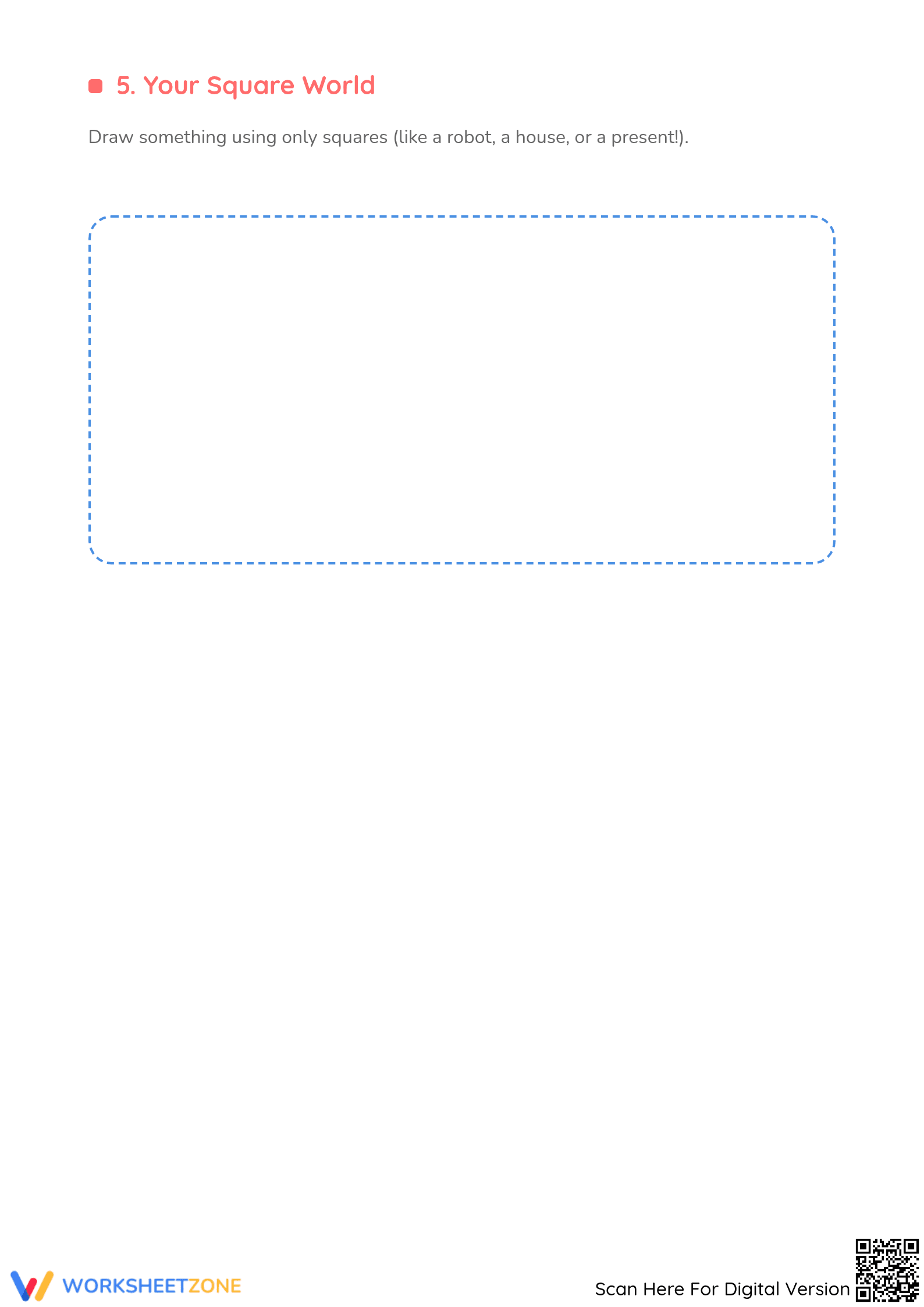
This three-page PDF features five distinct sections designed for young learners. The resource begins with "Meet Mr. Square," where students fill in blanks about sides and corners. It continues with guided tracing for fine motor development, a "Square Search" counting activity on a school bus, a sorting task to find hidden squares, and a creative drawing prompt to apply knowledge. The full answer key ensures parents and teachers can quickly verify results.
Zero-Prep Workflow
This classroom-ready resource requires zero teacher preparation. 1. Print: Send the three-page PDF to your printer in less than 30 seconds. 2. Distribute: Hand out the worksheets to your students; the instructions are simple enough for independent or small-group work. 3. Review: Use the provided answer key to grade or review the work in under two minutes total. The total teacher prep time is significantly minimized, making this an ideal choice for emergency sub plans.
Standards Alignment
The activities are rigorously aligned to CCSS.MATH.CONTENT.K.G.B.4, which requires students to analyze and compare two-dimensional shapes. This resource also supports CCSS.MATH.CONTENT.K.G.A.2 as students name squares in various real-world scenarios. Both standard codes can be copied directly into lesson plans, IEP goals, or district curriculum mapping tools to ensure instructional compliance.
How to Use It
Use this worksheet during your geometry unit after an initial lesson on shapes. It works perfectly as a formative assessment to see if students can differentiate squares from other quadrilaterals. A great tip is to observe students during the "Square Search" to see if they count the window shapes accurately, which provides immediate feedback on their spatial reasoning skills.
Who It's For
This resource is designed for Kindergarten students, but it also serves as a valuable review for first graders or an intervention tool for students needing extra support with shape attributes. It pairs naturally with physical manipulatives like pattern blocks or a classroom scavenger hunt for square-shaped objects to reinforce the concept.
The development of geometric reasoning in early childhood is a critical precursor to later mathematical success. According to the RAND AIRS 2024 report on early childhood education, structured practice with shape attributes—such as the number of sides and corners—helps solidify a student's mental model of geometry. This Kindergarten square worksheet targets CCSS.MATH.CONTENT.K.G.B.4 by requiring students to analyze and describe the functional properties of a square. The integrated tasks of tracing, counting, and sorting ensure that students engage with the shape from multiple cognitive angles, moving from basic recognition to analytical description. Research indicates that when students can explicitly name the attributes that define a shape, they are better prepared for the spatial demands of higher-level math. This PDF provides the necessary scaffolds to bridge the gap between seeing a shape and understanding its geometric definition through five intentional classroom activities.


