


























Views
Downloads

Square Roots Review Worksheet | Grade 8 Math Aligned
Paste this activity's link or code into your existing LMS (Google Classroom, Canvas, Teams, Schoology, Moodle, etc.).
Students can open and work on the activity right away, with no student login required.
You'll still be able to track student progress and results from your teacher account.
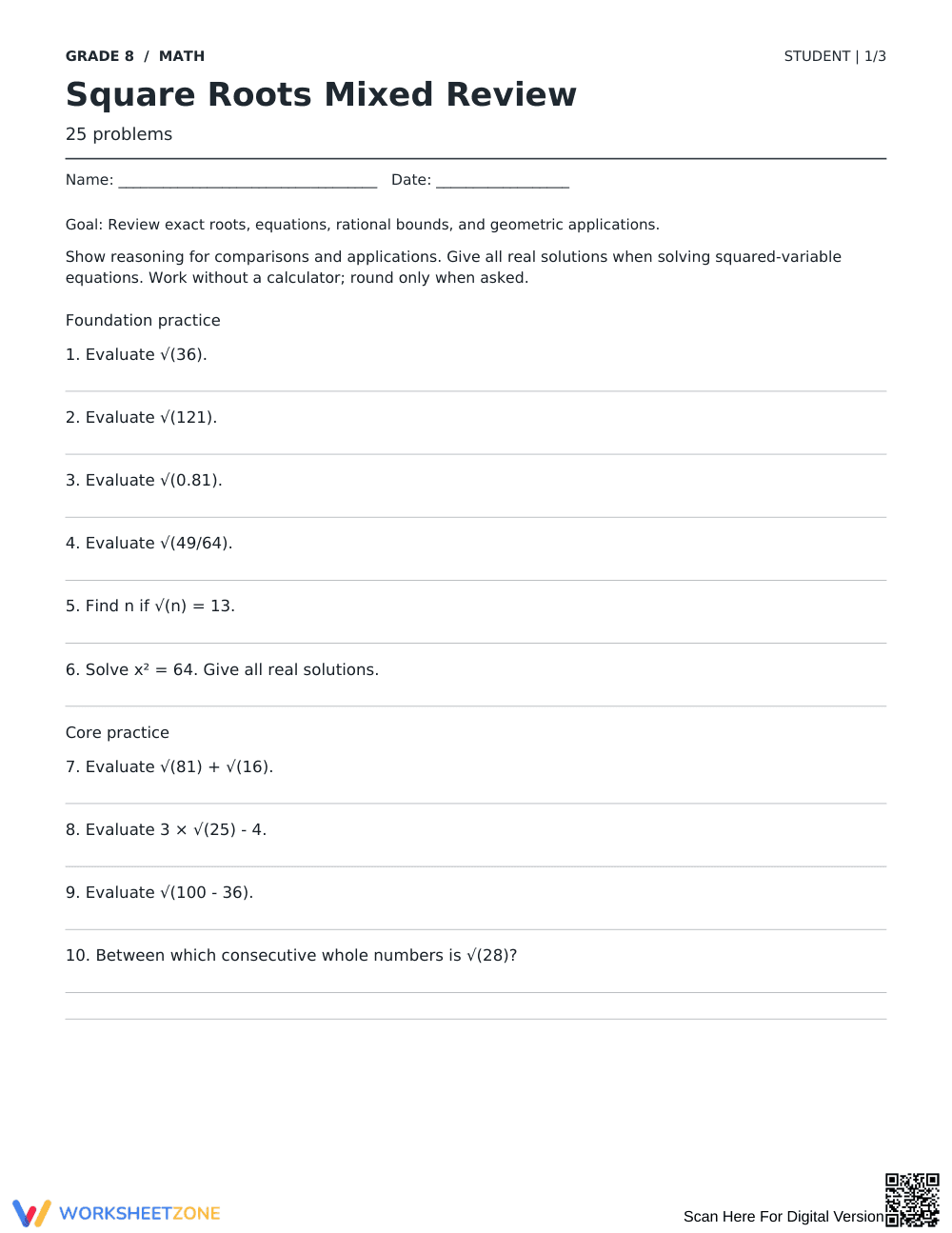
Mastering square roots requires students to connect exact evaluation, radical estimation, and quadratic equations. This three-page Grade 8 math worksheet provides 25 problems that build computational fluency. Students evaluate exact roots, approximate irrational radicals between integers, and solve equations with squared variables.
At a Glance
- Grade: 8 · Subject: Math
- Standard:
CCSS.MATH.CONTENT.8.EE.A.2— Evaluate square roots and solve squared variable equations- Skill Focus: Square roots, radical estimation, and quadratic equations
- Format: 3 pages · 25 problems · Answer key included · PDF
- Best For: End-of-unit review and assessment
- Time: 30–45 minutes
What's Inside
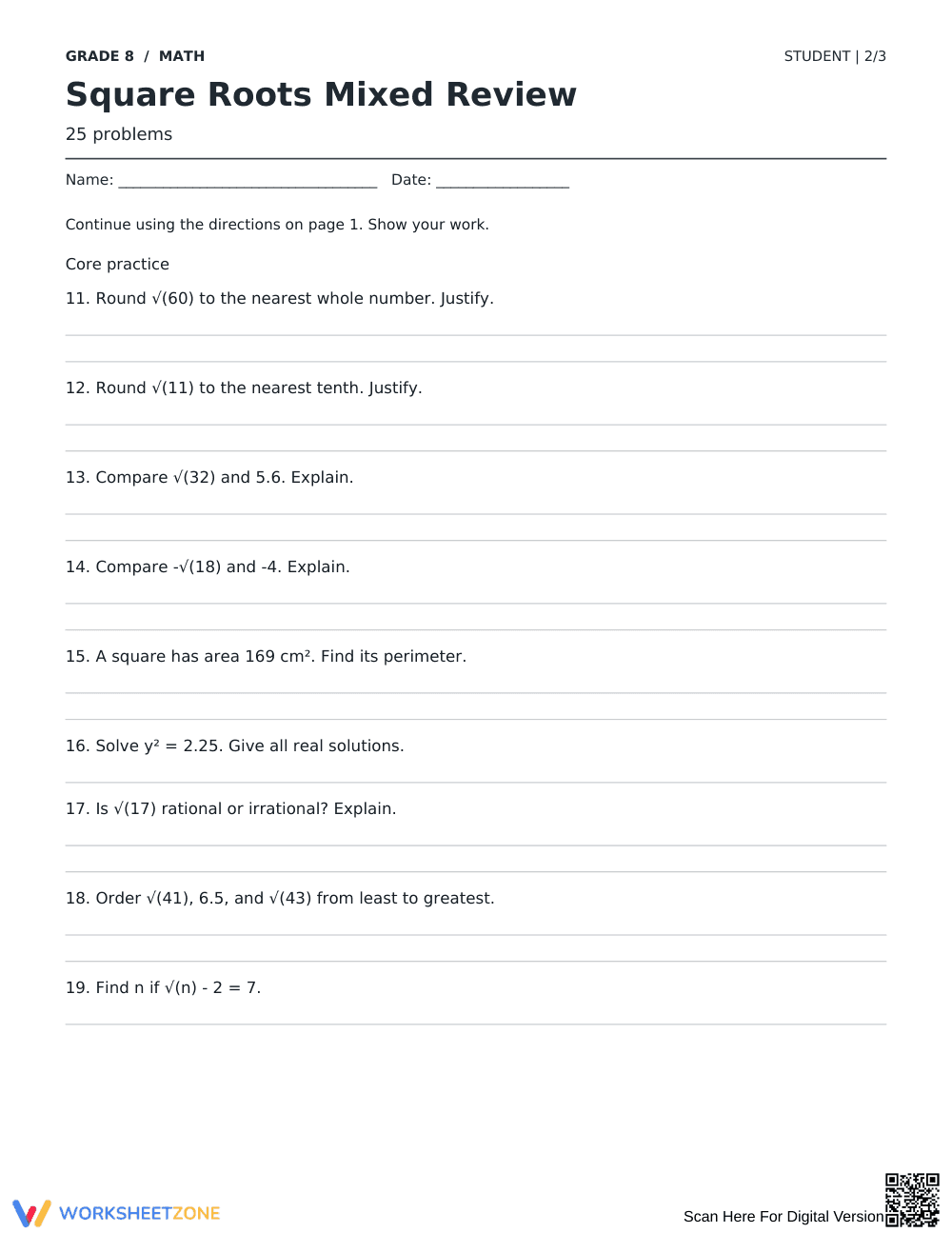
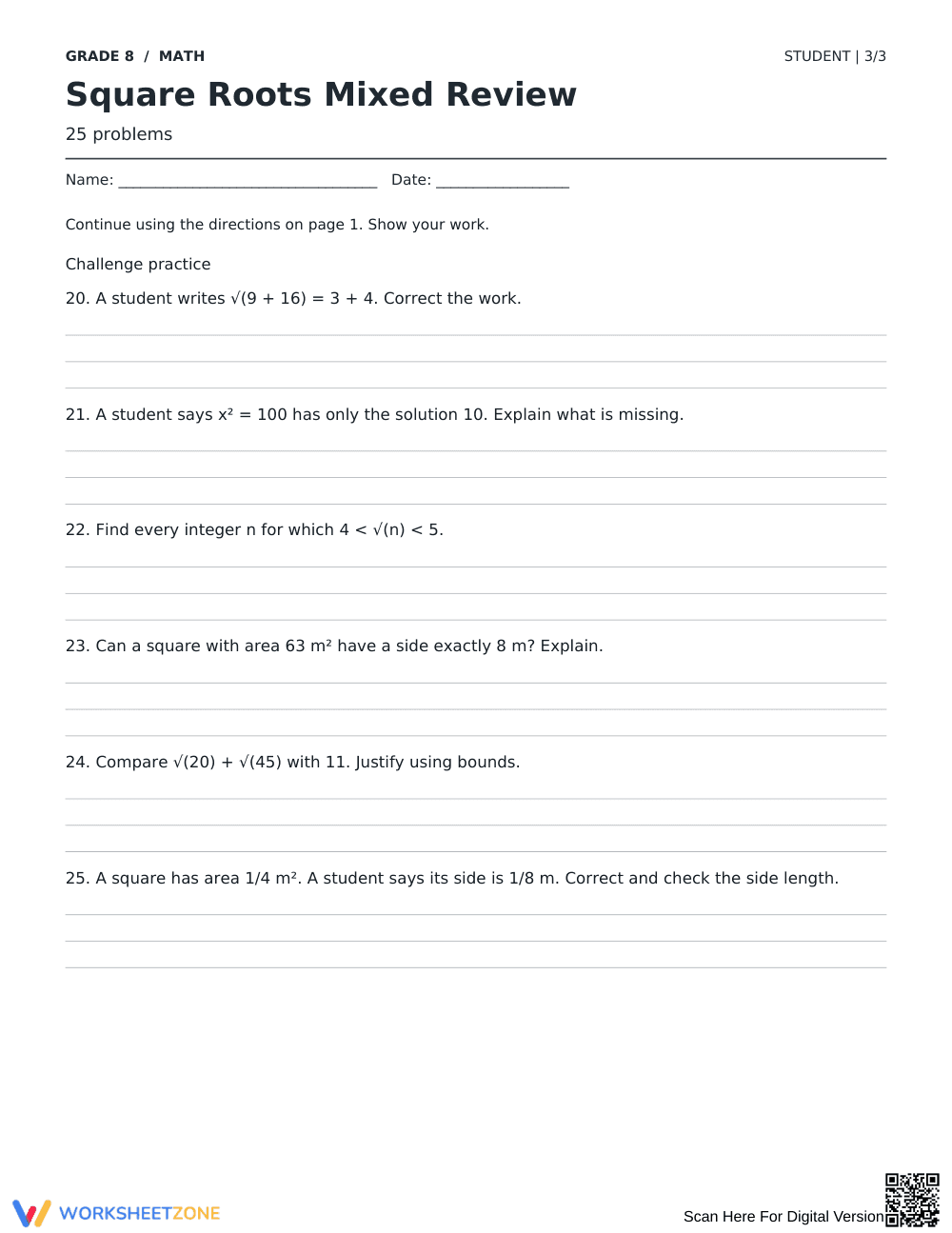
This resource features three student practice pages containing 25 structured problems, supported by a complete two-page answer key with worked solutions and scoring notes. Problem types include exact root computation, decimal approximations, arithmetic with radicals, geometric applications, and student error analysis.
Skill Progression
- Guided practice (Problems 1–6): Foundation root evaluation of whole numbers, decimals, fractions, and quadratic equations.
- Supported practice (Problems 7–19): Core tasks combining radical operations, integer bounds, approximations, and geometric perimeters.
- Independent practice (Problems 20–25): Challenge items emphasizing multi-step reasoning, inequalities, and written error corrections.
This sequence follows a gradual-release model, moving students from foundational calculation to independent analysis.
Standards Alignment
The primary focus aligns with `CCSS.MATH.CONTENT.8.EE.A.2`: Use square root symbols to represent solutions to equations of the form x² = p and evaluate square roots of small perfect squares. Additionally, this worksheet supports `CCSS.MATH.CONTENT.8.NS.A.2` by requiring students to estimate irrational square roots between consecutive integer bounds. Both standard codes can be copied directly into lesson plans, IEP goals, or district curriculum mapping tools.
How to Use It
Use this worksheet after direct instruction on radicals to consolidate mastery. During independent work, inspect Problem 11 and Problem 17 to check whether students distinguish rational from irrational values. The set takes 30 to 45 minutes to complete, fitting well into class review or partner practice.
Who It's For
This resource supports Grade 8 math classes, algebra readiness courses, and targeted intervention groups. Tiered sections allow struggling learners to practice basic roots while advanced students analyze algebraic errors. Pair this worksheet with a square root anchor chart to reinforce values.
Grade 8 students build essential mathematical proficiency when mastering standard CCSS.MATH.CONTENT.8.EE.A.2, which requires learners to evaluate square roots of perfect squares and solve quadratic equations. According to empirical research on structured gradual-release practice from Fisher & Frey (2014), instructional frameworks that move systematically from foundational arithmetic to complex error analysis generate significantly higher conceptual retention and skill transfer in middle school mathematics. This 25-problem mixed review operationalizes those principles by integrating exact square root computation with irrational estimation and geometric perimeter applications. By requiring students to justify decimal approximations, compare real numbers, and identify missing negative roots in quadratic equations, the worksheet ensures deep procedural fluency and mathematical reasoning. Educators can utilize the included scoring criteria and step-by-step solutions to benchmark student mastery and inform targeted small-group intervention across diverse learning environments.


