


























Views
Downloads

Square Roots 1-100 Worksheet | Grade 8 Math Printable
Paste this activity's link or code into your existing LMS (Google Classroom, Canvas, Teams, Schoology, Moodle, etc.).
Students can open and work on the activity right away, with no student login required.
You'll still be able to track student progress and results from your teacher account.
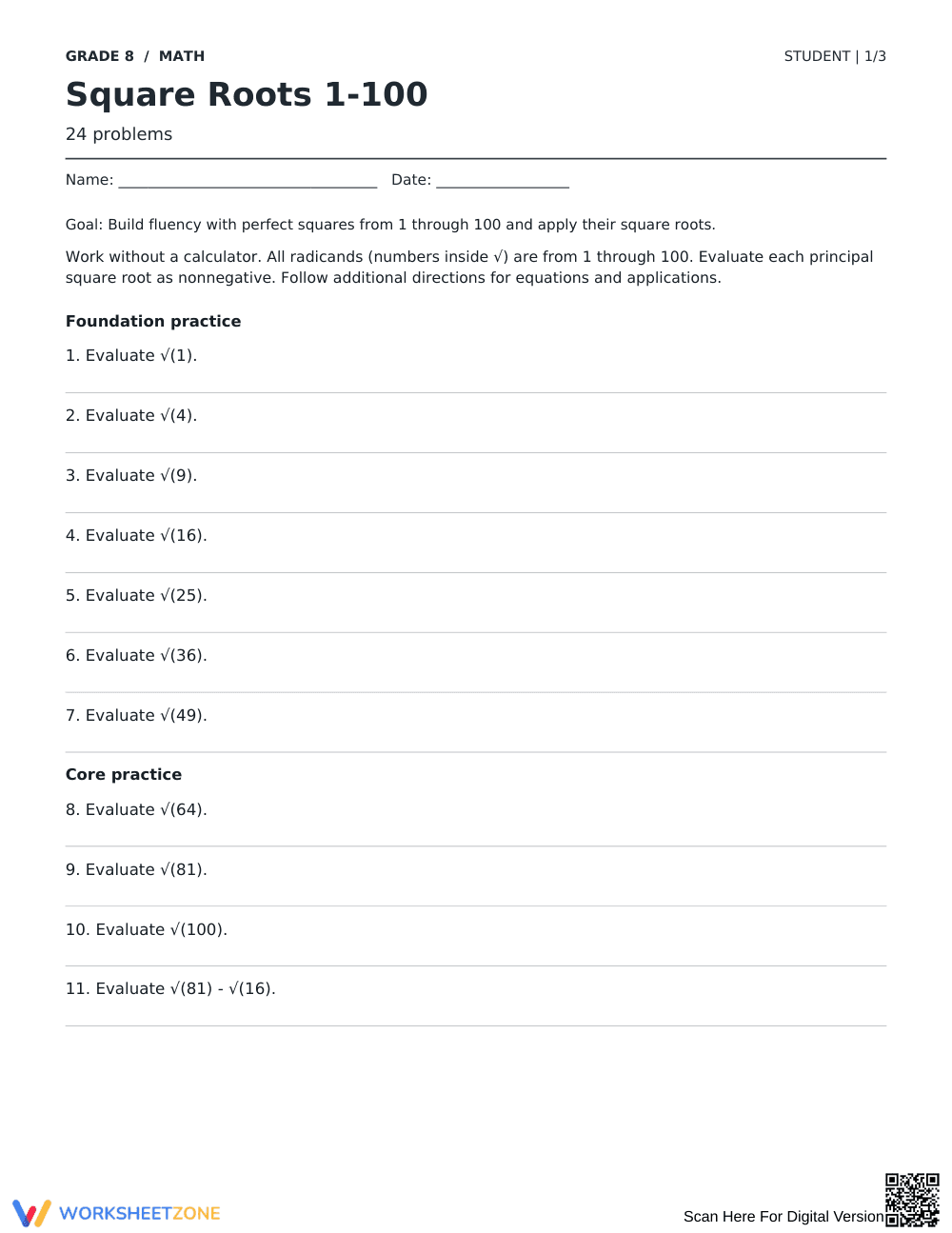
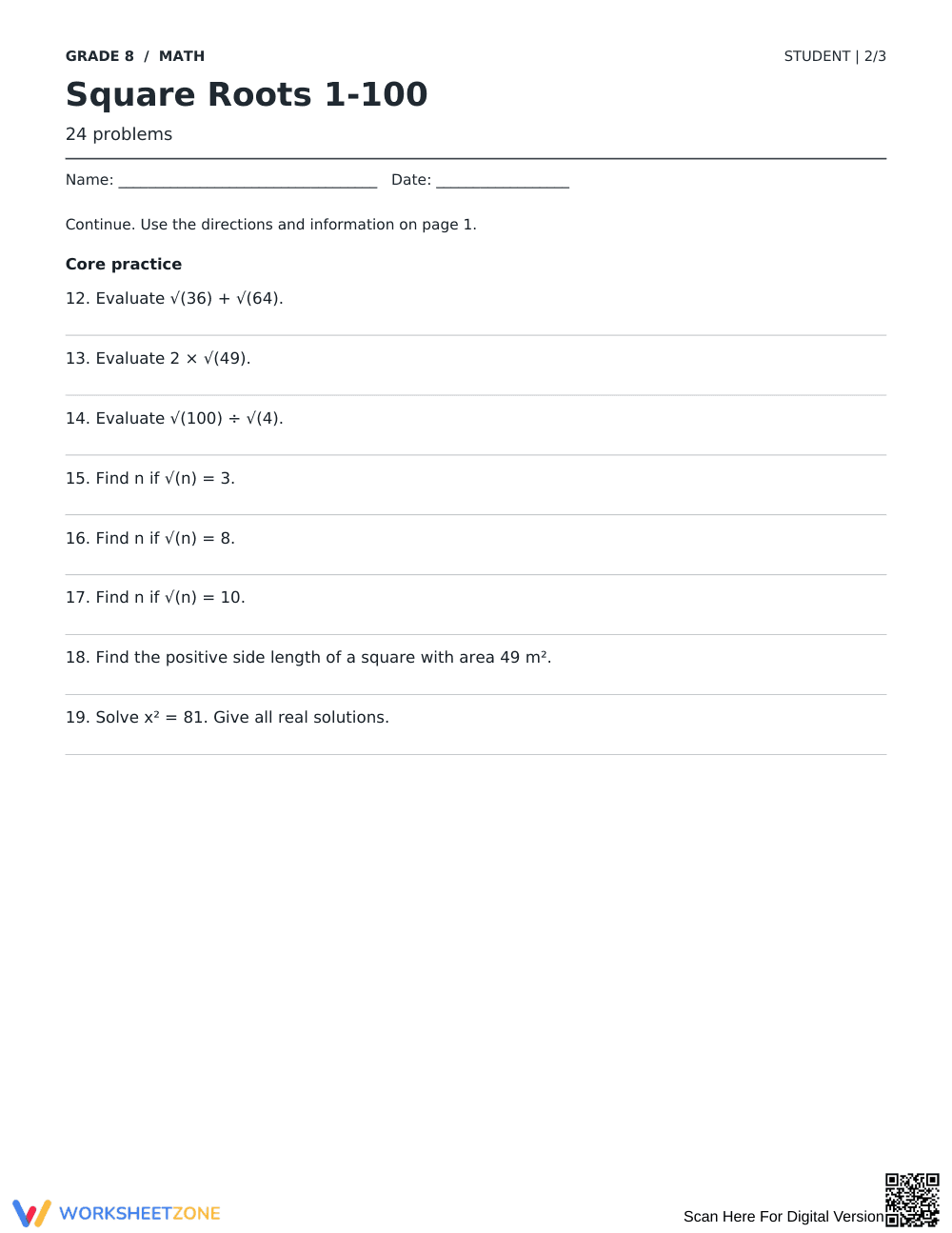
This Grade 8 math worksheet builds computational fluency and conceptual understanding of principal square roots for perfect squares from 1 through 100. Students evaluate radicals, calculate multi-step numerical expressions, solve single-variable quadratic equations, and resolve geometric side-length word problems across 24 structured exercises designed to solidify core algebraic reasoning.
At a Glance
- Grade: 8 · Subject: Math
- Standard:
CCSS.MATH.CONTENT.8.EE.A.2— Evaluate square roots of small perfect squares and solve quadratic equations- Skill Focus: Perfect squares and principal square roots from 1 to 100
- Format: 3 pages · 24 problems · Answer key included · PDF
- Best For: Independent practice, homework, or skill reinforcement
- Time: 30–40 minutes
What's Inside
This 3-page printable resource delivers 24 thoughtfully sequenced problems accompanied by a complete 2-page answer key with point allocations totaling 39 points. Tasks encompass direct radical evaluations, arithmetic with radicals, finding radicands from known roots, real-world area applications, quadratic equations yielding two real solutions, and written error analysis questions requiring students to justify mathematical claims.
Skill Progression
- Guided practice (Problems 1–7): Foundation tasks establish baseline fluency with non-negative principal square roots from √(1) to √(49), prompting rapid recall without calculator assistance.
- Supported practice (Problems 8–19): Core items combine higher perfect squares through √(100), introduce mixed operations, solve inverse square root relationships, calculate square side lengths, and distinguish dual roots in quadratic equations.
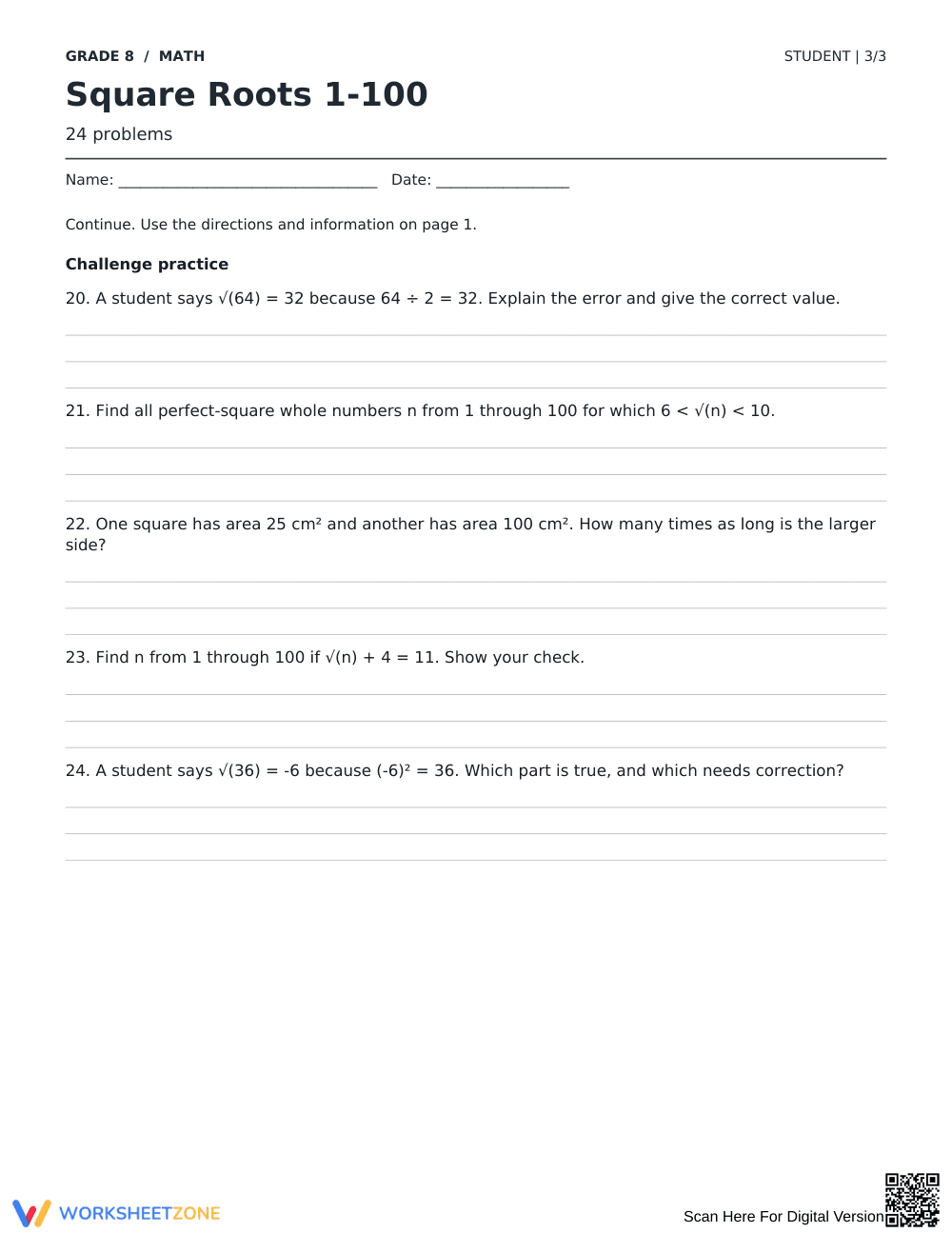
- Independent practice (Problems 20–24): Challenge items require non-routine problem solving, error analysis regarding division misconceptions, compound inequality bounds, and geometric scaling questions without teacher prompting.
This systematic progression embodies the gradual-release model, transitioning students smoothly from basic recall to autonomous conceptual application.
Standards Alignment
The primary standard addressed is `CCSS.MATH.CONTENT.8.EE.A.2`, which requires students to use square root symbols to represent solutions to equations and evaluate square roots of small perfect squares. A supporting standard is `CCSS.MATH.CONTENT.8.NS.A.1`, as students recognize that roots of perfect squares represent rational values. Both standard codes can be copied directly into lesson plans, IEP goals, or district curriculum mapping tools.
How to Use It
Deploy this worksheet after direct instruction on perfect squares and inverse operations. It functions effectively as a 30-to-40-minute independent seatwork assignment or as a targeted two-day station rotation activity. During work time, observe whether students confuse finding square roots with dividing by two on Problem 20, using this formative checkpoint to redirect flawed mental models immediately.
Who It's For
This resource is tailored for Grade 8 mathematics students mastering expressions and equations, as well as high school Algebra I students needing prerequisite remediation. Teachers can differentiate by assigning Foundation items to emerging learners while advancing accelerated students directly to the Challenge section. Pair this printable with a visual perfect square anchor chart for maximal instructional support.
Mastery of `CCSS.MATH.CONTENT.8.EE.A.2` requires middle school students to accurately evaluate square roots of perfect squares, distinguish principal roots, and apply inverse relationships when solving quadratic equations. According to Fisher & Frey (2014), structured instructional materials that organize mathematical practice into clear scaffolds—moving from foundational retrieval to complex problem-solving and error analysis—substantially increase student retention and self-efficacy. This 24-item worksheet operationalizes that framework by moving learners through non-negative square root facts from 1 to 100 before challenging them to evaluate algebraic expressions, deduce area dimensions, and critique common mathematical fallacies. By cementing the distinction between taking a square root and dividing by two, students establish essential conceptual prerequisites for eighth-grade radical arithmetic, the Pythagorean theorem, and secondary algebra coursework. The structured layout ensures measurable skill acquisition that educators can reliably document through formative scoring.


