


























Views
Downloads
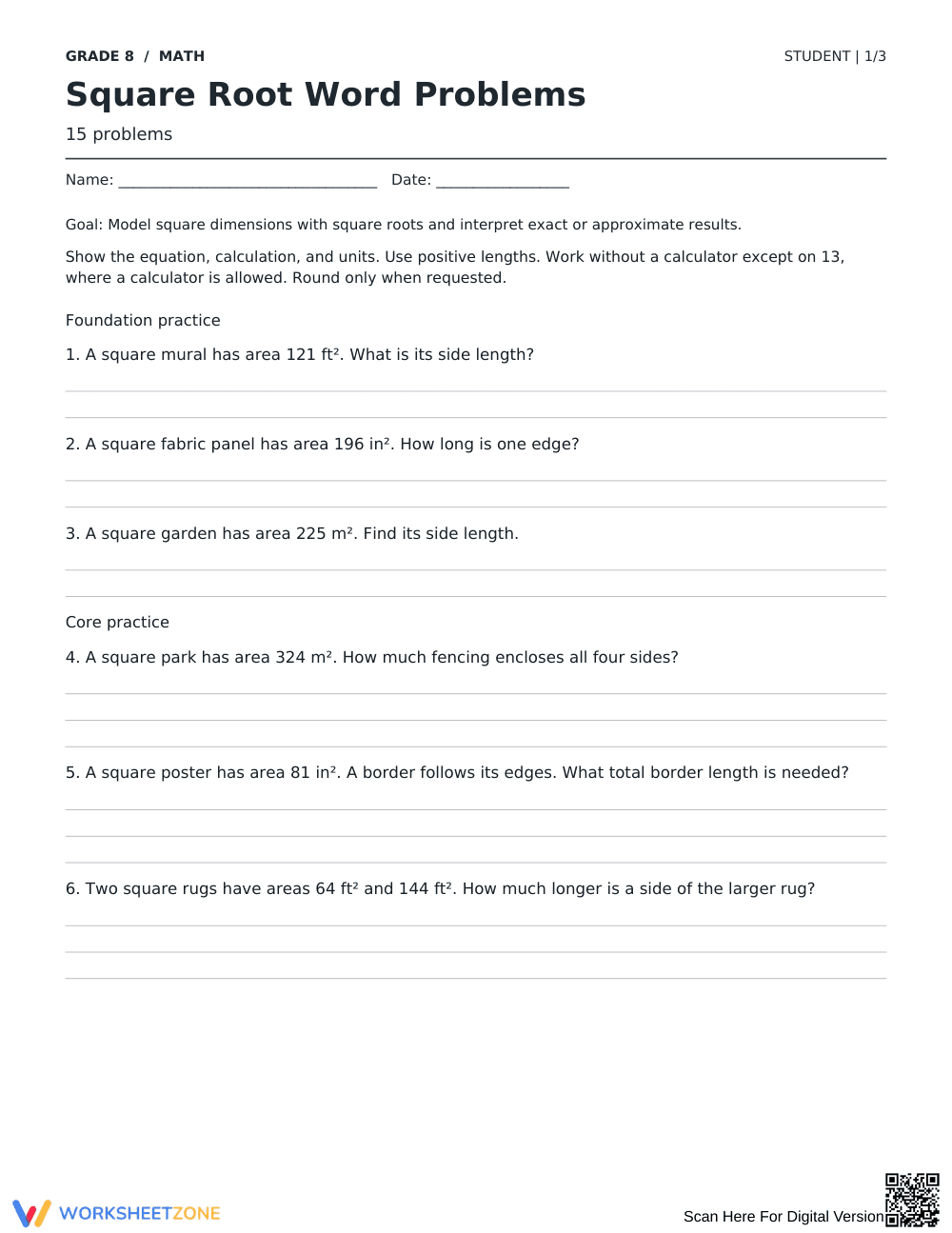
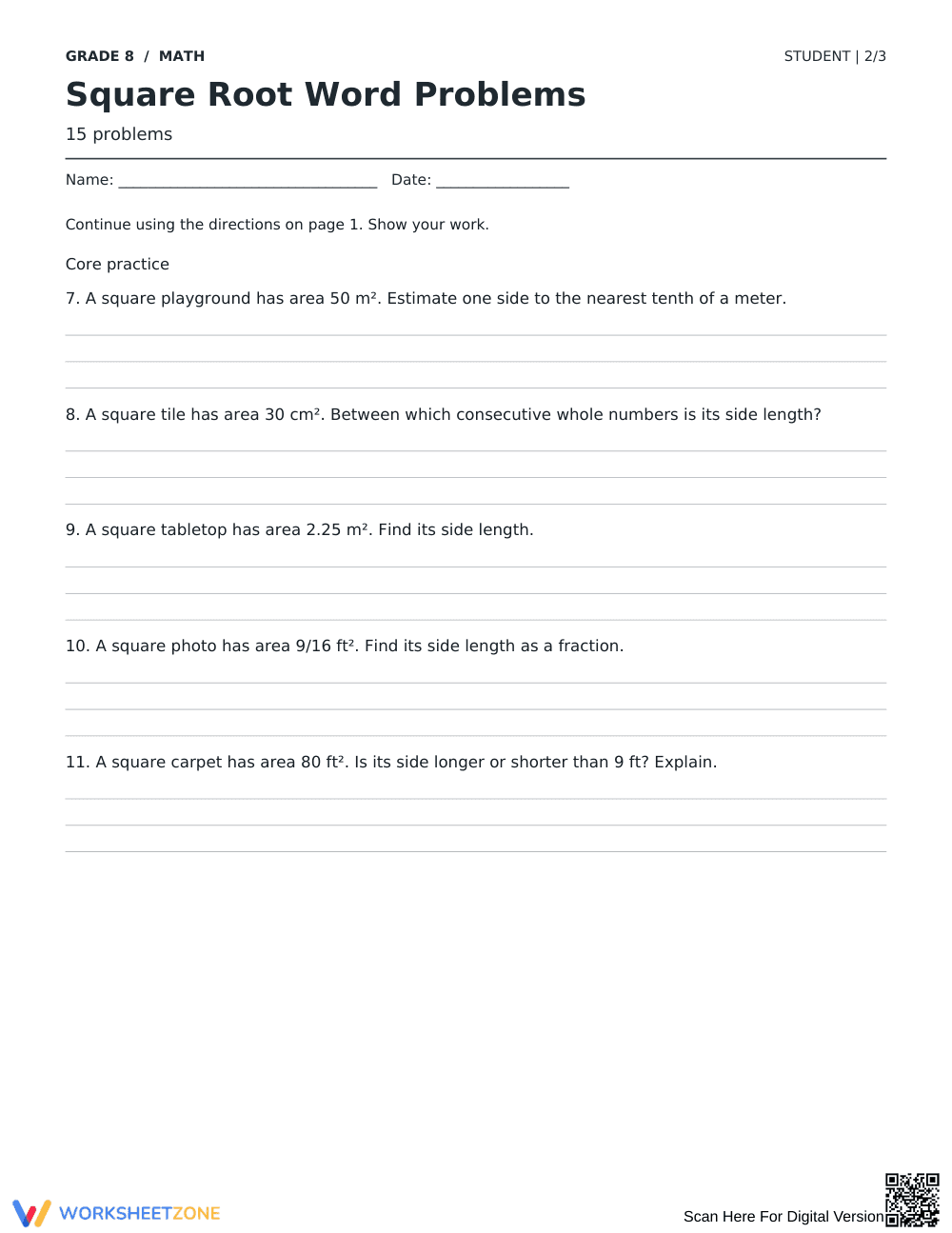
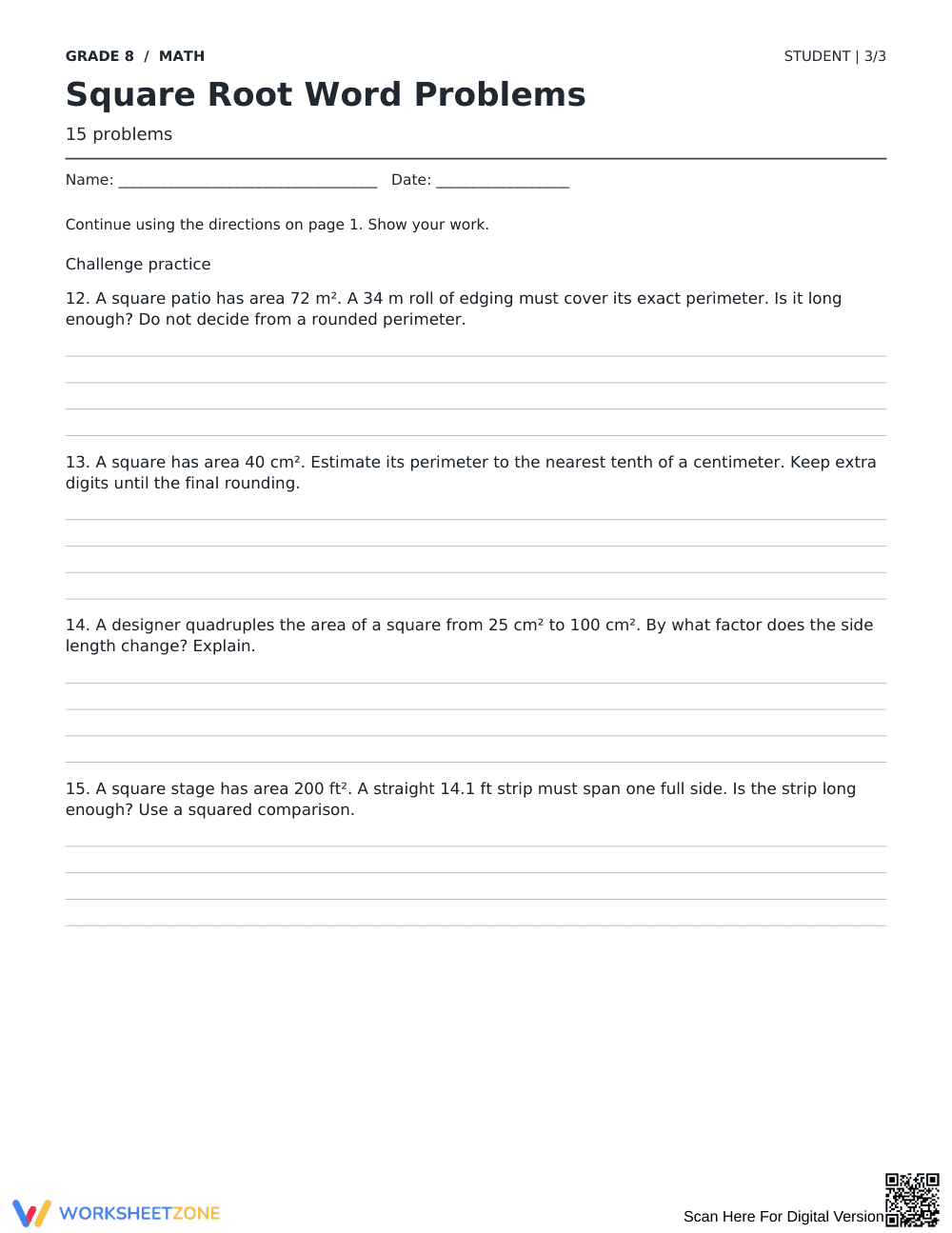

Square Root Word Problems | Grade 8 Math Printable
Paste this activity's link or code into your existing LMS (Google Classroom, Canvas, Teams, Schoology, Moodle, etc.).
Students can open and work on the activity right away, with no student login required.
You'll still be able to track student progress and results from your teacher account.
This Grade 8 math worksheet helps students apply square roots to solve 15 real-world geometric word problems. Learners model side lengths from given square areas, evaluate rational roots, and estimate irrational roots within practical contexts. Students build conceptual fluency transitioning from direct radical equations to multi-step perimeter and comparison tasks.
At a Glance
- Grade: 8 · Subject: Math
- Standard:
CCSS.MATH.CONTENT.8.EE.A.2— Use square roots to represent solutions to equations and evaluate radical values- Skill Focus: Square root application and estimation in geometric word problems
- Format: 3 pages · 15 problems · Answer key included · PDF
- Best For: Independent practice and small-group targeted review
- Time: 30–45 minutes
What's Inside: This 3-page printable PDF features 15 structured word problems spanning integer squares, fractional areas, decimals, and non-perfect squares. It provides lined workspace for equations and calculations, followed by a complete 2-page answer key with step-by-step verification methods, exact solutions, and point allocations.
Skill Progression
- Foundation Practice (Problems 1–3): Direct single-step items evaluating integer square roots from whole-number areas up to 225 with explicit side-length units.
- Core Practice (Problems 4–11): Multi-step real-world applications requiring perimeter calculations, non-perfect square approximations, decimal roots, and rational fractional radicands.
- Challenge Practice (Problems 12–15): Complex non-calculator geometric comparisons, area-scaling factor analysis, and bounds evaluation using squared comparisons.
This structured progression leverages a gradual-release model, advancing students systematically from procedural recall to deep analytical problem-solving.
Standards Alignment
The primary standard addressed is `CCSS.MATH.CONTENT.8.EE.A.2`, which requires students to use square root symbols to represent solutions to equations of the form x² = p, where p is a positive rational number, and evaluate square roots of small perfect squares. Supporting standard `CCSS.MATH.CONTENT.8.NS.A.2` is integrated through contextual tasks requiring students to approximate irrational square roots between consecutive integers and tenths. Both standard codes can be copied directly into lesson plans, IEP goals, or district curriculum mapping tools.
How to Use It
Deploy this activity during independent seatwork after introducing roots of quadratic equations, or assign it as a collaborative partner station during review units. For formative assessment, examine students' work on Problem 8 and Problem 11 to identify whether they use nearest-square bounding or rely on flawed rounding. Most Grade 8 learners will complete the 15 tasks in 30 to 45 minutes.
Who It's For
This worksheet serves general Grade 8 mathematics classrooms, introductory algebra students, and learners requiring targeted intervention on radical modeling. Teachers can differentiate by assigning Foundation problems to emerging learners while reserving Challenge tasks for advanced students. Pair this worksheet with an anchor chart displaying the first twenty perfect squares and their geometric models.
According to EdReports 2024, rigorous middle school mathematics instructional materials must establish an intentional balance among procedural fluency, conceptual understanding, and contextual application to ensure comprehensive standard mastery. This resource directly targets standard CCSS.MATH.CONTENT.8.EE.A.2 by challenging Grade 8 learners to apply square root concepts to solve realistic geometric area equations and evaluate both exact and approximate side dimensions. Rather than presenting isolated computational drills, the 15 contextual items require students to interpret physical measurement units, calculate bounding intervals for irrational lengths, and verify numerical results through inverse squaring operations. Incorporating multi-step real-world prompts ensures learners move past rote radical extraction toward authentic mathematical modeling. By systematically bridging perfect square roots with non-perfect square estimation, this structured practice set supports coherent pre-algebra progression aligned with national benchmarks for eighth-grade algebra readiness, reinforcing essential quantitative reasoning skills.


