




























Views
Downloads

Grade 5 Seed Germination — Printable No-Prep Worksheet

Paste this activity's link or code into your existing LMS (Google Classroom, Canvas, Teams, Schoology, Moodle, etc.).
Students can open and work on the activity right away, with no student login required.
You'll still be able to track student progress and results from your teacher account.
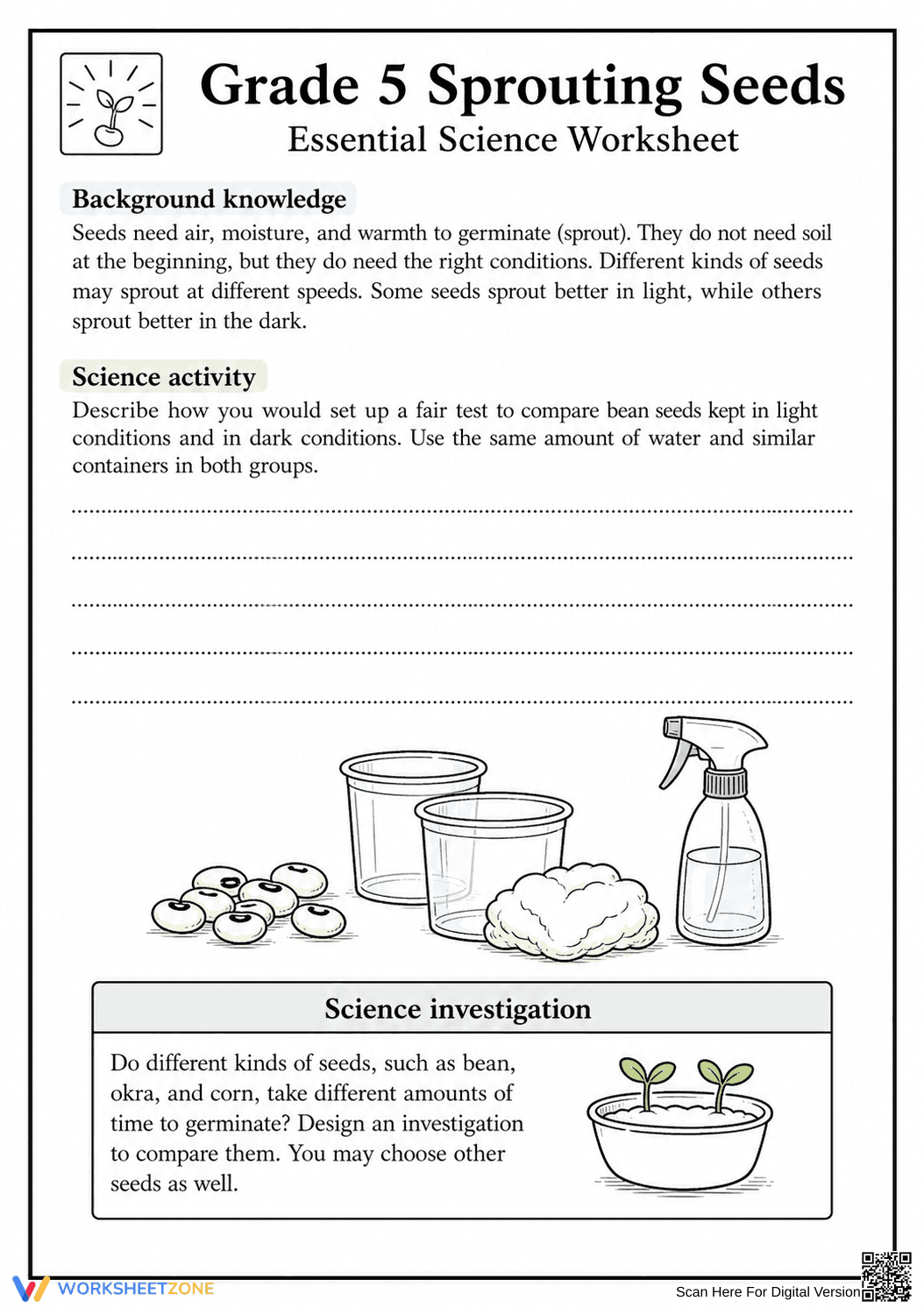
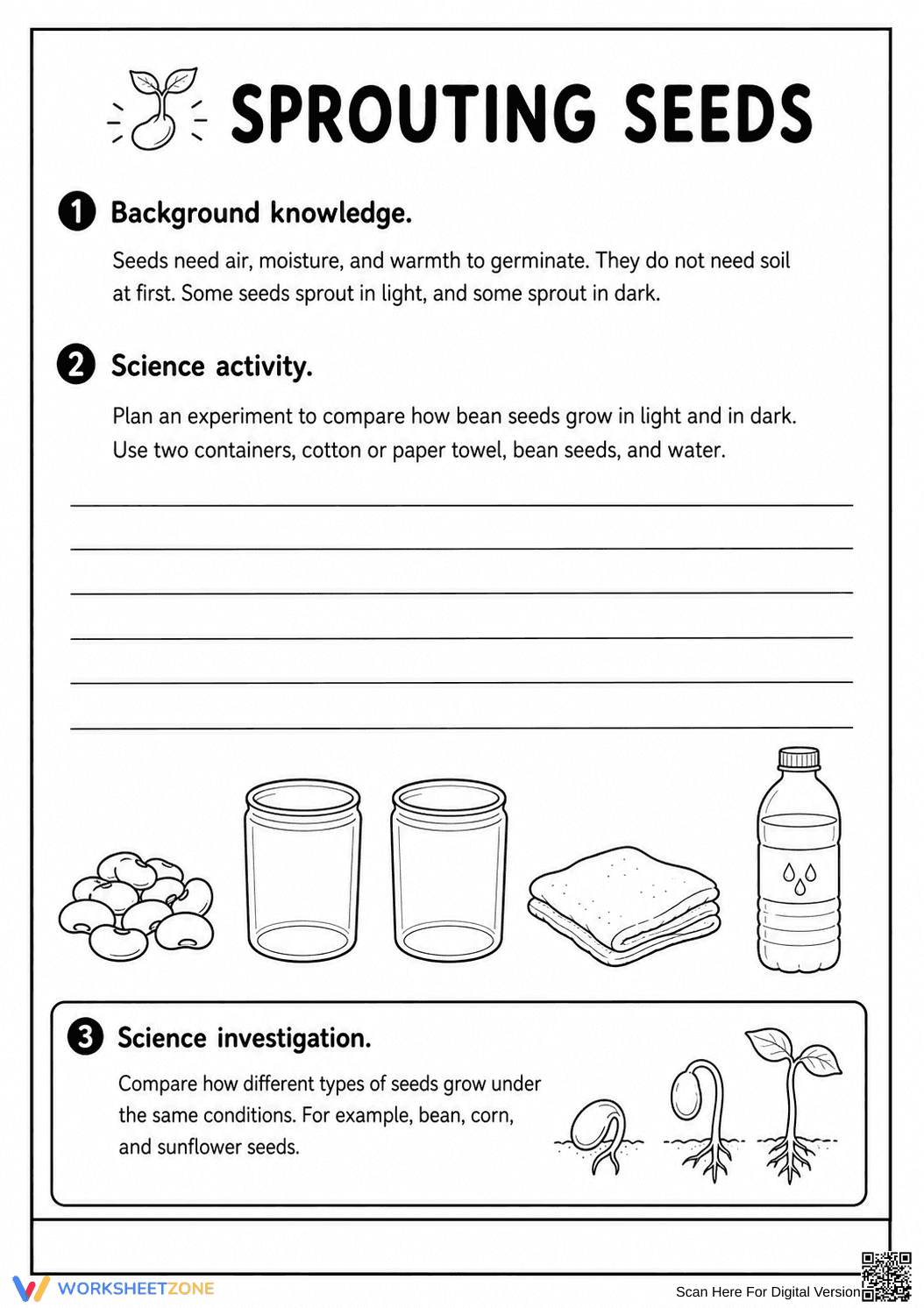
This Grade 5 science worksheet guides students through the fundamental requirements for seed germination, focusing on air, moisture, and warmth. Students transition from reading background knowledge to practical inquiry, developing a robust understanding of how living things interact with their environment to begin their life cycles successfully.
At a Glance
- Grade: 5 · Subject: Science
- Standard:
5-LS1-1— Support arguments that plants get materials for growth from air and water- Skill Focus: Experimental Design
- Format: 2 pages · 2 tasks · Answer key included · PDF
- Best For: Independent science lab prep or homework
- Time: 20–30 minutes
This resource contains a concise background knowledge section explaining the core needs of seeds. It features two primary tasks across two pages: a science activity where students describe a set-up to compare germination in light versus dark conditions, and an investigation prompt for comparing different seed types. A sample answer key is provided to facilitate quick grading.
Zero-Prep Workflow
- Print (30 seconds): Simply select the PDF and print the required number of copies for your Grade 5 cohort.
- Distribute (1 minute): Hand out the worksheets alongside the provided background reading to ground the lesson in scientific facts.
- Review (30 seconds): Use the included sample response to guide class discussion or perform rapid formative assessment of student experimental designs.
Total teacher prep time is under 2 minutes, allowing for immediate classroom implementation. It is also highly suitable for a substitute teacher plan.
Standards Alignment
This resource aligns with 5-LS1-1, requiring students to support an argument that plants get the materials they need for growth chiefly from air and water. By exploring how seeds sprout in various moisture and light levels, students gather evidence regarding the necessity of environmental inputs. Both standard codes can be copied directly into lesson plans, IEP goals, or district curriculum mapping tools.
How to Use It
Use this worksheet during the Explore phase of a 5E lesson on life cycles to help students conceptualize experimental variables before conducting a physical lab. Alternatively, assign it as a post-lab reflection after an in-class seed planting activity to reinforce the logic behind controlled experiments. Teachers should observe whether students correctly identify the independent variable versus the constant variables during formative assessment. Expected completion time ranges from 20 to 30 minutes.
Who It's For
This activity is designed for Grade 5 students studying living things and biology. It offers natural differentiation for English Language Learners through visual aids and clear, accessible background text. It pairs naturally with a time-lapse video of germination or a hands-on bean planting kit for a comprehensive instructional experience that bridges theory and practice.
Scientific literacy in elementary education relies on structured inquiry to build foundational knowledge of biological processes. This Grade 5 worksheet focuses on seed germination, a critical component of the 5-LS1-1 standard, where students support arguments that plants get materials for growth from air and water. Students demonstrate mastery by designing experiments that isolate environmental variables to determine optimal growth conditions. According to RAND AIRS 2024, the use of structured inquiry-based worksheets significantly improves student retention of scientific concepts compared to passive reading alone. By engaging with two distinct tasks, learners develop the specific skill of evidence-based argumentation. This resource provides focused content that aligns with core science frameworks for physical and life science interactions. It serves as a reliable tool for assessing scientific reasoning and design logic in a classroom setting, ensuring students meet curriculum objectives efficiently.


