


























Views
Downloads

Essential Kindergarten Spelling Scramble | Ready
Paste this activity's link or code into your existing LMS (Google Classroom, Canvas, Teams, Schoology, Moodle, etc.).
Students can open and work on the activity right away, with no student login required.
You'll still be able to track student progress and results from your teacher account.
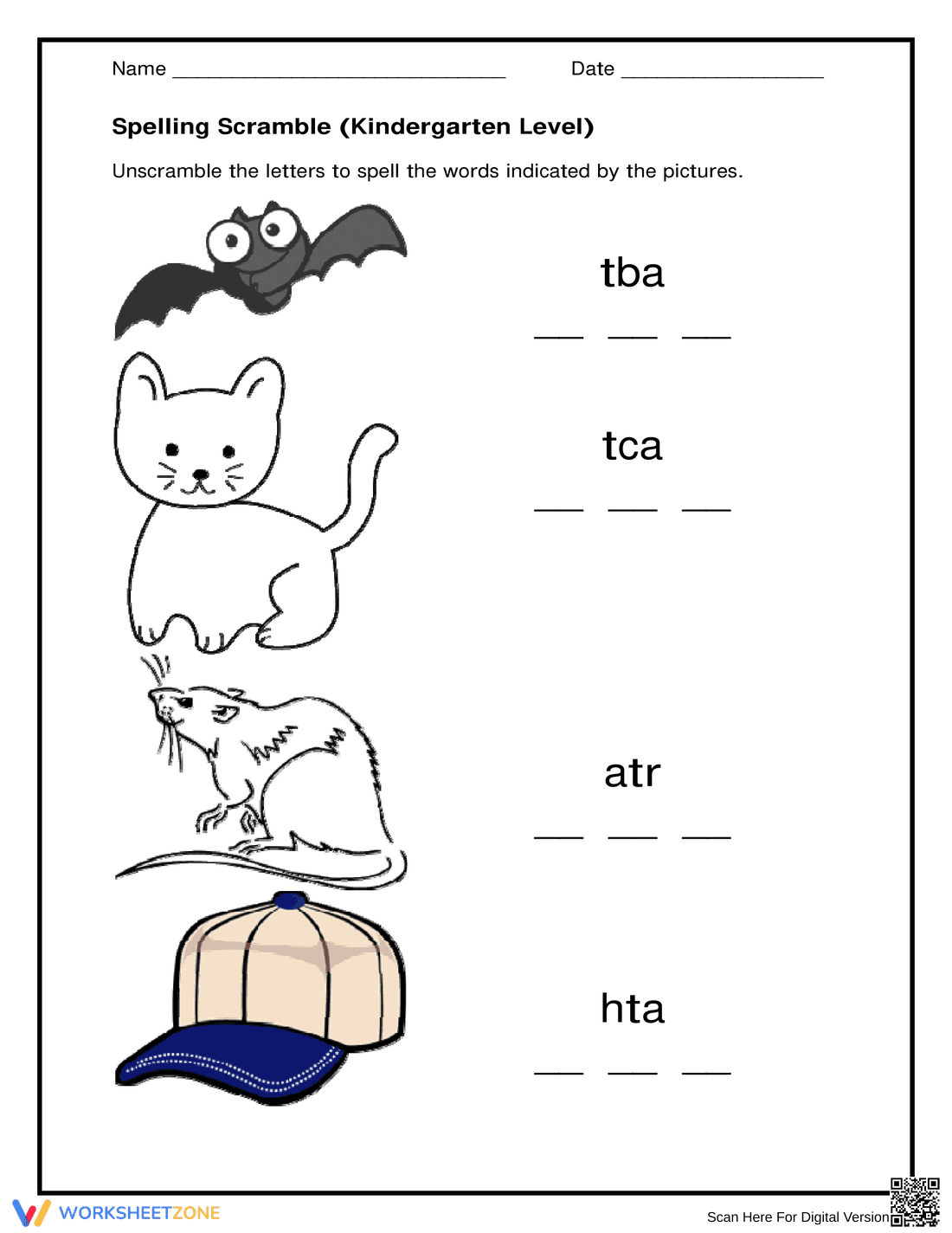
This Kindergarten spelling scramble worksheet provides young learners with a targeted way to practice CVC word construction through letter unscrambling. By combining visual illustrations with scrambled letter sets, the resource builds phonemic awareness and reinforces the spelling of common three-letter words. Students gain confidence as they decode the pictures and organize letters correctly.
At a Glance
- Grade: Kindergarten · Subject: ELA
- Standard:
CCSS.ELA-LITERACY.L.K.2.D— Spell simple words phonetically by drawing on knowledge of sound-letter relationships- Skill Focus: CVC Word Unscrambling
- Format: 1 page · 4 problems · Answer key included · PDF
- Best For: Literacy centers and quick morning work
- Time: 10–15 minutes
Inside this single-page PDF, you will find four distinct spelling challenges centered on the "at" family. Each problem features a clear, engaging cartoon illustration of a common animal or object—including a bat, cat, rat, and hat—paired with a scrambled sequence of its component letters. Dedicated writing lines provide ample space for students to write their final unscrambled answers.
The zero-prep workflow is designed for immediate classroom implementation. Teachers can print the worksheet in under 30 seconds, distribute it to students in approximately 1 minute, and conduct a full-class review in just 5 minutes. This streamlined approach makes it an ideal resource for substitute folders or as a fast-finisher activity that requires no prior teacher setup.
This resource is explicitly aligned to CCSS.ELA-LITERACY.L.K.2.D, which requires students to spell simple words phonetically. By focusing on the relationship between sounds and letters, the worksheet supports early literacy milestones. This standard code can be copied directly into lesson plans, IEP goals, or district curriculum mapping tools to ensure instructional consistency and data-driven tracking.
Use this worksheet as a formative assessment during the guided practice phase of a phonics lesson. Observe students as they attempt to unscramble the letters to see if they can identify the beginning, middle, and ending sounds. It also works perfectly as a quiet transition activity after recess, helping students settle back into academic focus while practicing essential literacy skills.
This resource is designed for Kindergarten students but is also highly effective for first-grade learners needing remedial support. It pairs naturally with a short CVC reading passage or a classroom anchor chart focused on the "at" word family. The visual cues provide necessary support for English Language Learners and students with varied processing speeds.
According to a RAND AIRS 2024 analysis, structured phonics practice that utilizes multisensory cues, such as the visual-to-letter mapping found in this spelling scramble, significantly improves retention of phonemic patterns in early childhood education. The worksheet targets the CCSS.ELA-LITERACY.L.K.2.D standard by forcing students to manipulate letters and sounds in a way that builds permanent orthographic mapping. Research from Fisher & Frey (2014) emphasizes that when students engage in active decoding and encoding tasks with scaffolds like these pictures, they are more likely to achieve automaticity in word recognition. This single-page resource provides a focused, high-impact environment for students to demonstrate their understanding of CVC construction. Educators can rely on this validated approach to move students from simple letter recognition to the more complex task of phonetic spelling, ensuring foundational ELA skills are mastered before progressing to more advanced reading levels.


