


























0
Views
0
Downloads

0.0
0
Save
0 Likes
Solving Specific Heat Problems
0 Views
0 Downloads
Paste this activity's link or code into your existing LMS (Google Classroom, Canvas, Teams, Schoology, Moodle, etc.).
Students can open and work on the activity right away, with no student login required.
You'll still be able to track student progress and results from your teacher account.
Information
Description
What It Is:
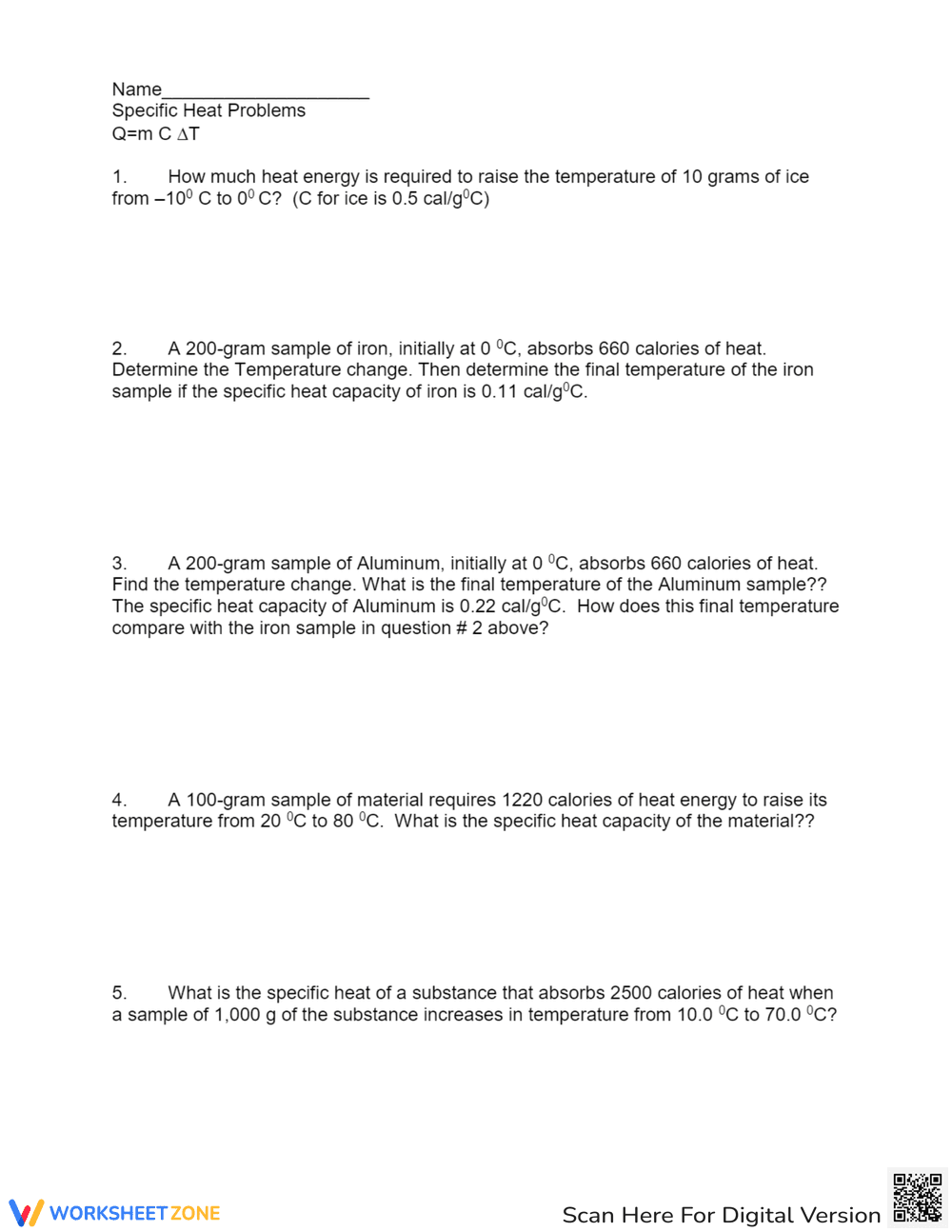
This is a worksheet containing specific heat problems. It presents five problems involving the calculation of heat energy, temperature change, and specific heat capacity for different materials like ice, iron, and aluminum. The worksheet uses the formula Q = m C ΔT.
Grade Level Suitability:
This worksheet is suitable for grades 9-12, particularly in physics or chemistry classes. It requires students to apply algebraic skills and an understanding of heat transfer concepts.
Why Use It:
This worksheet reinforces the understanding of specific heat capacity and its relationship to heat transfer. It helps students practice using the formula Q = m C ΔT to solve quantitative problems, and to apply these concepts to real-world materials.
How to Use It:
Students should use the given information (mass, specific heat capacity, initial and final temperatures, or heat absorbed) to calculate the missing variable in each problem. They should show their work and include units in their answers. Some problems require multiple steps to arrive at the final answer.
Target Users:
This worksheet is designed for high school physics and chemistry students who are learning about heat transfer and specific heat. It can also be used as a review for students who have already covered the topic.
This is a worksheet containing specific heat problems. It presents five problems involving the calculation of heat energy, temperature change, and specific heat capacity for different materials like ice, iron, and aluminum. The worksheet uses the formula Q = m C ΔT.
Grade Level Suitability:
This worksheet is suitable for grades 9-12, particularly in physics or chemistry classes. It requires students to apply algebraic skills and an understanding of heat transfer concepts.
Why Use It:
This worksheet reinforces the understanding of specific heat capacity and its relationship to heat transfer. It helps students practice using the formula Q = m C ΔT to solve quantitative problems, and to apply these concepts to real-world materials.
How to Use It:
Students should use the given information (mass, specific heat capacity, initial and final temperatures, or heat absorbed) to calculate the missing variable in each problem. They should show their work and include units in their answers. Some problems require multiple steps to arrive at the final answer.
Target Users:
This worksheet is designed for high school physics and chemistry students who are learning about heat transfer and specific heat. It can also be used as a review for students who have already covered the topic.


