


























1 / 5
0
Views
0
Downloads



0.0
0
Save
0 Likes
Share
Specific Heat and Heat Calculations Worksheet
0 Views
0 Downloads
Paste this activity's link or code into your existing LMS (Google Classroom, Canvas, Teams, Schoology, Moodle, etc.).
Students can open and work on the activity right away, with no student login required.
You'll still be able to track student progress and results from your teacher account.
Information
Description
What It Is:
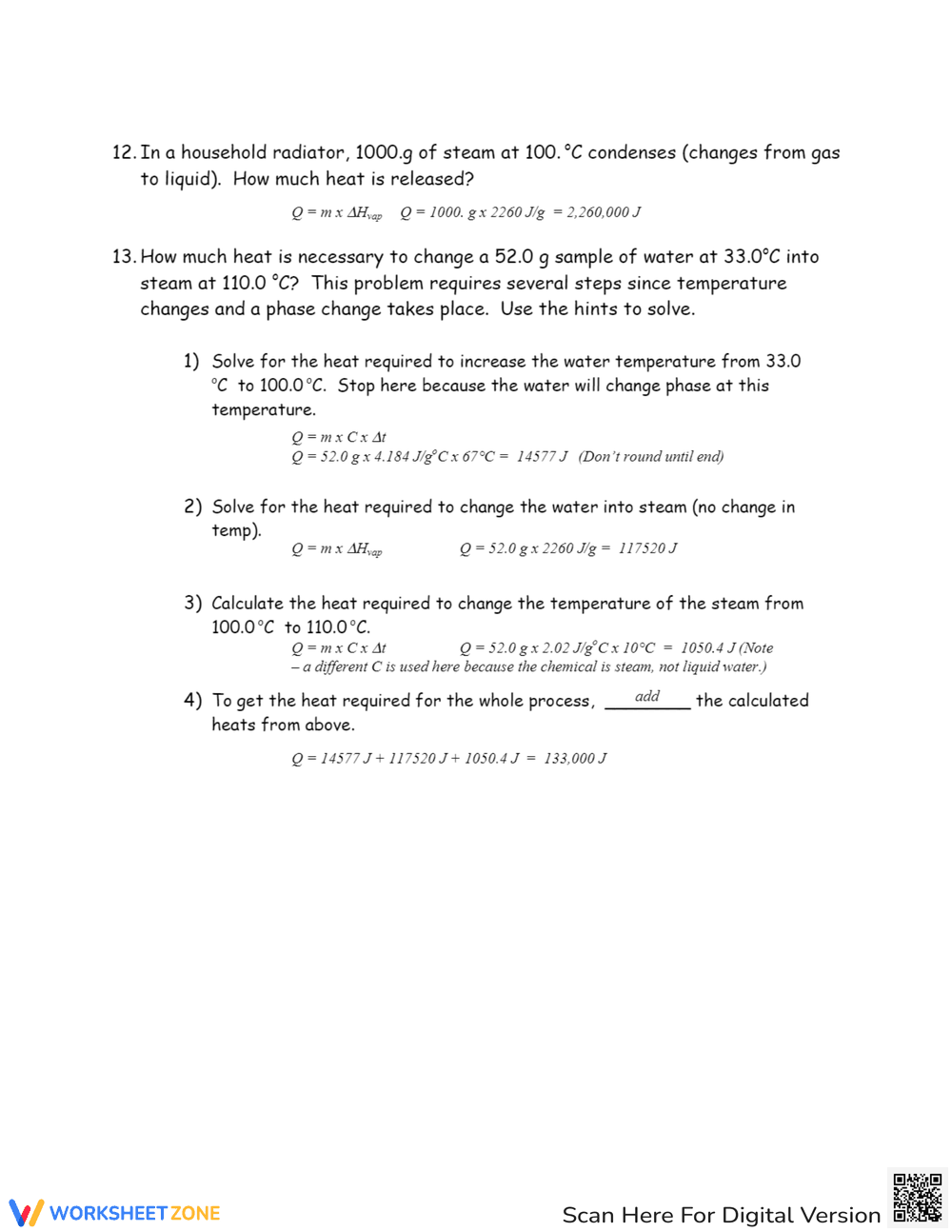
This is a worksheet titled 'Heat and Heat Calculations.' It contains a mix of fill-in-the-blank and short answer questions. The questions cover topics such as the difference between temperature and heat, kinetic and potential energy, factors affecting temperature rise when heating a substance, the definition of specific heat capacity, an explanation of why an aluminum pan can be touched while the food it contains can burn you, why water temperature doesn't continually increase when heated, and equations used to calculate heat associated with a phase change.
Grade Level Suitability:
This worksheet is suitable for grades 9-12 (high school) physics or chemistry. The concepts covered, such as specific heat capacity and phase changes, are typically introduced at the high school level. The questions require understanding of energy concepts and potentially some basic calculations.
Why Use It:
This worksheet helps students reinforce their understanding of heat, temperature, and related concepts. It encourages critical thinking by asking students to explain phenomena and apply their knowledge to real-world examples. It also tests their ability to recall definitions and relationships between different forms of energy.
How to Use It:
Students should read each question carefully and answer to the best of their ability. For fill-in-the-blank questions, they should provide the missing words or phrases. For short answer questions, they should write a concise and accurate explanation. The worksheet can be used as a review activity, a homework assignment, or a quiz.
Target Users:
The target users are high school students taking physics or chemistry courses. It is also suitable for students reviewing these concepts for standardized tests or college preparation. Teachers can use it to assess student understanding and provide targeted instruction.
This is a worksheet titled 'Heat and Heat Calculations.' It contains a mix of fill-in-the-blank and short answer questions. The questions cover topics such as the difference between temperature and heat, kinetic and potential energy, factors affecting temperature rise when heating a substance, the definition of specific heat capacity, an explanation of why an aluminum pan can be touched while the food it contains can burn you, why water temperature doesn't continually increase when heated, and equations used to calculate heat associated with a phase change.
Grade Level Suitability:
This worksheet is suitable for grades 9-12 (high school) physics or chemistry. The concepts covered, such as specific heat capacity and phase changes, are typically introduced at the high school level. The questions require understanding of energy concepts and potentially some basic calculations.
Why Use It:
This worksheet helps students reinforce their understanding of heat, temperature, and related concepts. It encourages critical thinking by asking students to explain phenomena and apply their knowledge to real-world examples. It also tests their ability to recall definitions and relationships between different forms of energy.
How to Use It:
Students should read each question carefully and answer to the best of their ability. For fill-in-the-blank questions, they should provide the missing words or phrases. For short answer questions, they should write a concise and accurate explanation. The worksheet can be used as a review activity, a homework assignment, or a quiz.
Target Users:
The target users are high school students taking physics or chemistry courses. It is also suitable for students reviewing these concepts for standardized tests or college preparation. Teachers can use it to assess student understanding and provide targeted instruction.


