


























Views
Downloads
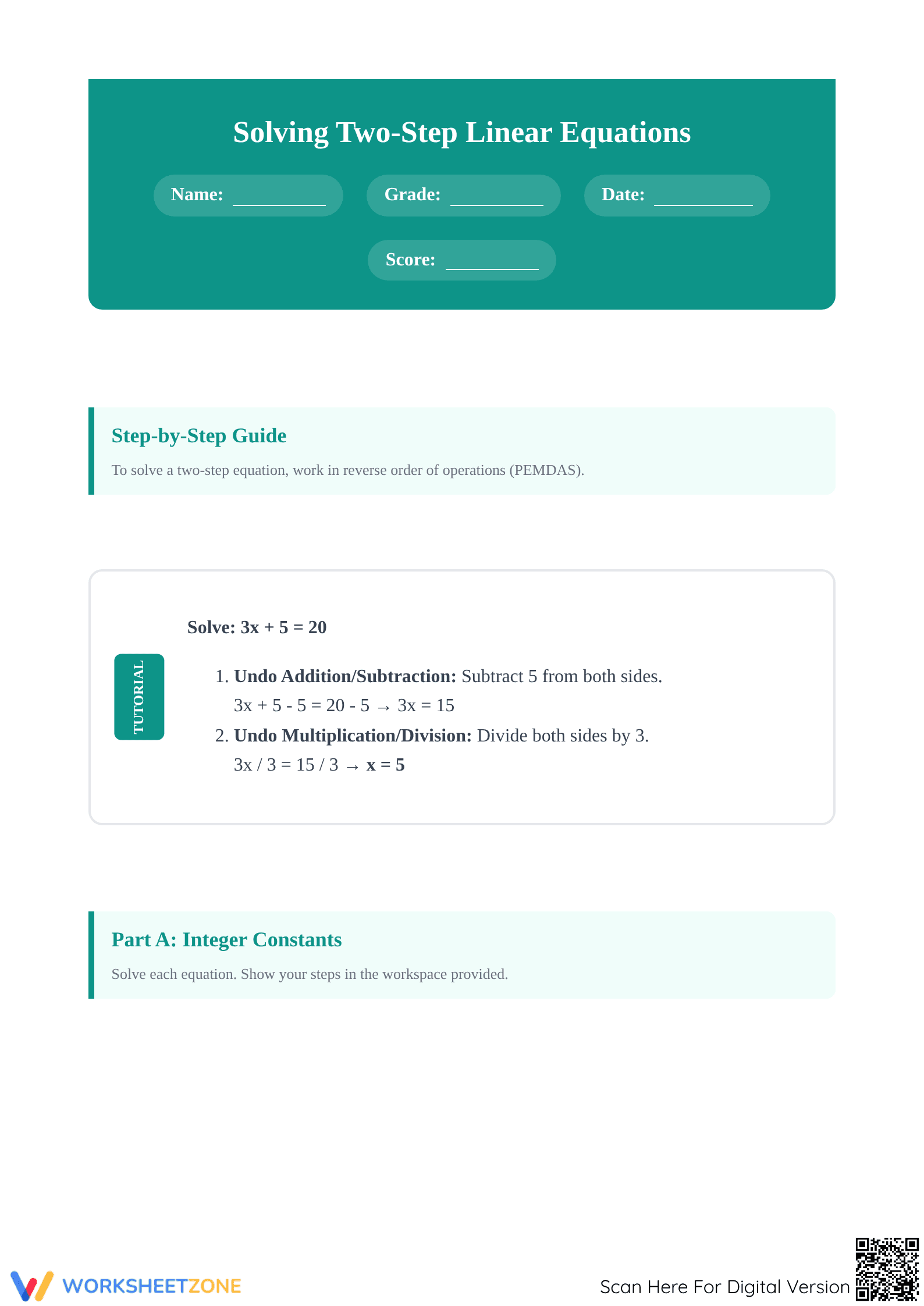



Essential Solving Two-Step Linear Equations Guide — Grade 8
Paste this activity's link or code into your existing LMS (Google Classroom, Canvas, Teams, Schoology, Moodle, etc.).
Students can open and work on the activity right away, with no student login required.
You'll still be able to track student progress and results from your teacher account.
Solving two-step linear equations is a foundational algebraic skill that bridges basic arithmetic and complex functions. This 5-page worksheet pack provides structured practice, guiding students from simple integer constants to challenging word problems and rational numbers. Students will master the reverse order of operations to isolate variables with confidence.
At a Glance
- Grade: 8 · Subject: Math · Algebra
- Standard:
CCSS.MATH.CONTENT.8.EE.C.7.B— Solve linear equations with rational number coefficients and collect like terms.- Skill Focus: Solving Two-Step Linear Equations
- Format: 5 pages · 22 problems · Answer key included · PDF
- Best For: Homework, sub plans, or remedial algebra practice
- Time: 45–60 minutes
This comprehensive packet contains 5 pages of instructional and practice material. It starts with a clear tutorial guide using the PEMDAS reversal method. The 22 problems are divided into four logical sections: Integer Constants (8 tasks), Fractions & Division (4 tasks), Negative Values (6 tasks), and real-world Word Problems (4 tasks). A full answer key is provided for every page.
Zero-Prep Workflow
- Print: Generate copies for your class in under 1 minute; the layout is optimized for clear black-and-white reproduction.
- Distribute: Students can begin immediately using the built-in "Step-by-Step Guide" and worked example to work independently.
- Review: Use the provided answer keys to facilitate quick self-grading or peer review at the end of the session.
The total teacher preparation time for this entire multi-page lesson is under 2 minutes, making it an ideal choice for emergency sub plans or last-minute classroom fillers.
Standards Alignment
8.EE.C.7.B — Solve linear equations with rational number coefficients, including equations whose solutions require expanding expressions using the distributive property and collecting like terms. This worksheet focuses specifically on the two-step mechanics required for algebraic fluency. Both standard codes can be copied directly into lesson plans, IEP goals, or district curriculum mapping tools.
How to Use It
Assign this packet as a standalone practice unit after an introductory lecture on isolating variables. Use the Word Problems section (Part D) as a formative assessment to check if students can translate verbal scenarios into algebraic expressions. Expected completion time is 45 to 60 minutes for the full set.
Who It's For
This resource is designed for Grade 8 students or high schoolers in Algebra 1 needing a refresher on foundational balance. It is naturally paired with a linear equations anchor chart or a digital graphing calculator activity.
Solving two-step linear equations requires a cognitive shift from arithmetic thinking to operational symmetry. Research from Fisher & Frey (2014) emphasizes the importance of the "gradual release of responsibility" model, which this worksheet employs through its initial worked tutorial followed by scaffolded practice sections. By isolating variables through inverse operations (8.EE.C.7.B), students build the procedural fluency necessary for higher-order algebraic modeling. The inclusion of word problems in Part D addresses the critical need for situational context in math instruction, as highlighted in the RAND AIRS 2024 reports on STEM readiness. This 22-problem set provides sufficient repetition to move students from guided imitation to independent mastery of linear relationships. Educators can use these structured tasks to identify specific misconceptions regarding negative integers or fractional coefficients before progressing to multi-step equation systems. This approach ensures that learners develop a deep understanding of equality and balance, which are core tenets of middle school mathematics curricula across the United States.


