Students will create and apply estimation and solution-finding techniques for basic narrative problems. Students are going to:
- construct and implement financial problem-solving techniques.
- create and employ whole-number computation strategies, concentrating on multidigit addition and subtraction both with and without regrouping.
- compute and estimate sums and differences of quantities using various techniques and tools, then assess the outcome's plausibility.
- What are some applications for expressions, equations, and inequalities in the quantification, modeling, solving, and/or analysis of mathematical situations?
- How do we represent, compare, quantify, and model numbers using mathematics?
- Fact Family: A set of related addition and subtraction or multiplication and division equations using the same numbers (e.g., 6 + 9 = 15, 15 − 9 = 6, 9 + 6 = 15, 15 − 6 = 9).
- a deck of numeral cards with only the numbers 2–9
- whiteboards and markers
- copies of the Balloon Math worksheet (M-2-3-4_Balloon Math)
- copies of the Lost Families worksheet (M-2-3-4_Lost Families and KEY)
- copies of the Lesson 4 Assessment (M-2-3-4_Lesson 4 Assessment)
- number line (optional)
- base-ten blocks (optional)
- Student progress will be evaluated through observations made during whole-class discussions, small-group work, and student interaction.
- Students' comprehension of the lesson material can be evaluated using the paper-and-pencil assessment (M-2-3-4_Lesson 4 Assessment).
Explicit instruction, modeling, scaffolding, and active engagement
W: Explain to the class how addition and subtraction are frequently used in daily life to solve problems and make comparisons.
H: Tell students about linked story problems that make use of a relatable common activity. To help students follow along, write the problems on the board as well.
E: Allow students to work through the problems independently before starting a class discussion to find out the strategies they employed.
R: Read a second pair of related story problems, a little trickier this time. Find out if the students can make the connections between the stories and the solutions.
E: Keep an eye on students during class to make sure they are adding or subtracting problems correctly.
T: Work on solving problems mentally by practicing number facts daily. Utilize the lesson materials and exercises at your disposal to keep practicing the lesson's key concepts.
O: Students will learn more about the relationships between addition and subtraction in this lesson.
Students are encouraged to make connections between addition and subtraction in this lesson. They count upward from the smaller number to determine the difference between two numbers, or their distance from one another. Students apply the techniques they learned in Lesson 2 to find sums and differences. To strengthen their understanding of the relationships between addition and subtraction, students subsequently work with fact families.
Say, "We utilize addition and subtraction to solve problems and provide answers in our daily lives. When do you use addition or subtraction during the day? I'll read you a few stories that have puzzles to answer, and together we'll decide on some helpful strategies."
This lesson aims to give students the chance to build their understanding of addition and subtraction. Students must comprehend the relationship between addition and subtraction as well as the possibility of subtraction in the "comparison" and "removal" strategies, which they practically used in Lessons 2 and 3. According to Catherine Twomey Fosnot and Maarten Dolk in their book Young Mathematicians at Work, "teachers have traditionally often told learners that subtraction means 'take away.'" This is a superficial, trivialized, if not incorrect, understanding of subtraction. It is equally incorrect to say that subtraction means 'difference'" (p. 90).
In this problem, the numbers were carefully selected. It's possible that students won't recognize the connection between the first and second problems. Lead their conversations, embracing all efforts and encouraging any indications of relationships that are only partially complete.
Read through the story problem (you may want to write it down for everyone to see and refer to).
"Ms. Clover is working on a flowerbed. She purchased one hundred seeds in a package. She has sown 76 seeds so far. To use up all of her seeds, how many more plants does she need to plant?"
"June, her next-door neighbor, is also gardening. She purchased a packet of one hundred seeds as well. June has so far only sown 24 seeds. To use up all of June's seeds, how many more must she plant?"
Provide students with paper so they can document their work as they try to solve the problems. Start a class discussion after giving students enough time to come up with answers. These problems will not only introduce the lesson but also act as a review of the tactics that students learned in Lesson 2.
"Who wants to share what they did to solve the first part of our problem, which is figuring out how many more seeds Ms. Clover needs to plant?" (I said she needed to plant 24 more seeds.)
"How did you find the solution?" (From 76 to 96, I counted up by tens, and that came to 20. Next, I counted in ones from 96 to 100, and that amounted to 4. Hence, I got 24 by adding 20 and 4.)
"You employed a 'counting on' strategy, counting up from 76 by tens and ones. Has anyone attempted it another way?" (I peered at the number line, jumping from 76 to 96 by tens, and from 96 to 100 by ones. That was 24 in total.)
"To compare numbers and determine "how many more" or "how many less," the number line is a useful tool. Did anyone experiment with a subtraction strategy?" (I deducted 30 from 100–70, and then 30–6 = 24.)
"I see that while you left the first number whole, you broke up the second number. That is effective!"
"Now let's discuss the second section of our narrative. June, Ms. Clover's neighbor, also begins with a packet of one hundred seeds. She has only 24 seeds planted. To use all of June's seeds, how many more seeds does she need to plant? Who is willing to share their work?" (I know June needs to sow 24 seeds. My initial count was 34, 44, 54, 64, 74, 84, and 94. Counting by ones, I then reached 95, 96, 97, 98, 99, and 100. I counted 7 tens and 6 ones, or 76, to get to 100.)
"Very clever. Did anyone employ a different strategy?" (I deducted 20 from 100 to arrive at 80. Then I started with the 80, a decade number, and took away 4 more to get 76, because 10 – 4 = 6.)
"You deducted 100 - 24 and obtained 76 as a result." (Hey, Ms. Clover needed to plant an additional 24 seeds after planting 76. June only needed to plant 76 more seeds after planting 24! They both made use of the same numbers.)
Some students may start seeing the relationships between the numbers 100 − 24 = 76 and
100 − 76 = 24; so 76 + 24 = 100, and 24 + 76 is also 100. Our goal is for students to develop this part-part-whole relationship. Further practice will also help to develop the relationship between addition and subtraction. Some students may understand that if 76 + 24 = 100, then
100 − 24 = 76. Allowing students to share their ideas will help their classmates develop these concepts.
"Let's hear more of our narrative: Along with that, Ms. Clover is growing a vegetable patch. Despite having 305 corn seeds, she has only planted 28 of them. How many more seeds does she need to sow?"
Students are essentially asked to find "how many more," which implies adding to this problem. However, since 305 is so much larger than 28, this issue makes adding on difficult. Be on the lookout for students who subtract using a removal strategy. Students practice estimation techniques by subtracting "chunks."
"Who can respond and explain how they arrived at the solution?" (There are a lot more plants for her to plant if she has only planted 28 so far. As a result, the number must be large. I guessed 28, and how many more would make 305? I decided to remove the portion of the 305 that she is finished with—the 28. Thus, I must deduct 305 - 28.)
"How did you calculate 305 - 28?" (At first, I removed 200 since I knew I needed to have 28 remaining, but 300 was too much. I deducted 80 to reach the 20s, so I was left with 105–28. But since it was 25, I took away three too many. Thus, I counted back 3 from 280.)
"How many more corn seeds does Ms. Clover need to plant?" (277)
"Did anyone approach this problem differently?"
Some students will employ adding-on techniques, like the following: (Add 80 to 28 to get 108; add 200 to get 308; subtract 3 to get 105; 80 + 200 − 3 = 277).
During the student-sharing process, identify the students who came up with incorrect answers and have a conversation with them one-on-one to hear their explanations. As a small group, gather them for supervised practice.
"Ms. Clover has 305 seeds; if she has planted 277 of them, how many more seeds does she have left?"
Students who understand the connections will respond that she has 28 seeds to plan without having to calculate.
How are you aware of this?" (since 277 + 28 = 305)
Informal assessments can be used to inform instruction by keeping an eye on students' responses during discussions and small-group work.
You can carry on with the above activity by using Random Reporter as well. Write the two numbers you've selected on the board. For these two numbers, each group composed a short story, which they then read aloud to the class.
Two groups will add and subtract the numbers, while the other group will add the numbers and use the sum as a third number. The numbers 24 and 37 are written on the board (24 + 37 = 61). In response, the group says, "Mr. Smith has sixty-one marbles. How many will he have left after giving his son 24?"
Extension:
Routine: The Routine exercise in every lesson follows a logical progression. After practicing number facts daily, students progress to practicing the Goal activity mentally daily. The next step is to have students practice two-digit addition or subtraction problems every day, to have them solve the problem mentally. Once more, it is enough to tackle one problem each day because the conversation is what counts. Asking students to provide you with one more number sentence using those three numbers (a member of the fact family) is another option once the problem has been solved.
Small Group: Give students practice mentally computing addition, subtraction, and estimating. Choose the operation that your group will use.
Give the students the Balloon Math worksheet (M-2-3-4_Balloon Math) and instruct them to draw an X on two balloons to "pop"—one from the A bunch and one from the B bunch. Next, they will write an addition or subtraction sentence using the two numbers to solve the problem. Encourage students to record their actions in the additional space on the page and to use a number line or models, such as base-ten blocks, if necessary. Select two more balloons and write a new number sentence once they have successfully finished one problem. Continue until all balloons have been "popped."
Students can either work individually on selecting which balloons to pop or they can take turns selecting which balloons to pop so that everyone in the class is working on the same problem. While they are working, ask students to describe what's going through their minds.
Expansion: Students will finish the M-2-3-4_Lost Families and KEY worksheet on Lost Families. The objective is to identify the numbers that form a fact family. The students will need to use their basic number facts and problem-solving abilities to figure out which place the sum is at to get the families back together.
Workstation: Students work in groups of two. To create a two-digit number, each student draws two cards and arranges them on the table. The student who has the highest number gets to pick between addition and subtraction. Next, using the chosen operation and two-digit numbers, each student constructs a number sentence.
After both parties have come up with a solution, they review each other's work. One student keeps all four cards if they are the only one with the right answer. Students each retain two cards if they are both right. If they are both incorrect, the cards are shuffled to the bottom of the deck. The game goes on until five consecutive number sentences are correctly answered. Students who have the most cards at the end will win.

Engaging Problem Solving Worksheet
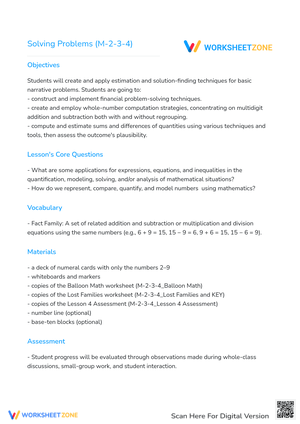
This is an educational worksheet titled 'Solving Problems (M-2-3-4)' focusing on financial problem-solving techniques, whole number computation strategies, and estimating sums and differences. It includes objectives for students to create and apply estimation and solution-finding techniques, construct financial problem-solving techniques, and employ computation strategies concentrating on multi-digit addition and subtraction. The worksheet includes core questions about the applications of expressions, equations, and inequalities. Vocabulary includes the definition of a 'Fact Family.' The materials section lists numeral cards (2-9), whiteboards, copies of 'Balloon Math,' 'Lost Families,' and 'Lesson 4 Assessment' worksheets, as well as optional number lines and base-ten blocks. Assessment will be based on observation during class discussions and group work.
Grade Level Suitability:
This worksheet is suitable for grades 2-4. The focus on multi-digit addition and subtraction, fact families, and financial problem-solving aligns with the curriculum standards for these grades. The inclusion of optional base-ten blocks and number lines suggests it can be adapted for students needing extra support.
Why Use It:
This worksheet helps students develop critical thinking and problem-solving skills in the context of financial literacy and number sense. It reinforces computation strategies, promotes estimation skills, and introduces the concept of fact families. It encourages the application of mathematical concepts to real-world situations.
How to Use It:
Begin by reviewing the objectives and core questions with the students. Use the numeral cards, whiteboards, and other provided materials to work through the 'Balloon Math,' 'Lost Families,' and 'Lesson 4 Assessment' worksheets. Encourage students to use estimation techniques and assess the plausibility of their answers. Observe student progress during whole-class discussions and small-group work.
Target Users:
This worksheet is designed for elementary school teachers and students in grades 2-4 who are learning about addition, subtraction, financial literacy, and problem-solving. It is also beneficial for homeschooling parents who are looking for structured math activities.