




























Views
Downloads

Printable Solving Equations with Brackets | Grade 10 Math

Paste this activity's link or code into your existing LMS (Google Classroom, Canvas, Teams, Schoology, Moodle, etc.).
Students can open and work on the activity right away, with no student login required.
You'll still be able to track student progress and results from your teacher account.
This algebra worksheet provides targeted practice for solving linear equations that include brackets. Students apply the distributive property to expand expressions, simplify terms, and isolate the variable. This resource builds essential algebraic fluency required for higher-level mathematics and complex problem-solving.
At a Glance
- Grade: 10 · Subject: Algebra
- Standard:
HSA-REI.B.3— Solve linear equations and inequalities in one variable- Skill Focus: Expanding brackets and solving for x
- Format: 3 pages · 34 problems · Answer key included · PDF
- Best For: Independent practice and skill reinforcement
- Time: 25–35 minutes
This comprehensive three-page packet includes 34 distinct equation-solving tasks. The problems are formatted with ample workspace beneath each equation, allowing students to clearly show their step-by-step expansion and simplification process. The resource progresses from basic single-bracket equations to more advanced problems requiring students to combine like terms after distributing. A complete answer key is included to support quick grading and immediate student feedback.
The problem sets are structured to support a gradual release of responsibility:
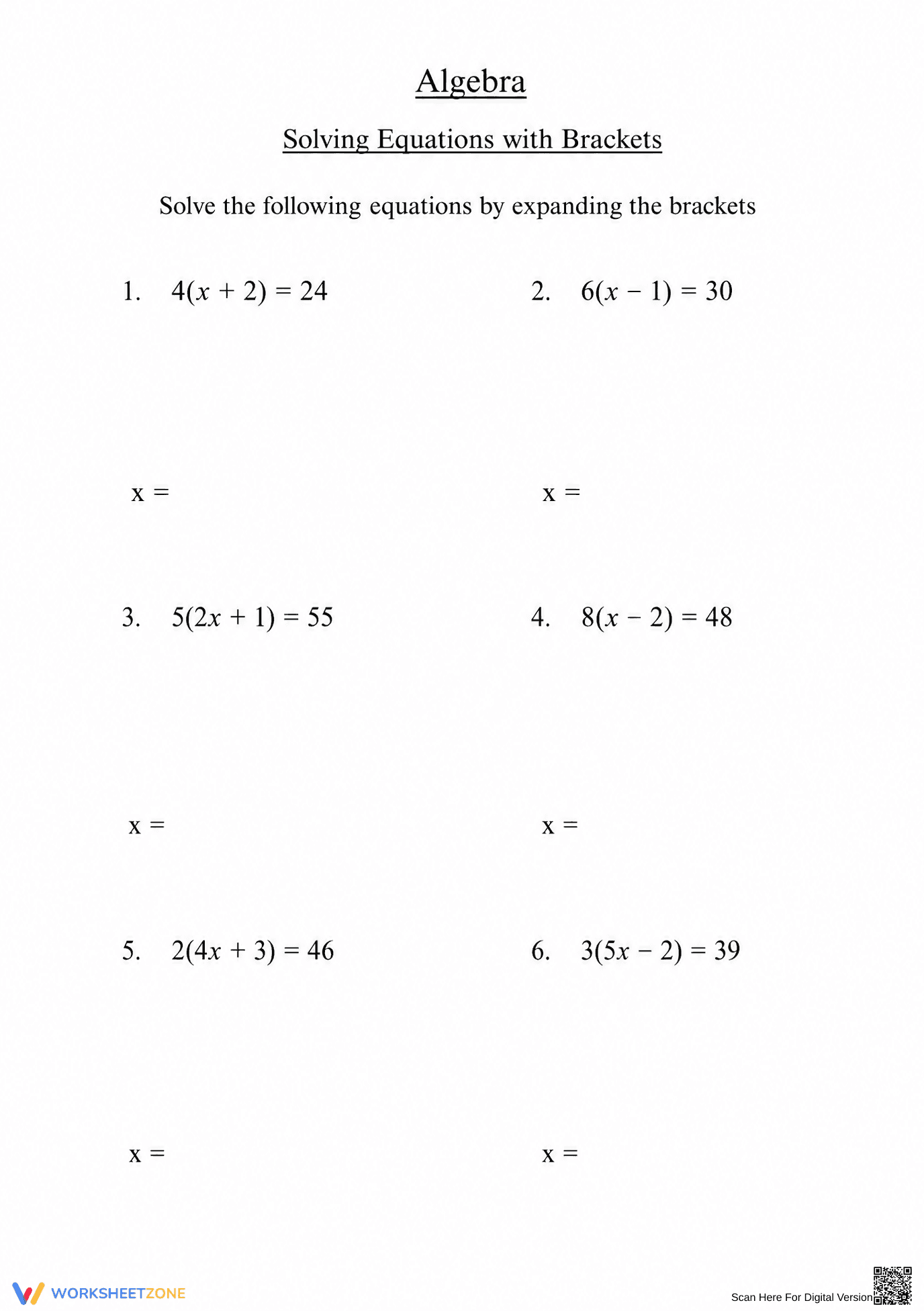
- Guided practice: The first page features 6 straightforward equations where students practice the basic application of the distributive property.
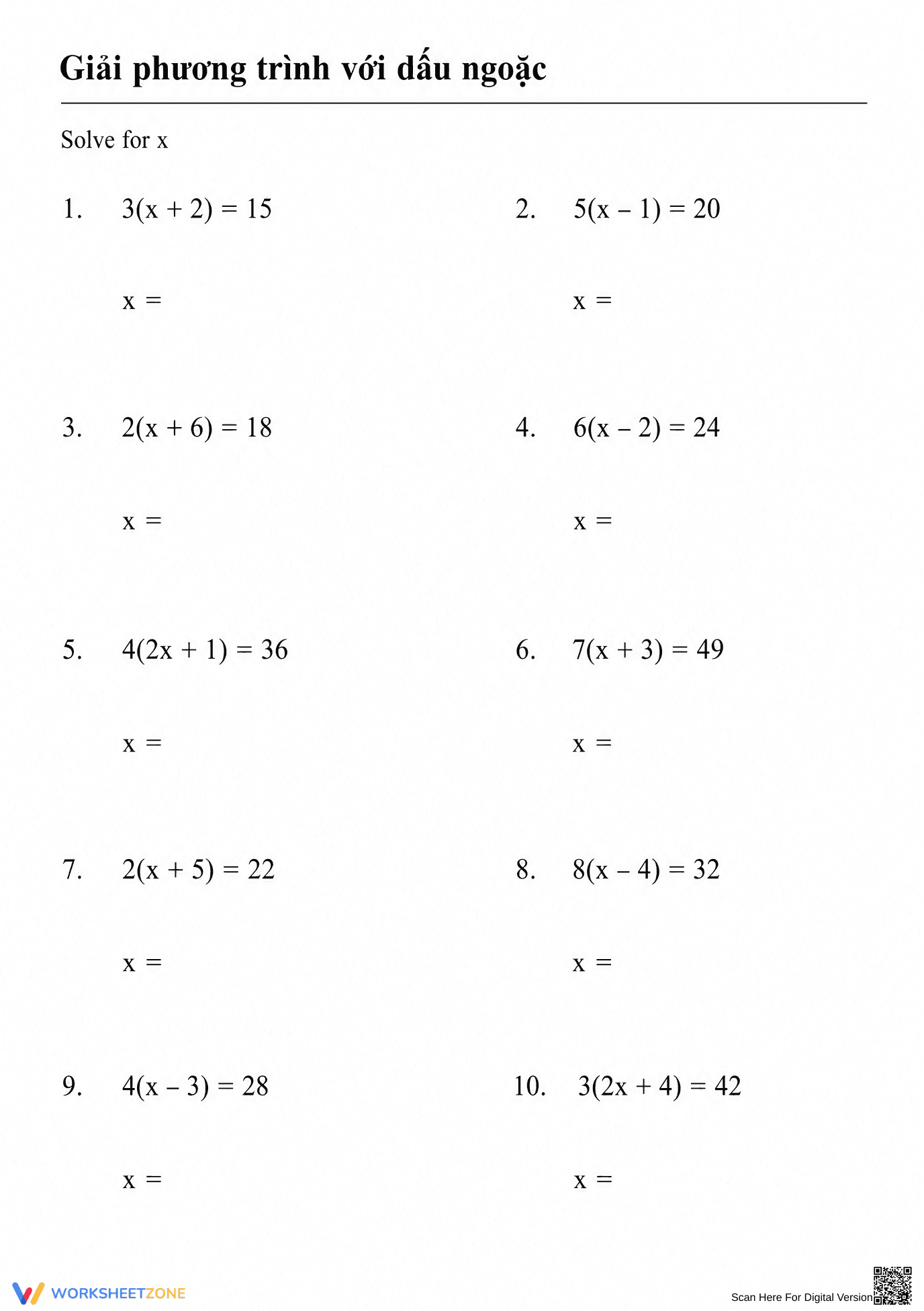
- Supported practice: The second page offers 10 additional problems, reinforcing the core skill with slightly varied numerical values to build confidence.
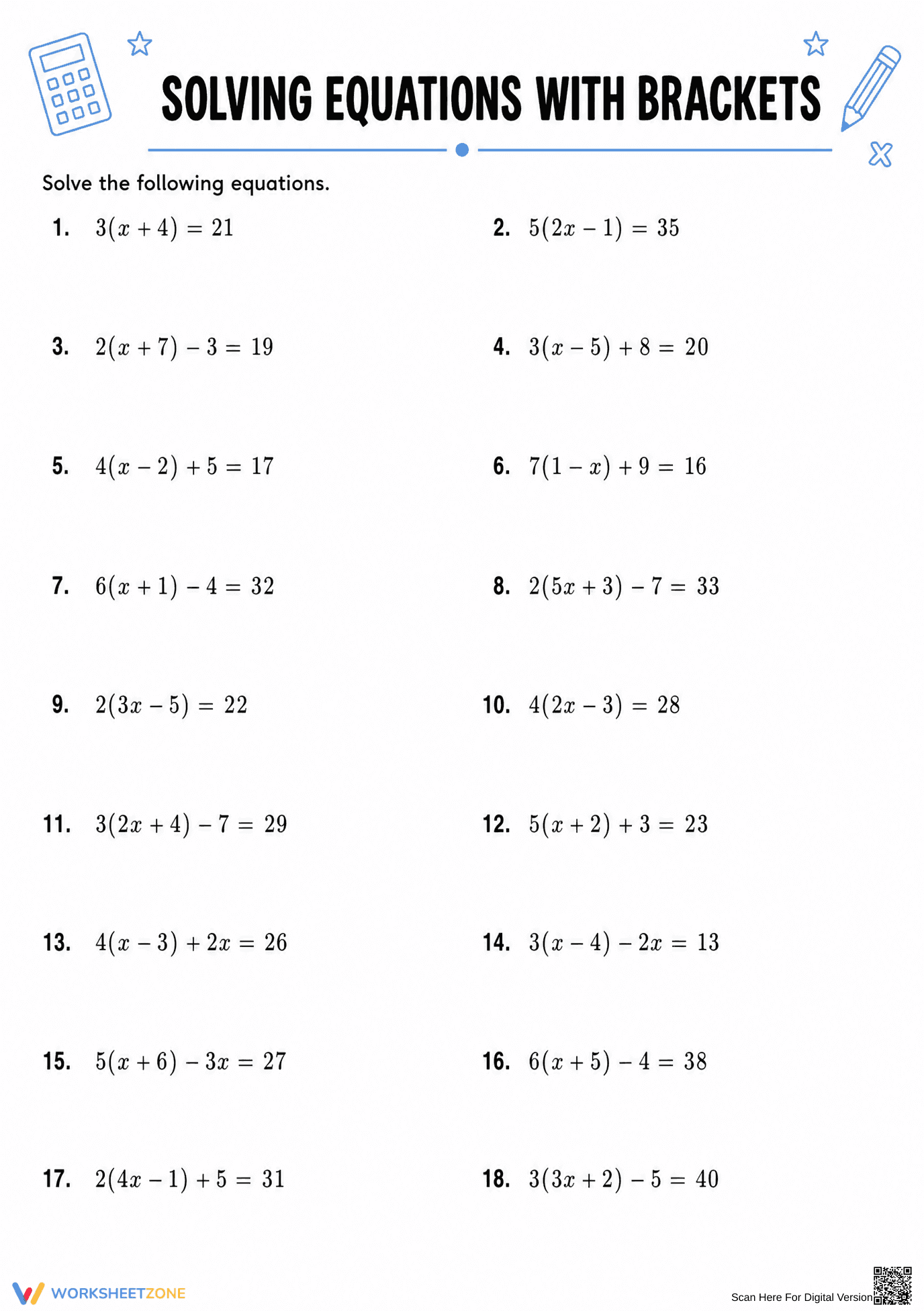
- Independent practice: The final page challenges students with 18 complex equations that include additional terms outside the brackets, requiring multi-step simplification.
This I Do, We Do, You Do approach ensures students master the fundamental mechanics before tackling rigorous algebraic challenges.
This material is directly aligned with HSA-REI.B.3: "Solve linear equations and inequalities in one variable, including equations with coefficients represented by letters." It also supports foundational middle school standards regarding the distributive property and order of operations. Both standard codes can be copied directly into lesson plans, IEP goals, or district curriculum mapping tools.
Teachers can deploy this worksheet during the independent practice phase of a lesson on the distributive property. It also serves as an excellent homework assignment or review packet. While students work, educators should observe whether they correctly multiply the outside term by every term inside the bracket. The progressive nature of the pages allows the assignment to be split across multiple days, taking 25 to 35 minutes to complete.
This resource is designed for high school algebra students, specifically those in tenth grade who need to solidify their equation-solving mechanics. The clear, uncluttered layout makes it highly accessible for students requiring visual accommodations or those who benefit from structured workspace. It pairs perfectly with introductory direct instruction on algebraic properties or a visual anchor chart detailing the steps of distribution.
Mastering the distributive property is a critical gateway skill for advanced algebraic reasoning and overall mathematical proficiency. This resource aligns directly with HSA-REI.B.3, ensuring students can solve linear equations and inequalities in one variable with accuracy and confidence. According to Fisher & Frey (2014), providing structured, progressive practice opportunities significantly improves long-term retention of multi-step mathematical procedures. By breaking down the process of expanding brackets and isolating variables into manageable, repeated tasks, students develop the procedural fluency necessary for higher-level mathematics. The clear progression from simple distribution to complex, multi-term equations supports cognitive load management, allowing learners to focus on one operational rule at a time without becoming overwhelmed. This targeted, evidence-based approach reduces mathematical anxiety and builds the automaticity required for success in subsequent STEM coursework, district benchmarks, and standardized assessments.


