


























Views
Downloads

Printable Compound Inequalities Worksheet | Grade 9 Algebra
Paste this activity's link or code into your existing LMS (Google Classroom, Canvas, Teams, Schoology, Moodle, etc.).
Students can open and work on the activity right away, with no student login required.
You'll still be able to track student progress and results from your teacher account.
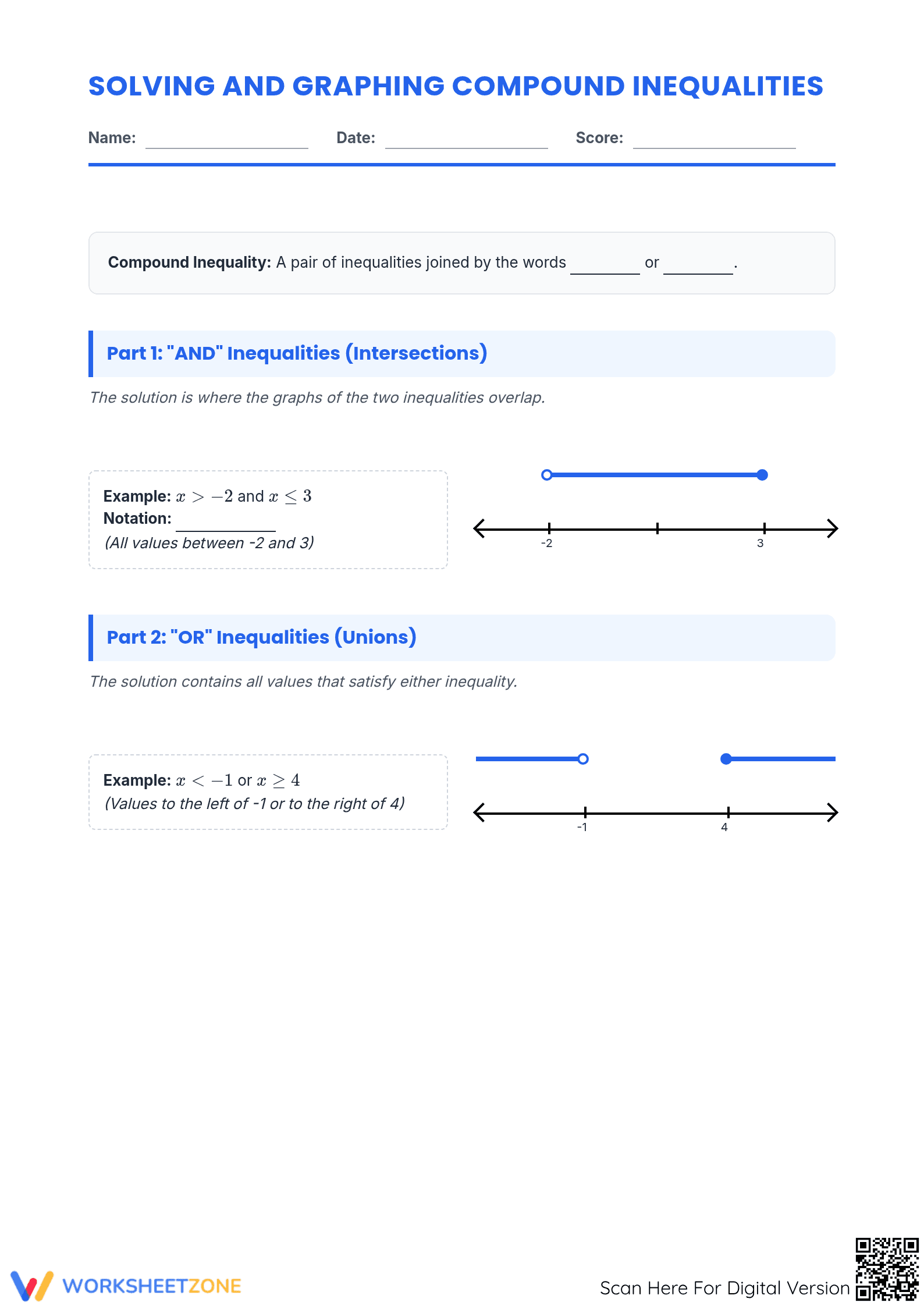
This Algebra 1 worksheet provides a complete instructional path for solving and graphing compound inequalities involving intersections (AND) and unions (OR). Students first engage with clear definitions and visual examples before progressing through guided and independent practice tasks. By the end of this activity, learners will confidently translate complex algebraic statements onto interactive number line graphs.
At a Glance
- Grade: 9–12 · Subject: Algebra
- Standard:
HSA.REI.B.3— Solve linear inequalities in one variable including compound AND and OR statements- Skill Focus: Solving and graphing compound inequalities
- Format: 3 pages · 6 problems · Answer key included · PDF
- Best For: High school algebra direct instruction and practice
- Time: 35–50 minutes
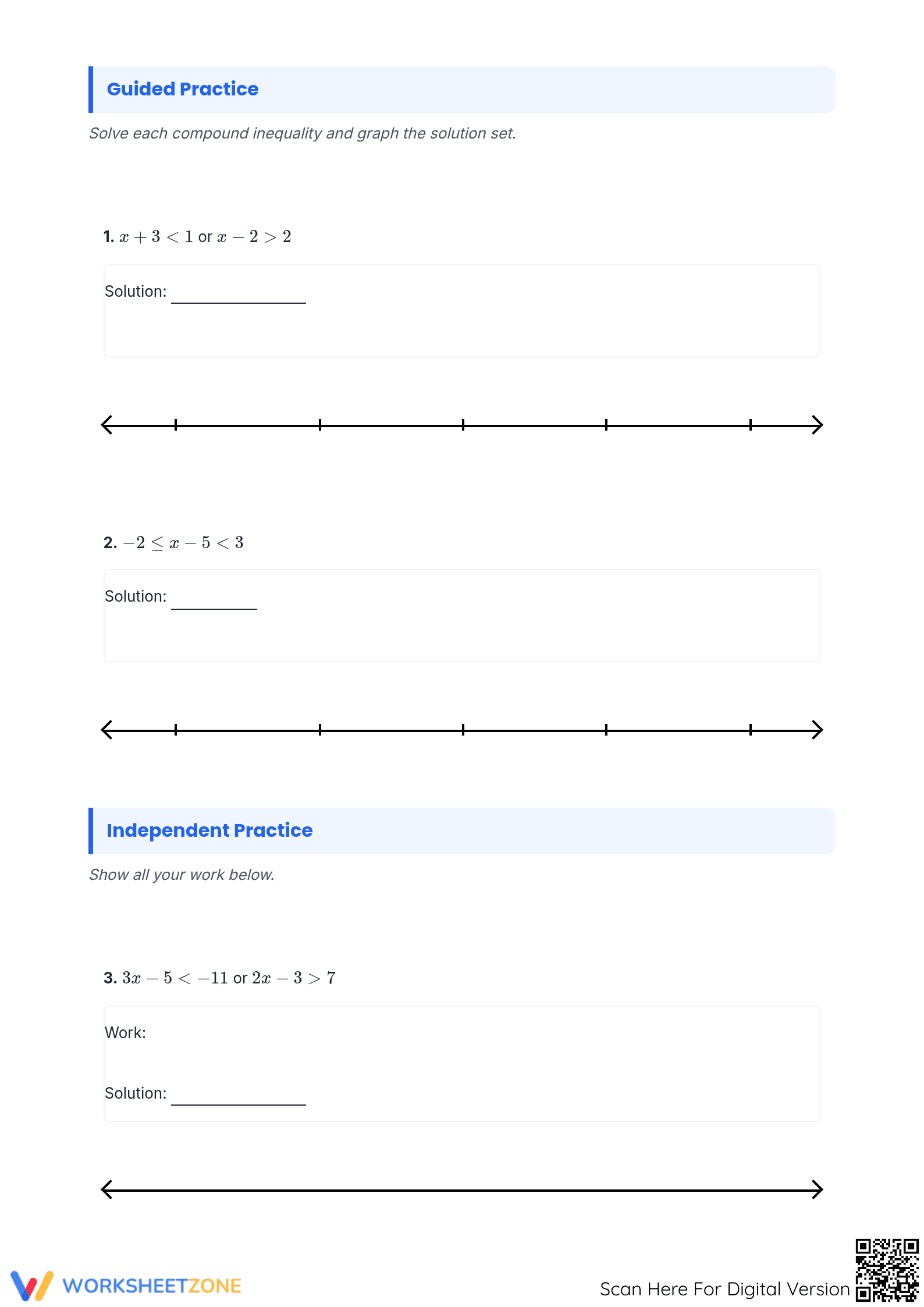
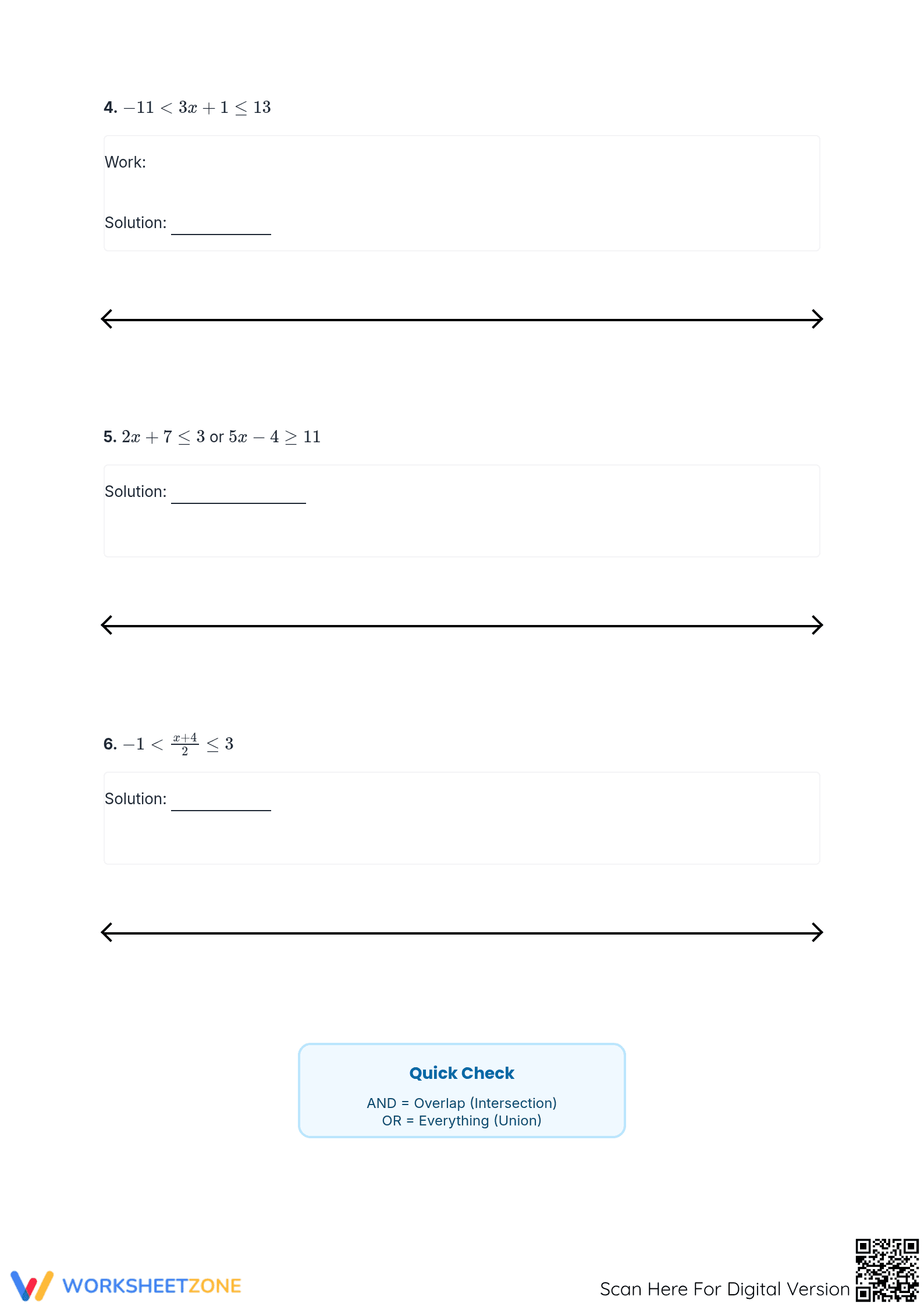
This comprehensive 3-page packet features a structured notes section, two guided practice problems, and four independent practice challenges. Each problem includes a dedicated work box and a corresponding number line for graphing solution sets. The layout ensures students account for both algebraic manipulation and visual representation. A full answer key is provided to facilitate rapid grading or student self-correction.
- Guided Practice: Two introductory problems allow students to solve for variables with immediate teacher support and visual scaffolding for both unions and intersections.
- Supported Practice: Mid-level challenges require students to handle multi-step inequalities and fractional components, building stamina for more complex algebraic operations.
- Independent Practice: Final problems demand complete mastery of logic and precise graphing techniques on empty number lines to demonstrate retention.
This instructional sequence follows a gradual-release framework to ensure student success during high-stakes algebra units.
This resource is meticulously aligned with HSA.REI.B.3, which requires students to solve linear equations and inequalities in one variable. It specifically addresses the nuance of compound statements, requiring learners to distinguish between overlapping intersections and divergent unions. This standard code can be copied directly into lesson plans, IEP goals, or district curriculum mapping tools.
Assign this worksheet during the guided practice phase of a lesson on linear inequalities. For a formative assessment observation, walk the room while students work on problem #3 to check if they correctly flip inequality signs when dividing by negatives. The total completion time typically ranges from 35 to 50 minutes depending on prior student knowledge of simple inequalities. It serves as an excellent check for understanding before moving toward systems of equations.
Designed for high school Algebra 1 students, this resource is ideal for whole-class instruction or targeted small-group intervention. It pairs naturally with a digital graphing calculator or a coordinate plane anchor chart to help students visualize the relationship between algebraic solutions and physical space. Teachers may also use it as a reliable sub plan for secondary mathematics classrooms.
Solving and graphing compound inequalities using HSA.REI.B.3 is a fundamental skill that bridges basic variable isolation with complex function analysis in higher mathematics. This worksheet facilitates the development of algebraic reasoning by requiring students to simultaneously manage symbolic manipulation and visual representation. According to Fisher & Frey (2014), the use of scaffolded guided practice followed by independent application is critical for developing mathematical fluency in secondary learners. By providing dedicated space for work and solution alongside number line graphs, this resource reduces cognitive load while ensuring students meet the rigorous demands of the Common Core State Standards. The inclusion of both AND and OR scenarios forces students to engage in higher-order comparative thinking rather than rote procedure. Educational research suggests that integrating multiple representations significantly improves long-term retention of mathematical concepts among diverse student populations in high school settings.


