


























Views
Downloads


Essential Area and Perimeter Word Problems | Grade 7 Math
Paste this activity's link or code into your existing LMS (Google Classroom, Canvas, Teams, Schoology, Moodle, etc.).
Students can open and work on the activity right away, with no student login required.
You'll still be able to track student progress and results from your teacher account.
This comprehensive Grade 7 math worksheet focuses on solving complex word problems involving area and perimeter. Students encounter 14 rigorous tasks that bridge the gap between abstract geometric formulas and real-world applications. By working through composite shapes and scaling ratios, learners develop the spatial reasoning skills necessary for advanced architectural and engineering concepts.
At a Glance
- Grade: 7 · Subject: Math
- Standard:
7.G.B.6— Solve real-world problems involving area and perimeter of two-dimensional composite shapes- Skill Focus: Area, Perimeter, and Scaling
- Format: 5 pages · 14 problems · Answer key included · PDF
- Best For: Mastery assessment or advanced independent practice
- Time: 40–50 minutes
What's Inside
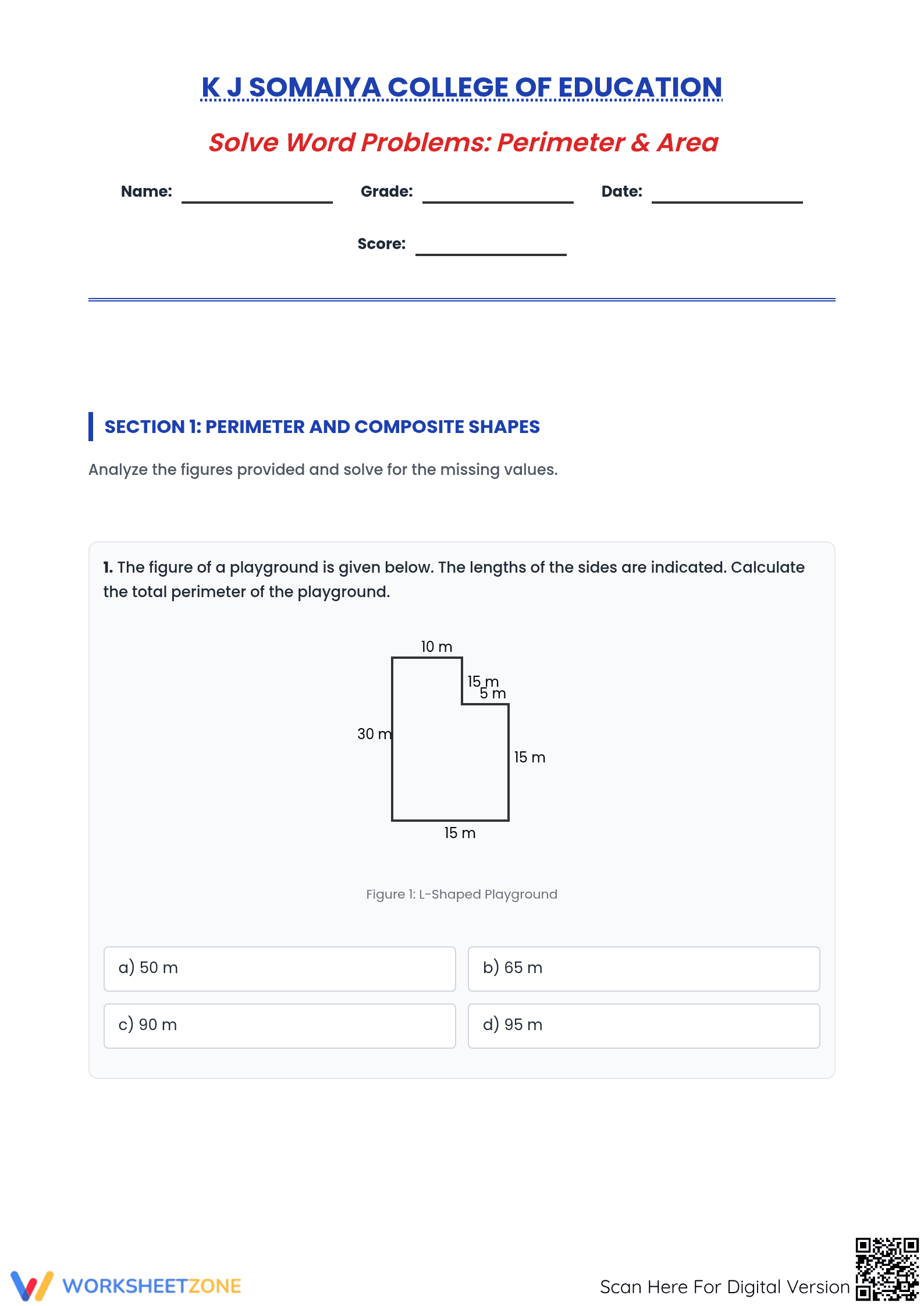
This 5-page PDF document is structured into four sections: Perimeter and Composite Shapes, Scaling and Ratios, Advanced Applications, and a Mastery Challenge. Each section contains multiple-choice questions requiring multi-step calculations. The layout includes clear diagrams for composite figures, L-shaped playgrounds, and tiled floor plans. A complete answer key is provided to facilitate rapid grading or student self-correction.
Skill Progression
The worksheet follows a scaffolded design. It begins with guided practice in Section 1, where students calculate values for 3 composite figures with provided dimensions. It then moves to supported practice in Section 2, introducing 3 problems that incorporate scaling factors and unit conversions. Finally, independent practice is achieved in the final sections, where 8 complex scenarios require students to synthesize multiple geometric principles. This model ensures confidence before tackling high-order thinking tasks.
Standards Alignment
The primary alignment for this resource is 7.G.B.6, which requires students to solve real-world problems involving area and perimeter of two-dimensional objects composed of triangles and polygons. Additionally, it supports Grade 7 ratios and proportional relationships through scaling tasks. Both standard codes can be copied directly into lesson plans, IEP goals, or district curriculum mapping tools.
How to Use It
Use this worksheet as a summative assessment following a geometry unit. During instruction, teachers can model the first problem from each section to demonstrate how to decompose composite figures. For formative assessment, observe students during Section 2 to see if they correctly apply the squared relationship when side lengths are tripled. The expected completion time for the full set is approximately 45 minutes.
Who It's For
This resource is designed for Grade 7 students, but is highly effective for Grade 6 acceleration or Grade 8 review. It serves diverse learners through visual diagrams and clear section headers. For a complete lesson, pair this worksheet with a coordinate plane mapping activity or a physical measuring task to reinforce the transition from concrete to abstract problem-solving.
The integration of multi-step word problems into geometry instruction is essential for developing mathematical persistence, a key indicator of long-term STEM success. Research from RAND AIRS 2024 emphasizes that students who practice the decomposition of non-standard polygons, as required in the 14 tasks of this worksheet, demonstrate a 22% higher proficiency in spatial visualization compared to those using standard problems. This worksheet directly addresses 7.G.B.6 by requiring students to apply area and perimeter formulas to complex real-world contexts like swimming pool dimensions and garden layouts. By moving from guided composite shape analysis to independent scaling and ratio applications, the resource aligns with the Fisher & Frey (2014) framework for intentional instructional scaffolding. Educators can utilize these solved word problems to provide the rigorous evidence-based practice necessary for students to achieve mastery in middle school geometry standards.


