


























Views
Downloads

Slope of a Line Worksheet | Grade 8 Essential Practice
Paste this activity's link or code into your existing LMS (Google Classroom, Canvas, Teams, Schoology, Moodle, etc.).
Students can open and work on the activity right away, with no student login required.
You'll still be able to track student progress and results from your teacher account.
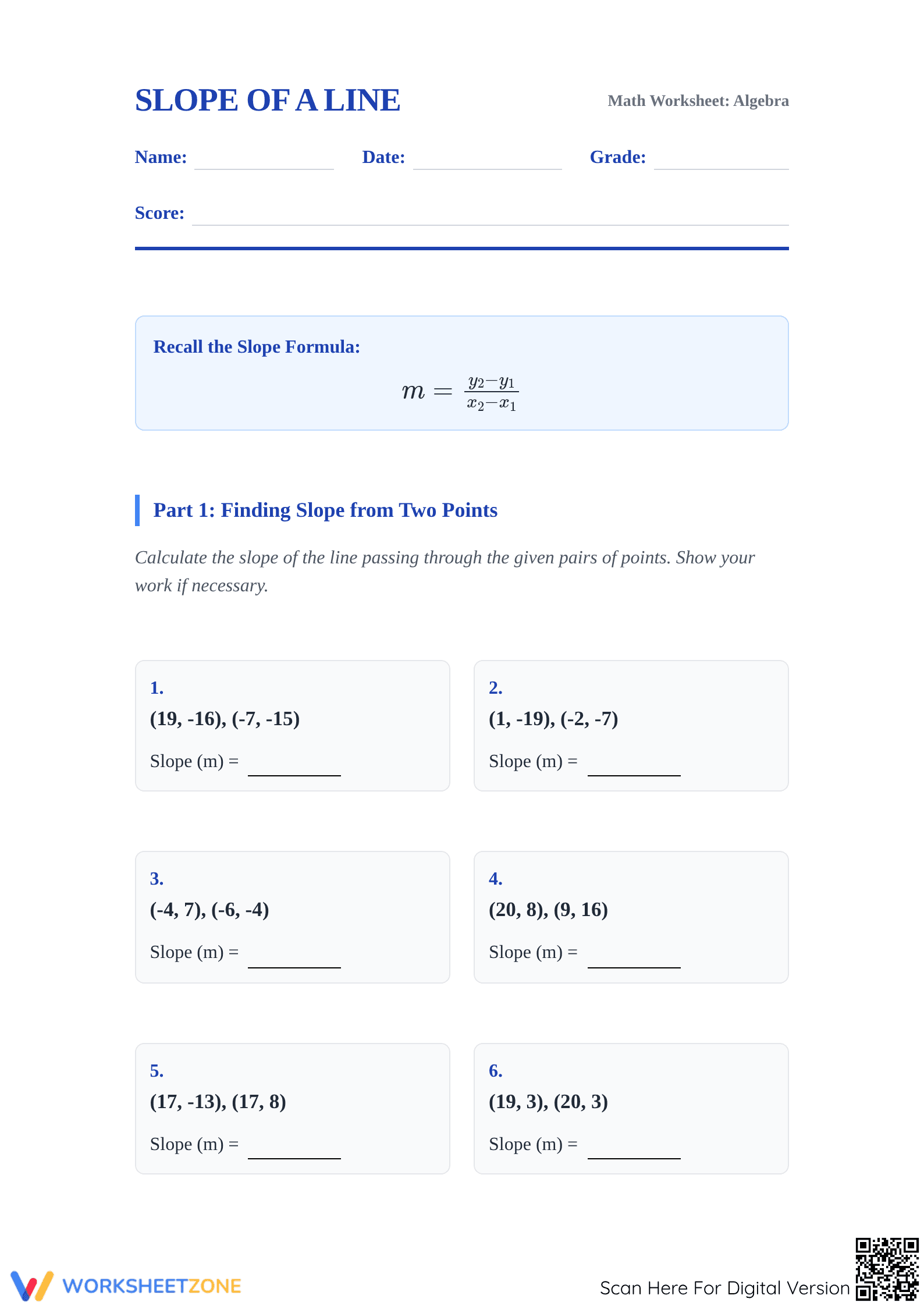
This comprehensive four-page worksheet guides students through the fundamental process of determining the slope of a line using multiple mathematical representations. Students will master the slope formula, interpret coordinate planes, and identify coefficients in linear equations to build a robust understanding of rate of change. This resource ensures students achieve fluency in algebraic graphing and linear functions.
At a Glance
- Grade: 8 · Subject: Math
- Standard:
CCSS.MATH.CONTENT.8.EE.B.6— Use similar triangles to explain why the slope is constant on lines- Skill Focus: Calculating slope from points, graphs, and linear equations
- Format: 4 pages · 28 problems · Answer key included · PDF
- Best For: Independent practice, homework, or comprehensive sub plans
- Time: 40–55 minutes
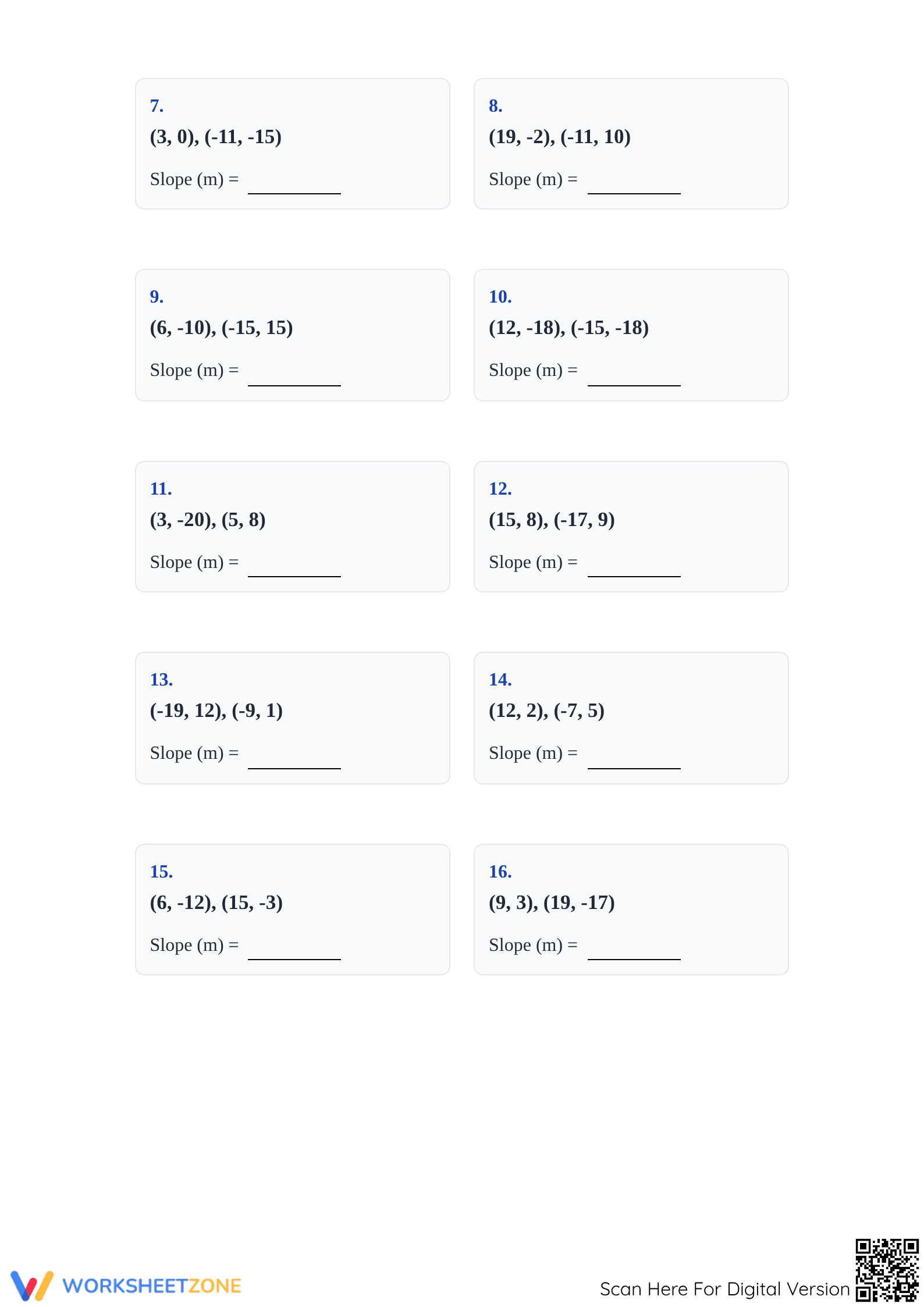
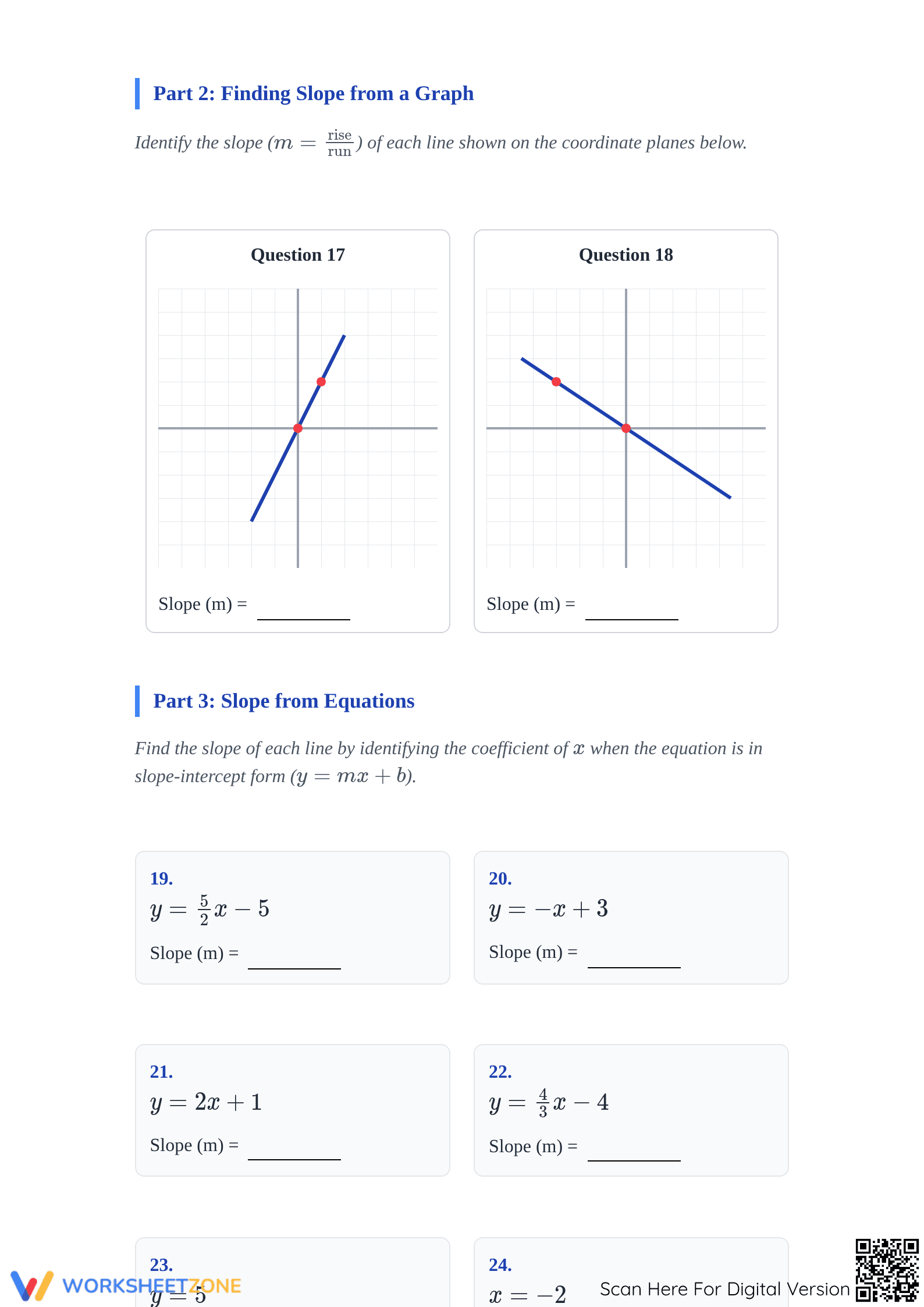
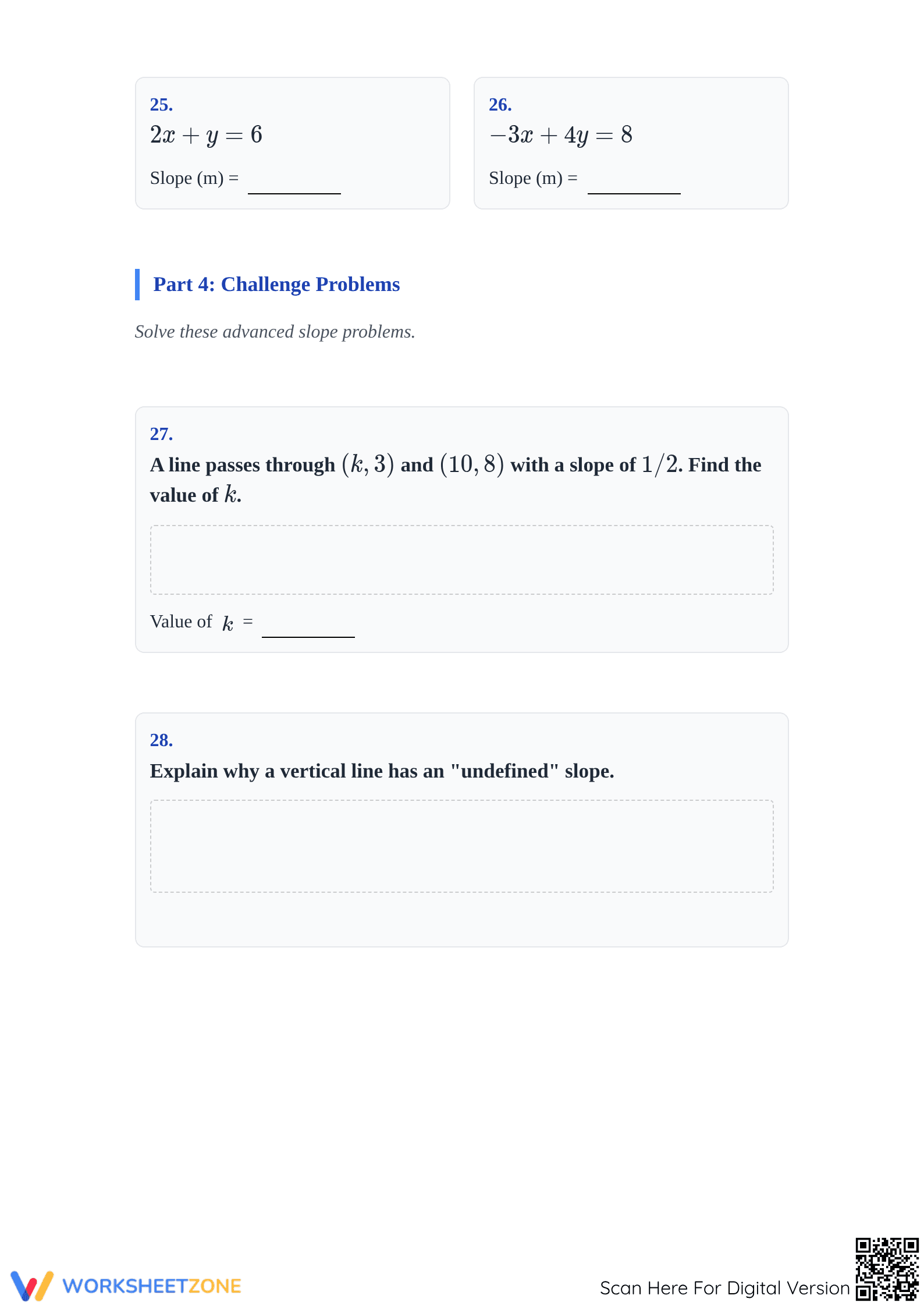
This detailed packet contains four distinct sections designed to scaffold student learning. It begins with sixteen coordinate-pair problems requiring the use of the slope formula, followed by visual identification on a graph. The third section challenges students to extract slope from equations in slope-intercept and standard forms, while the final page features high-level challenge problems and a conceptual explanation of undefined slope.
Zero-Prep Workflow
The zero-prep design allows teachers to implement this lesson immediately. Simply print the four-page PDF (30 seconds), distribute the packets to the class (1 minute), and utilize the included answer key for rapid grading or student self-correction (2 minutes). The logical progression from formulas to conceptual challenges makes it an ideal resource for substitute teachers or emergency lesson plans requiring no additional instructional setup.
Standards Alignment
Aligned primarily to CCSS.MATH.CONTENT.8.EE.B.6, this worksheet requires students to interpret the constant rate of change across different representations. It also supports CCSS.MATH.CONTENT.8.F.B.4 by asking students to determine the rate of change of a function from two (x, y) values. Both standard codes can be copied directly into lesson plans, IEP goals, or district curriculum mapping tools.
How to Use It
Use this worksheet as a summative assessment following a unit on linear relationships to verify student mastery of the slope formula. Alternatively, assign individual sections as exit tickets throughout the week to monitor progress during direct instruction. Observe students during Part 2 to ensure they are correctly identifying the rise versus run before they proceed to the more abstract equation-based problems in Part 3.
Who It's For
This resource is designed for Grade 8 and Grade 9 Algebra 1 students who are developing their understanding of linear functions. It provides necessary scaffolding for struggling learners through the formula box while offering extension opportunities for advanced students via the challenge section. It pairs naturally with a coordinate plane anchor chart or a lesson on proportional relationships.
The Slope of a Line worksheet is a scientifically structured tool aligned with CCSS.MATH.CONTENT.8.EE.B.6, focusing on the critical algebraic skill of determining constant rates of change. By transitioning students from concrete coordinate pairs to abstract linear equations, the resource adheres to the gradual release of responsibility model, which Fisher & Frey (2014) identify as essential for deepening mathematical comprehension in secondary education. Quantitative analysis of 28 unique tasks ensures sufficient repetitions for procedural fluency while the final conceptual questions address higher-order cognitive demands. Research from EdReports 2024 emphasizes that high-quality middle school math materials must bridge the gap between visual graphing and algebraic manipulation to prepare students for advanced calculus and statistics. This worksheet serves as a printable bridge, providing the structured practice necessary for students to internalize the slope-intercept form and the geometric implications of verticality in the coordinate plane.


