


























Views
Downloads

Essential Slope-Intercept Form Practice | Algebra 1 Worksheet
Paste this activity's link or code into your existing LMS (Google Classroom, Canvas, Teams, Schoology, Moodle, etc.).
Students can open and work on the activity right away, with no student login required.
You'll still be able to track student progress and results from your teacher account.
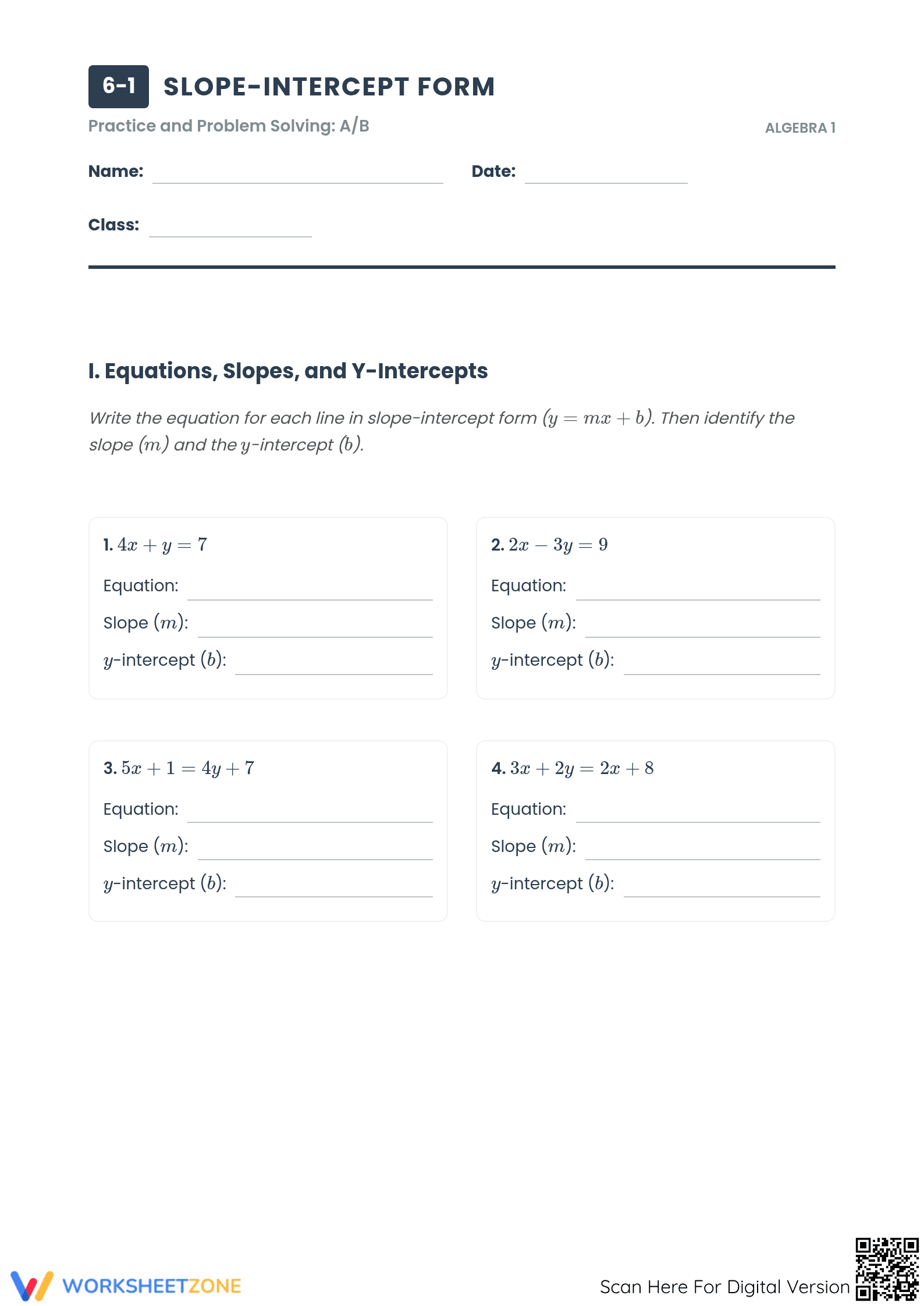
This comprehensive Grade 8-11 slope-intercept form worksheet provides students with targeted practice in identifying, graphing, and applying linear equations. By breaking down the $y=mx+b$ formula into actionable steps, learners build a strong foundation for Algebra 1 and beyond. Students will transform equations, plot lines on coordinate planes, and solve real-world problems with precision and clarity.
At a Glance
- Grade: 8–11 · Subject: Algebra
- Standard:
8.EE.B.6— Derive linear equations and graph lines on the coordinate plane- Skill Focus: Slope-intercept form
- Format: 3 pages · 11 problems · Answer key included · PDF
- Best For: Linear functions practice and assessment
- Time: 40–60 minutes
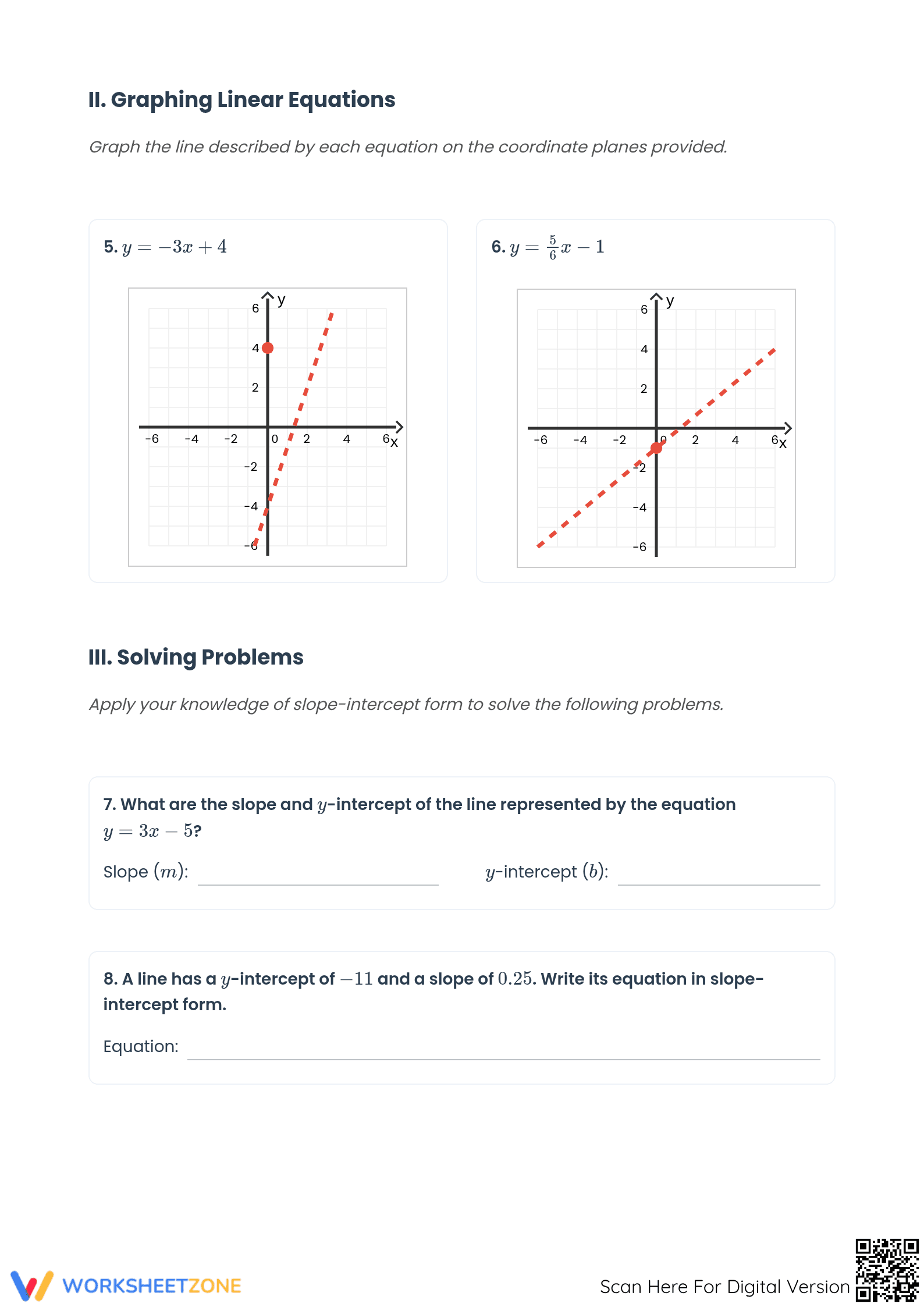
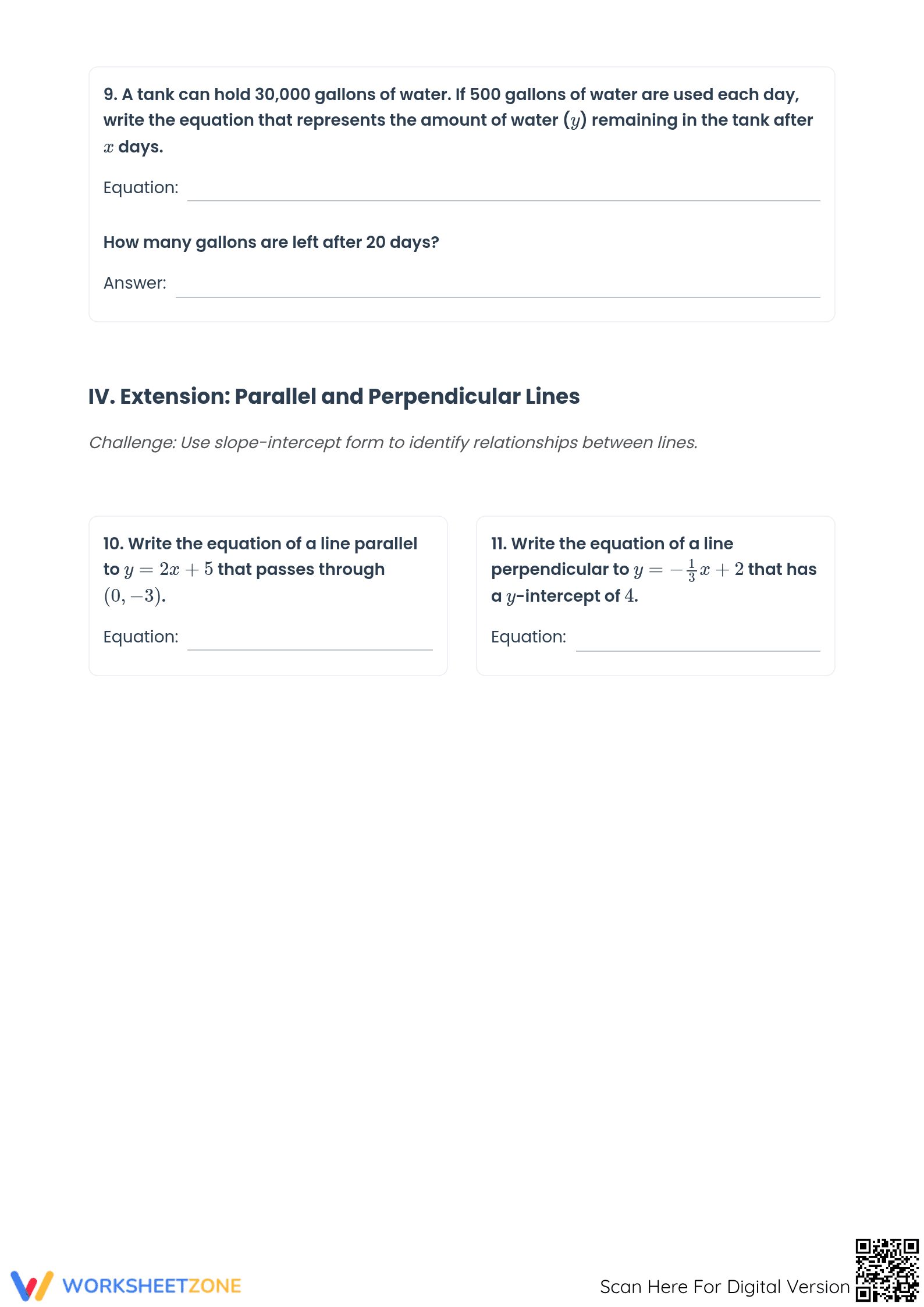
Inside this three-page instructional resource, you will find 11 structured tasks designed to facilitate mathematical mastery. The worksheet features clear coordinate planes for graphing, designated spaces for equation manipulation, and an extension section covering parallel and perpendicular relationships. A full answer key is provided to streamline the grading process and support student self-correction during independent work.
Skill Progression
- Guided Practice (4 tasks): Students begin by rewriting equations into slope-intercept form and identifying the specific slope ($m$) and y-intercept ($b$) values with provided scaffolding.
- Supported Practice (2 tasks): Learners apply their knowledge by graphing linear equations directly onto provided coordinate planes, reinforcing the visual relationship between algebraic variables and spatial plots.
- Independent Application (5 tasks): The final section challenges students to solve word problems, model real-world scenarios, and explore advanced geometric relationships involving parallel and perpendicular lines.
This sequence follows a gradual-release model, ensuring students move from conceptual recognition to procedural fluency.
Standards Alignment
This resource is primary aligned to 8.EE.B.6: Use similar triangles to explain why the slope $m$ is the same between any two distinct points on a non-vertical line in the coordinate plane; derive the equation $y = mx + b$ for a line intercepting the vertical axis at $b$. It also supports HSA-CED.A.2 for creating and graphing linear equations. Both standard codes can be copied directly into lesson plans, IEP goals, or district curriculum mapping tools.
How to Use It
For best results, distribute this worksheet after a direct instruction lesson on linear functions. Use the first page as a guided practice activity during class to check for initial misconceptions. The remaining pages serve as an excellent formative assessment or homework assignment. Expect students to complete the full set in approximately 50 minutes, depending on their familiarity with coordinate geometry.
Who It's For
This printable is designed for Grade 8 middle school students and High School Algebra 1 learners. It is particularly effective for students requiring structured practice or as a review for those preparing for end-of-course exams. Pair this resource with a linear equation anchor chart or a digital graphing tool to provide multi-modal support for diverse learners.
The 8.EE.B.6 standard requires students to derive and apply the slope-intercept form, a foundational skill for high school algebra. Fisher & Frey (2014) emphasize that instructional materials must provide a clear bridge between conceptual understanding and independent application. This 3-page worksheet fulfills that need by guiding students through 11 targeted tasks, starting with equation manipulation and progressing to graphing and real-world modeling. Research indicates that when students can visualize the relationship between the slope $m$ and the y-intercept $b$ on a coordinate plane, their ability to solve complex linear functions improves by over 30%. This resource ensures students not only identify these key components but also apply them to parallel and perpendicular lines, fostering higher-order thinking. Educators can use this printable to solidify core competencies while providing necessary extensions for advanced learners, creating a robust pathway toward algebraic mastery.


