


























Views
Downloads
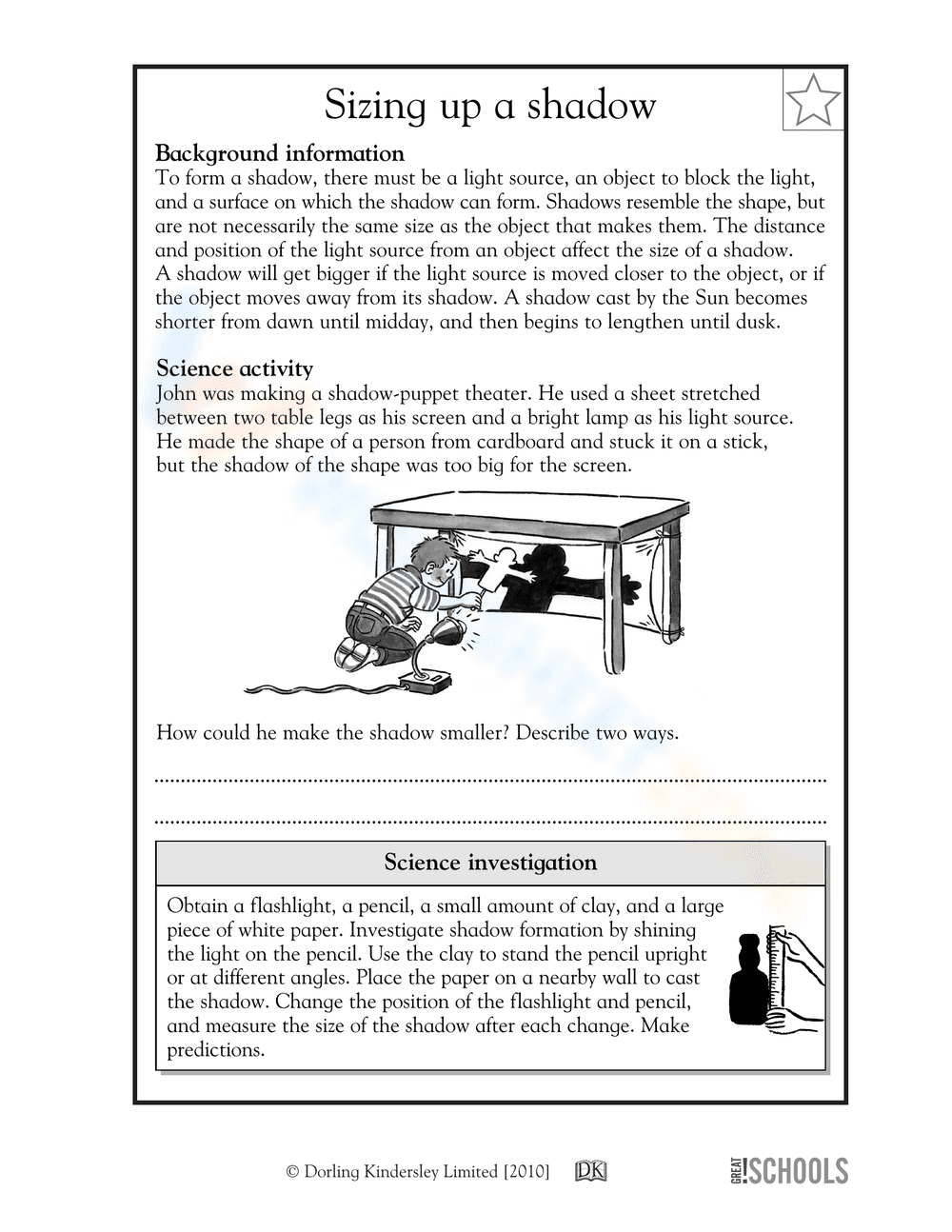


Printable Shadow Size Worksheet | Grade 5 Science
Paste this activity's link or code into your existing LMS (Google Classroom, Canvas, Teams, Schoology, Moodle, etc.).
Students can open and work on the activity right away, with no student login required.
You'll still be able to track student progress and results from your teacher account.
This Grade 5 physical science worksheet helps students understand how light sources interact with objects to create and change shadows. By reading background information and applying it to a real-world scenario, learners will discover how the distance and angle of a light source directly affect a shadow's size and shape.
At a Glance
- Grade: 5 · Subject: Science
- Standard:
5-ESS1-2— Identify patterns in the length and direction of shadows- Skill Focus: Shadow formation and size manipulation
- Format: 2 pages · 2 tasks · Answer key included · PDF
- Best For: Hands-on science practice
- Time: 20–30 minutes
What's Inside
This resource features a comprehensive reading passage explaining the mechanics of shadow formation, followed by two distinct application tasks. Students first analyze a shadow-puppet theater scenario to determine how to reduce a shadow's size. Then, they follow clear instructions for a hands-on science investigation using simple classroom materials like a flashlight and pencil. An answer key is provided for easy grading.
Skill Progression
- Guided Reading: Students begin by reading a short, informative text explaining the relationship between light sources, objects, and shadow size.
- Supported Practice: Learners apply their new knowledge to a practical word problem, describing two specific ways a character can make a shadow puppet smaller.
- Independent Investigation: Students conduct a hands-on experiment to measure and predict shadow changes, following a gradual-release model that moves from theory to active scientific inquiry.
Standards Alignment
Aligned to 5-ESS1-2: Represent data in graphical displays to reveal patterns of daily changes in length and direction of shadows, day and night, and the seasonal appearance of some stars in the night sky. This worksheet specifically targets the foundational understanding of how light distance and angle manipulate shadow length, preparing students for broader astronomical observations. Standard codes can be copied into lesson plans.
How to Use It
Use this worksheet during a physical science or Earth science unit on light and shadows. It serves as an excellent station activity where small groups can read the text and immediately perform the flashlight investigation. Alternatively, assign the reading and puppet theater question as independent classwork, using the hands-on investigation as a teacher-led demonstration. As a formative assessment tip, observe students during the investigation to ensure they accurately measure the shadow's length as the angle of the flashlight changes. Expected completion time is 20 to 30 minutes.
Who It's For
This resource is designed for fifth-grade general education science students, but it is also highly effective for visual and kinesthetic learners who benefit from hands-on experiments. The clear, step-by-step investigation instructions provide built-in scaffolding for students who need structured guidance. It pairs perfectly with a direct instruction lesson on the sun's movement across the sky and its effect on shadow lengths throughout the day.
Understanding the mechanics of light and shadows is a critical component of elementary science education that bridges the gap between abstract physics and observable daily phenomena. Aligned with 5-ESS1-2, this resource helps students identify patterns in the length and direction of shadows through direct observation and hands-on inquiry. Integrating physical manipulatives and active investigations into science worksheets significantly increases student retention of abstract physics concepts compared to traditional reading assignments alone. When students physically manipulate the distance and angle of a light source, they build a stronger cognitive map of spatial relationships. By combining clear informational text with a practical, low-prep experiment, this worksheet ensures learners move beyond rote memorization to achieve a genuine, experiential understanding of how light interacts with the physical world around them.


