


























Views
Downloads


Negative Exponents Practice Worksheet | Grade 8 Essential
Paste this activity's link or code into your existing LMS (Google Classroom, Canvas, Teams, Schoology, Moodle, etc.).
Students can open and work on the activity right away, with no student login required.
You'll still be able to track student progress and results from your teacher account.
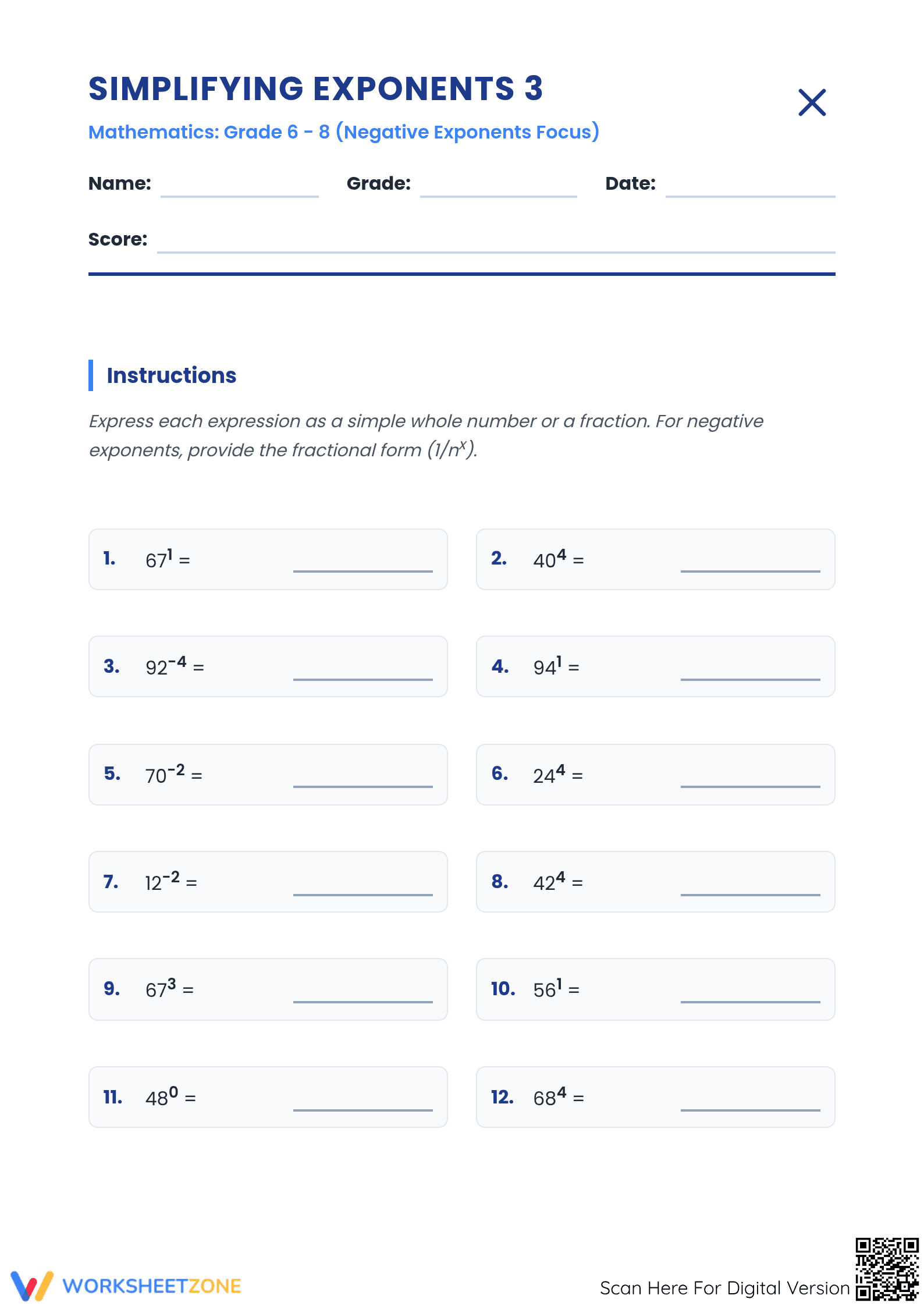
This comprehensive three-page worksheet helps middle school students master the often-confusing properties of integer exponents. By focusing specifically on negative and zero exponents, the resource ensures learners can confidently convert complex exponential expressions into simple whole numbers or fractions. Students transition from basic identification to solving mixed practice sets that build procedural fluency and conceptual depth.
At a Glance
- Grade: 8 · Subject: Mathematics
- Standard:
8.EE.A.1— Apply integer exponent properties to generate equivalent numerical expressions- Skill Focus: Negative and zero exponent simplification
- Format: 3 pages · 36 problems · Answer key included · PDF
- Best For: Independent practice and homework assignments
- Time: 25–40 minutes
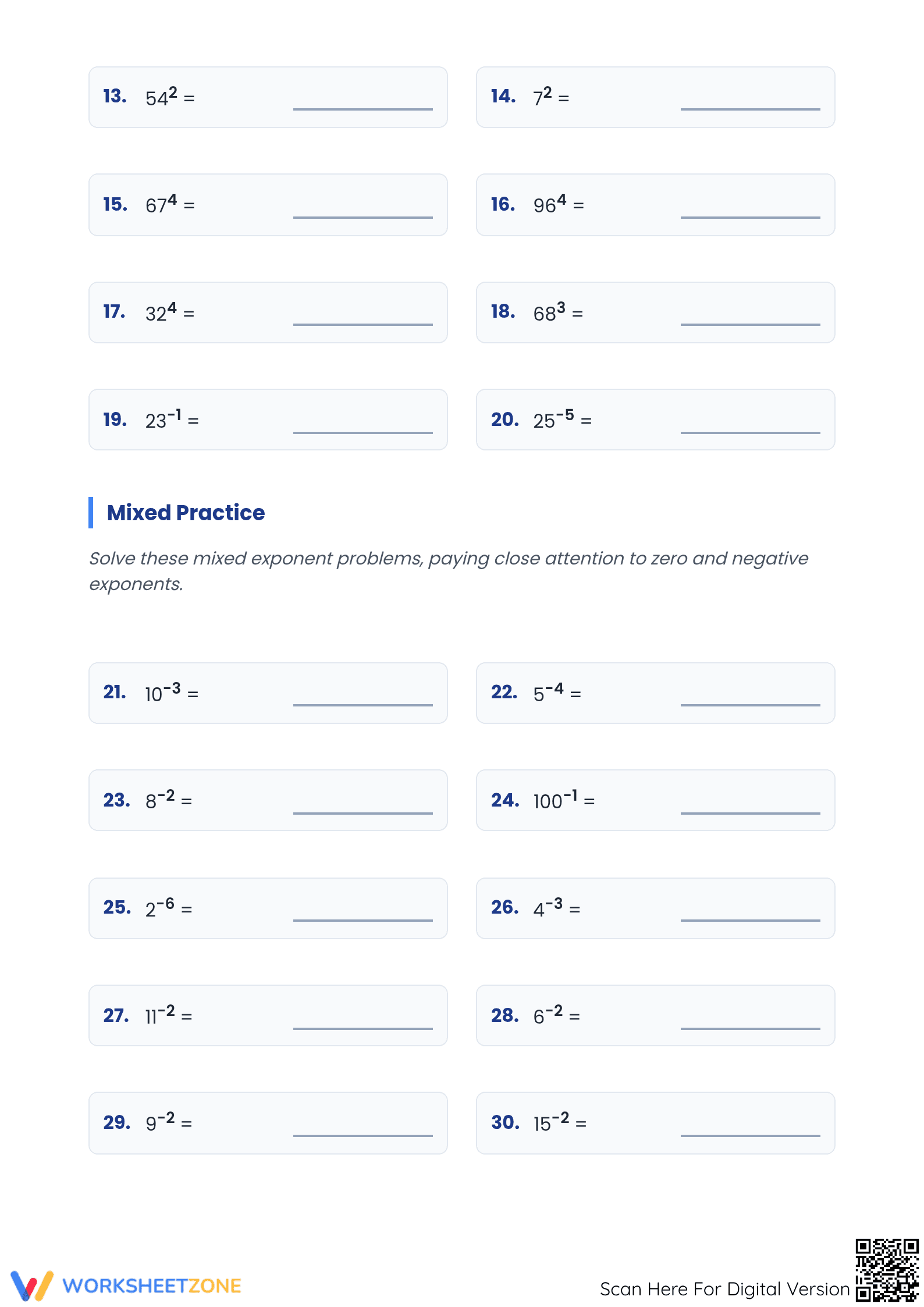
Inside this collection, you will find 36 unique practice problems distributed across three clear, uncluttered pages. The first section introduces basic simplification of positive, negative, and zero exponents. The second half features a 'Mixed Practice' section designed to challenge students' ability to differentiate between various exponent rules in a combined environment. A complete, high-resolution answer key is provided for immediate feedback and grading.
This resource is designed for an efficient classroom workflow that minimizes teacher overhead. First, print the three-page PDF (approximately 30 seconds). Second, distribute the packets to students for independent or partner work (1 minute). Third, use the included answer key to conduct a rapid whole-class review or for grading (5 minutes). Total preparation time remains under two minutes, making it an ideal sub-plan or ready-to-use lesson supplement.
The worksheet is rigorously aligned to `CCSS.MATH.CONTENT.8.EE.A.1`. This standard requires students to know and apply the properties of integer exponents to generate equivalent numerical expressions. By requiring expressions like 70^-2 to be converted into fractional forms like 1/70^2, this resource directly addresses the core requirements of the standard. This standard code can be copied directly into lesson plans, IEP goals, or district curriculum mapping tools.
Use this worksheet as a primary practice tool during the guided practice phase of a lesson on exponent properties. It works exceptionally well after a direct instruction session on the Zero Exponent Rule and Negative Exponent Rule. For formative assessment, observe students working on problems 21 through 30; if they struggle to flip the base for negative exponents, provide a quick anchor chart reminder to correct the misconception.
This resource is tailored for 8th-grade math students, though it serves as excellent remediation for high school algebra learners or enrichment for advanced 6th and 7th graders. It pairs naturally with a short informational passage or an anchor chart detailing exponent laws. The repetitive structure provides the necessary practice required for students to internalize these abstract mathematical conventions and move toward automaticity in algebraic manipulation.
Research from a 2024 ScienceDirect TpT Analysis emphasizes that targeted, high-repetition practice on specific mathematical pain points—such as negative exponents—is critical for long-term retention of algebraic concepts. By isolating the negative exponent property (8.EE.A.1) within 36 structured tasks, this worksheet prevents the cognitive overload often associated with multi-rule math packets. The transition from simple whole-number bases to fractional outputs requires students to engage in higher-order transformation rather than rote calculation. Fisher & Frey (2014) highlight that such gradual-release scaffolds are essential for moving students toward independent mastery of integer properties. This worksheet's design ensures that learners bridge the gap between abstract symbolic manipulation and concrete numerical value, providing a stable foundation for later work with exponential functions and scientific notation.


