


























Views
Downloads

Simple Predicates & Verbs Worksheet | Grade 5-7 Printable
Paste this activity's link or code into your existing LMS (Google Classroom, Canvas, Teams, Schoology, Moodle, etc.).
Students can open and work on the activity right away, with no student login required.
You'll still be able to track student progress and results from your teacher account.
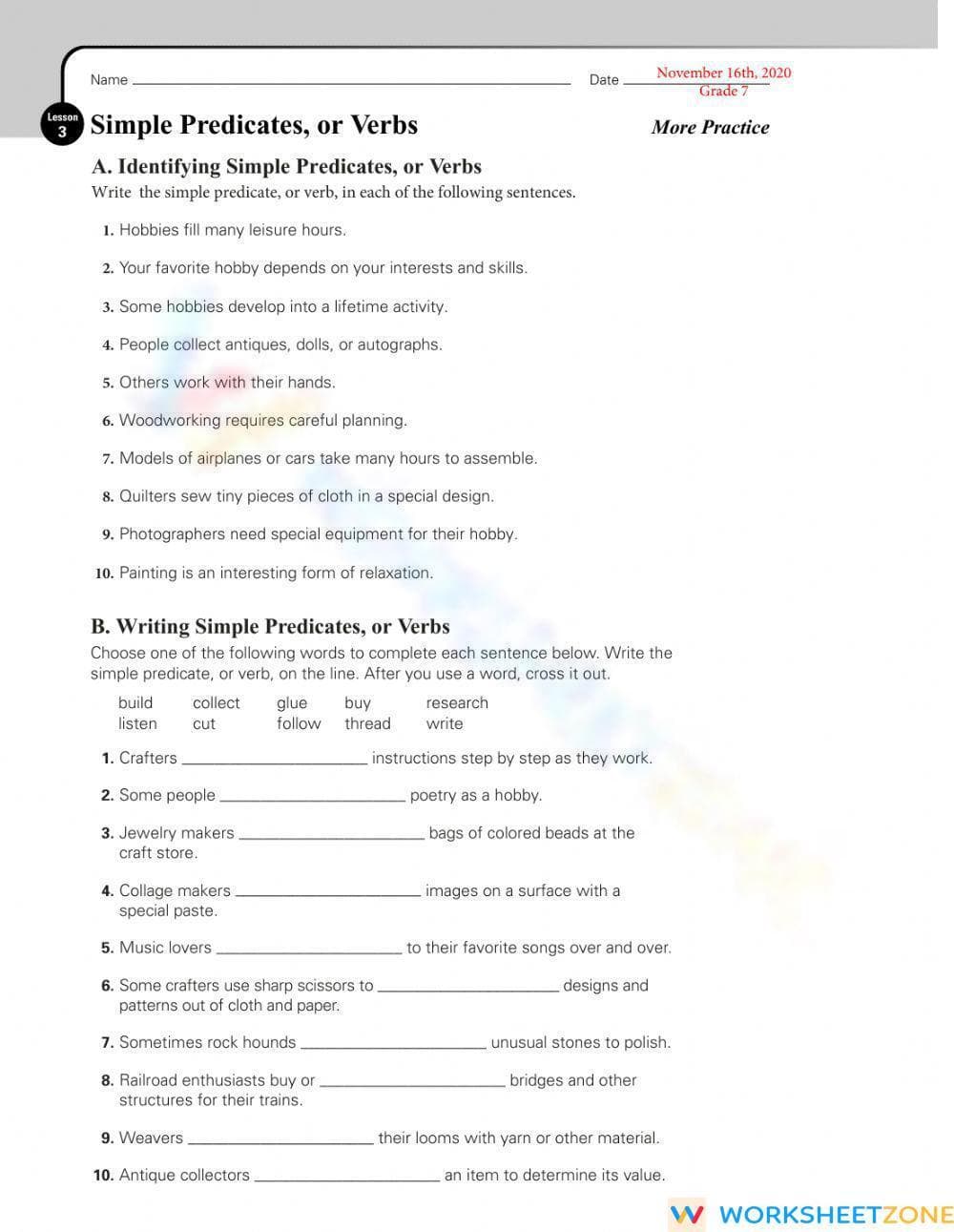
This essential Grade 5-7 English Language Arts worksheet helps students master identifying and using simple predicates, commonly known as verbs, within various sentence structures. By isolating the verb from the complete predicate, students strengthen their understanding of sentence mechanics and grammatical precision. This printable resource ensures students can confidently locate the core action in complex sentences.
At a Glance
- Grade: 5-7 · Subject: ELA
- Standard:
CCSS.ELA-LITERACY.L.7.1— Identify and use simple predicates and verbs correctly in sentences- Skill Focus: Simple Predicates and Verbs
- Format: 1 page · 20 problems · Answer key included · PDF
- Best For: Homework, sub plans, or grammar review
- Time: 15–20 minutes
This single-page PDF contains two distinct sections designed to reinforce verb recognition and application. Part A provides ten sentences where students must identify and write the simple predicate. Part B offers ten fill-in-the-blank sentences supported by a word bank, requiring students to select the most appropriate verb to complete the thought. A clear answer key is included for rapid grading.
Zero-Prep Workflow
- Step 1: Print the single-page document (30 seconds).
- Step 2: Distribute to students for independent or small-group work (1 minute).
- Step 3: Review the answers using the provided key (5 minutes).
Total teacher preparation time is under two minutes, making this an ideal choice for emergency sub plans or quick bell-ringer activities. The self-explanatory layout allows students to begin working immediately without extensive teacher direction.
The worksheet is primary aligned to CCSS.ELA-LITERACY.L.7.1, which requires students to demonstrate command of the conventions of standard English grammar and usage. Specifically, it targets the ability to recognize the function of verbs and their role as the simple predicate within a sentence. This standard code can be copied directly into lesson plans, IEP goals, or district curriculum mapping tools to track grammar progress.
Use this worksheet during the "Independent Practice" phase of a grammar lesson after introducing the difference between simple and complete predicates. It also serves as an excellent formative assessment tool; observe if students struggle more with identification (Part A) or application (Part B) to guide your next instructional steps. Completion usually takes 15 to 20 minutes depending on reading level.
This resource is tailored for upper elementary and middle school students in grades 5, 6, and 7 who are refining their sentence-level editing skills. It is particularly useful for students needing targeted intervention with word classes or for English Language Learners (ELL) practicing common action verbs in context. Pair this with a list of action verbs or a sentence-building anchor chart for additional support.
This Grade 5-7 ELA worksheet addresses the core requirement of CCSS.ELA-LITERACY.L.7.1 by focusing on the identification and application of simple predicates and verbs. Mastery of the simple predicate is a foundational step in syntactic development, allowing students to transition from basic sentence construction to more complex clause manipulation. According to Fisher & Frey (2014), the gradual release of responsibility—moving from identification in Part A to application in Part B—is critical for ensuring that grammatical skills transfer from isolated drills to authentic student writing. By providing 20 structured opportunities for practice, this resource enables educators to collect actionable data on student command of standard English conventions. The inclusion of a word bank scaffolds the writing task, ensuring that cognitive load remains focused on the grammatical function of the verb rather than vocabulary retrieval. This data-driven approach supports both general classroom instruction and specialized IEP goal tracking for literacy.


