


























Views
Downloads

Printable 2D and 3D Shapes Naming & Sorting Worksheet
Paste this activity's link or code into your existing LMS (Google Classroom, Canvas, Teams, Schoology, Moodle, etc.).
Students can open and work on the activity right away, with no student login required.
You'll still be able to track student progress and results from your teacher account.
This essential Grade 1 math worksheet helps students master the foundational skill of distinguishing between 2D flat shapes and 3D solid figures. By engaging in naming and sorting exercises, learners develop geometric vocabulary and spatial awareness. The structured format ensures students can independently demonstrate their ability to categorize shapes based on defining attributes and non-defining visual features.
At a Glance
- Grade: 1 · Subject: Math
- Standard:
CCSS.MATH.CONTENT.1.G.A.1— Distinguish between defining attributes and non-defining attributes of shapes- Skill Focus: 2D and 3D Shape Identification
- Format: 3 pages · 20 problems · Answer key included · PDF
- Best For: Independent practice and sorting assessment
- Time: 15–25 minutes
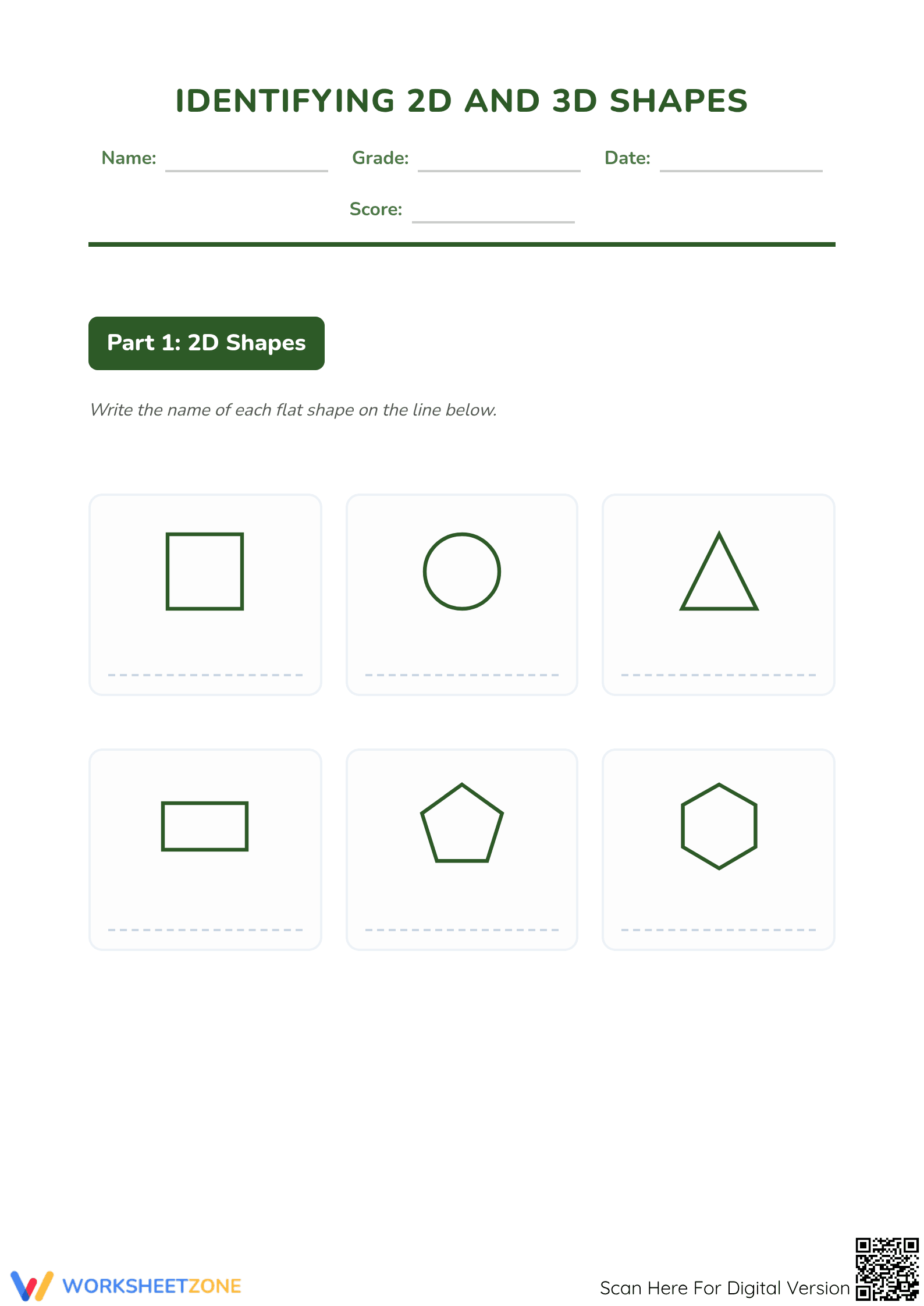
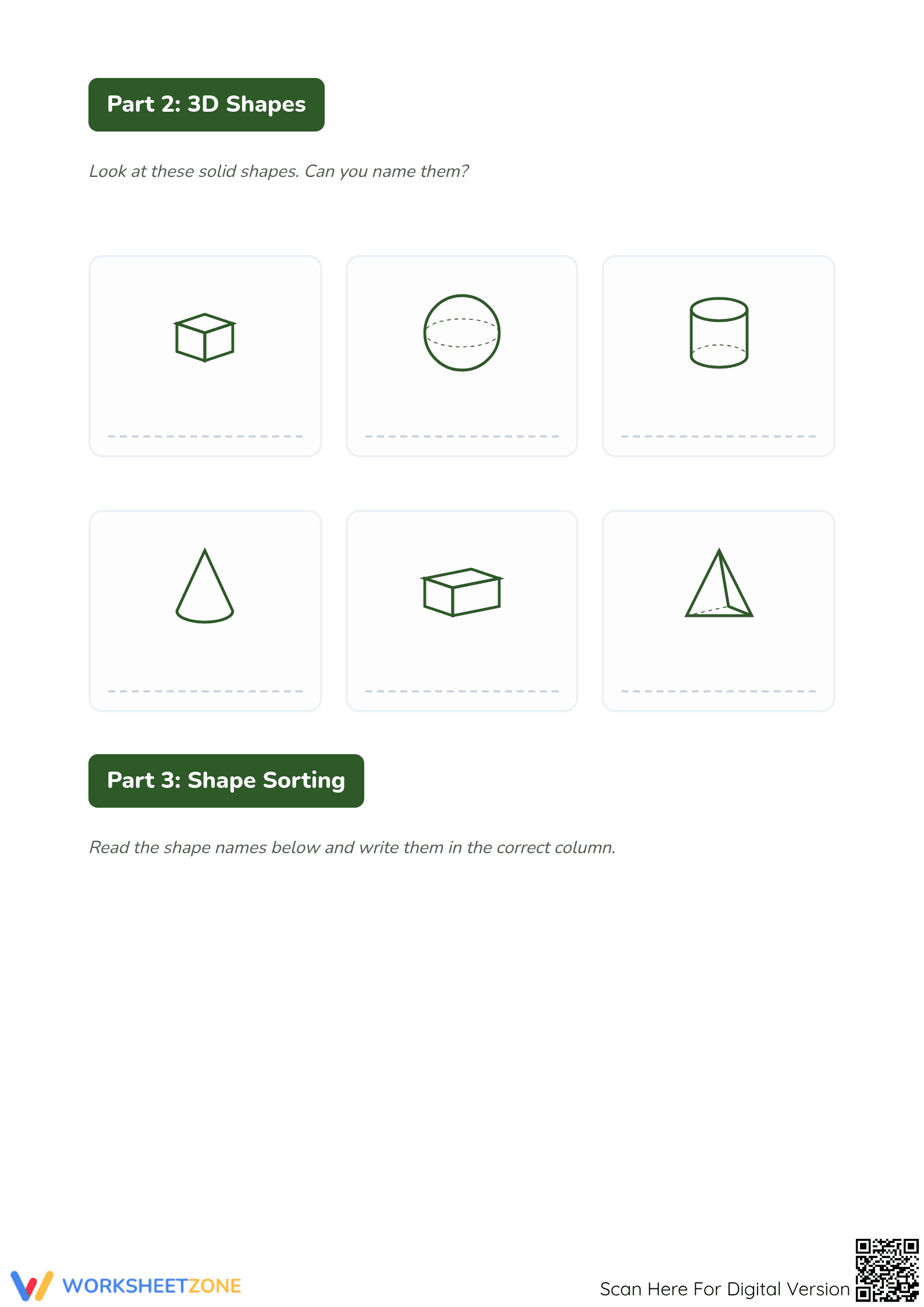
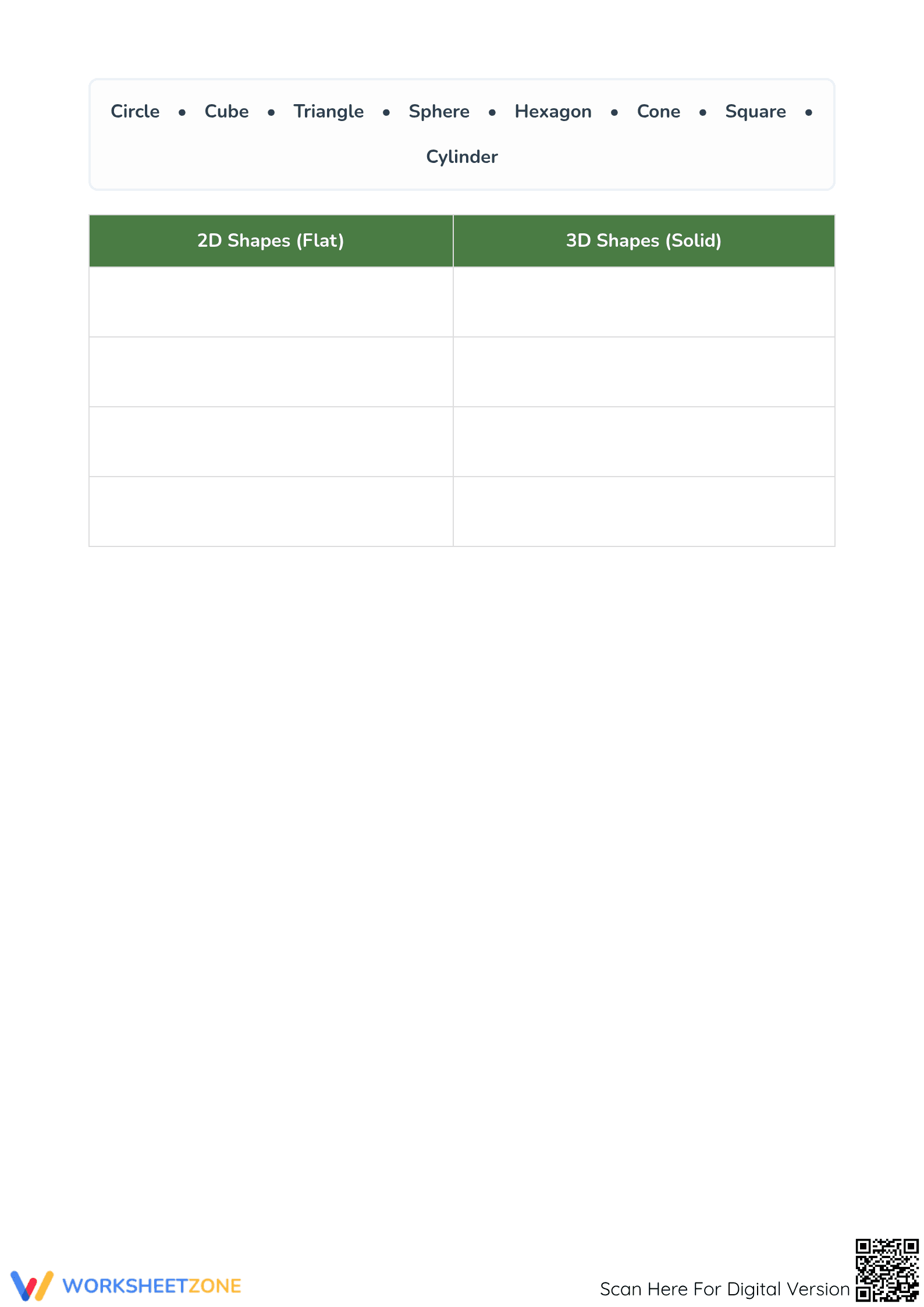
This 3-page packet contains three distinct sections designed to build mastery. Page 1 focuses on naming 2D shapes including squares, circles, and hexagons. Page 2 introduces 3D solids like cubes, spheres, and cylinders through clear visual representations. Page 3 provides a comprehensive sorting task where students classify eight different terms into a T-chart to show their understanding of dimension. A complete answer key is provided for rapid grading and feedback.
Zero-Prep Workflow
- Print: Select the desired pages and print enough copies for your class in under 1 minute.
- Distribute: Hand out the worksheets as a warm-up or independent practice block requiring minimal teacher explanation.
- Review: Use the included answer key to check student work in less than 2 minutes, identifying common misconceptions between flat and solid categories.
Standards Alignment
This resource is aligned to CCSS.MATH.CONTENT.1.G.A.1, which states that students should distinguish between defining attributes (e.g., triangles are closed and three-sided) versus non-defining attributes. This worksheet specifically targets the identification and naming of shapes which is a prerequisite for more advanced geometric reasoning and spatial construction. Both standard codes can be copied directly into lesson plans, IEP goals, or district curriculum mapping tools.
How to Use It
Use the sorting T-chart as a formative assessment check for understanding after a lesson on 3D objects to observe if students can differentiate between flat and solid properties. Alternatively, place these pages in a math center where students can work independently to reinforce shape vocabulary. Most students will complete the full set within 20 minutes.
Who It's For
Ideal for first-grade students and advanced kindergarteners, this worksheet provides visual scaffolds for English Language Learners and students requiring IEP support in math. It pairs naturally with geometric block manipulatives or a classroom shape scavenger hunt to bridge concrete and representational learning.
According to the NAEP framework, early mastery of geometric properties is a significant predictor of later success in spatial reasoning and high school geometry. This Grade 1 resource aligns with CCSS.MATH.CONTENT.1.G.A.1 by requiring students to accurately identify and sort flat (2D) and solid (3D) shapes. Through 20 targeted tasks, students move beyond simple recognition toward categorization by attribute. Research by Fisher & Frey (2014) emphasizes the importance of guided practice and independent application in the gradual release of responsibility model, which this worksheet supports through its progression from naming to sorting. By providing clear visual representations of squares, spheres, and cylinders, the resource minimizes cognitive load while maximizing vocabulary retention. Educators can easily integrate these pages into existing curricula or use them as a reliable sub-plan asset. This printable math guide ensures every learner achieves a complete understanding of basic geometry standards while maintaining high engagement and clarity.


