




























Views
Downloads
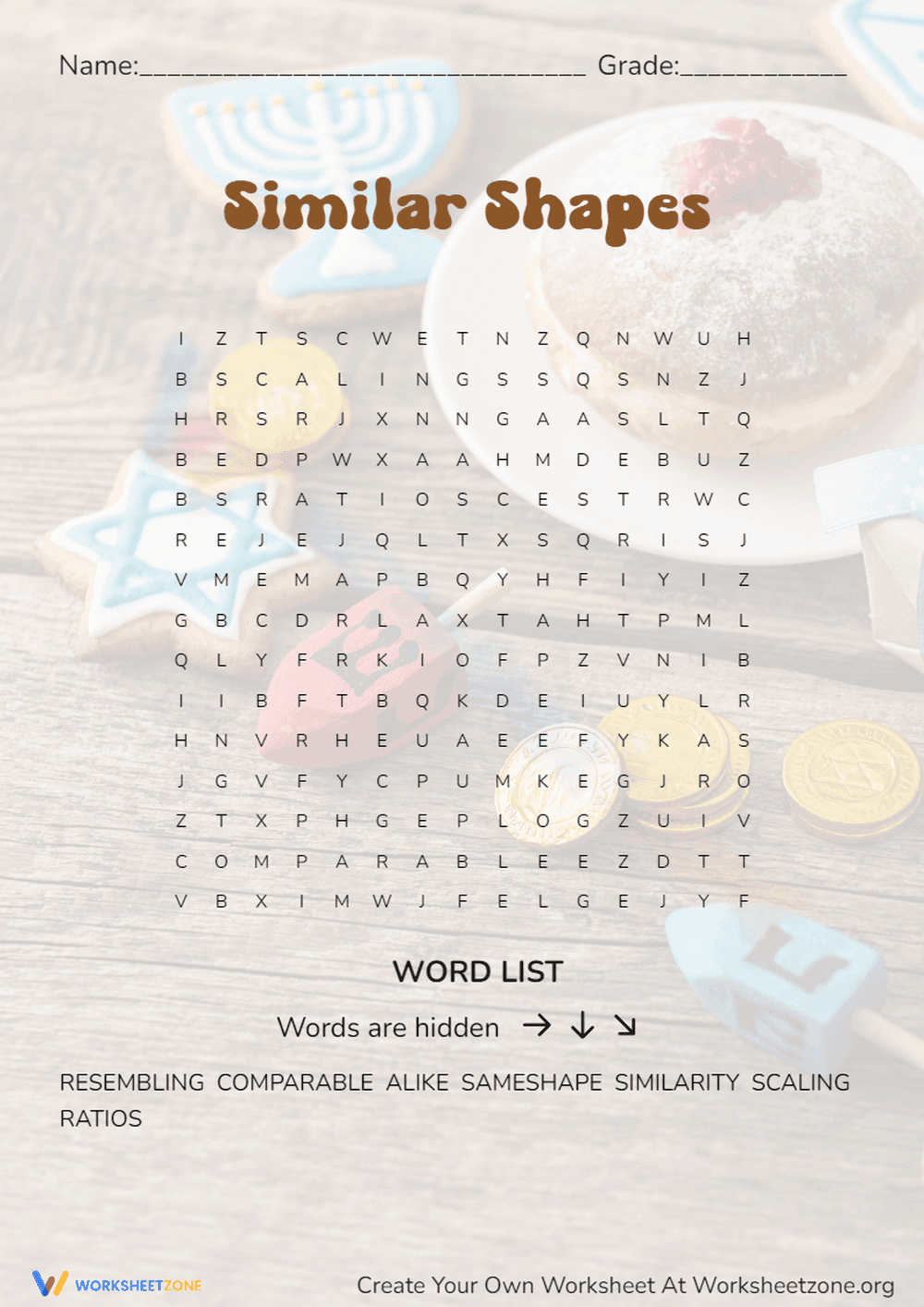

Grade 4 Similar Shapes — Printable No-Prep Worksheet

Paste this activity's link or code into your existing LMS (Google Classroom, Canvas, Teams, Schoology, Moodle, etc.).
Students can open and work on the activity right away, with no student login required.
You'll still be able to track student progress and results from your teacher account.
This engaging word search worksheet helps students master essential math vocabulary related to similar shapes and proportions. By actively seeking out domain-specific terms, learners reinforce their spelling and recognition of key geometry concepts. It provides a focused, independent activity that strengthens foundational academic language.
At a Glance
- Grade: 4 · Subject: Math
- Standard:
CCSS.ELA-LITERACY.L.4.6— Acquire and use domain-specific words- Skill Focus: Geometry vocabulary
- Format: 1 page · 7 problems · Answer key included · PDF
- Best For: Independent practice
- Time: 10–15 minutes
Inside this single-page resource, educators will find a straightforward word search puzzle featuring seven critical vocabulary terms: resembling, comparable, alike, sameshape, similarity, scaling, and ratios. The layout includes a clear word bank with directional arrows indicating that words are hidden horizontally, vertically, and diagonally. A complete answer key is provided to ensure quick grading.
This resource is designed for immediate classroom implementation with a highly efficient zero-prep workflow:
- Print (1 minute): Simply download the PDF and print the required number of copies. The black-and-white text format is printer-friendly.
- Distribute (1 minute): Hand out the puzzle to students as they enter the room or transition between subjects. No additional materials or teacher setup are required.
- Review (1 minute): Use the included answer key to quickly verify student work or project it on the board for self-correction.
Total teacher preparation time is under two minutes, making this an excellent option for emergency sub plans or unexpected schedule changes.
This activity aligns directly with CCSS.ELA-LITERACY.L.4.6: Acquire and use accurately grade-appropriate general academic and domain-specific words and phrases. By interacting with terms like "scaling" and "ratios," students build the precise vocabulary necessary for advanced geometry and proportional reasoning. Both standard codes can be copied directly into lesson plans, IEP goals, or district curriculum mapping tools.
Teachers can utilize this word search as an effective bell-ringer activity to introduce a new geometry unit before direct instruction begins. Alternatively, it serves as a quiet, focused task for early finishers during independent math centers. As a formative assessment observation tip, monitor which students struggle to locate longer words like "comparable" or "similarity," as this can indicate a need for additional spelling or phonics support. Expected completion time ranges from 10 to 15 minutes.
This worksheet is primarily designed for fourth and fifth-grade students developing their mathematical academic language. It offers built-in differentiation for visual learners who benefit from seeing terms written out in a grid format. For a comprehensive lesson, pair this vocabulary puzzle with a direct instruction lesson on geometric transformations or an anchor chart displaying visual examples of similar versus congruent shapes.
Integrating domain-specific vocabulary practice into daily routines is essential for long-term academic success. This resource targets CCSS.ELA-LITERACY.L.4.6, requiring students to acquire and use domain-specific words accurately. According to Fisher & Frey (2014), explicit vocabulary instruction combined with repeated exposure through varied activities significantly improves reading comprehension and content-area mastery. When students engage with terms like "scaling" and "ratios" in a low-stakes format such as a word search, they lower their affective filter and build confidence with complex mathematical language. This foundational exposure ensures that when these terms appear in high-stakes testing or advanced problem-solving scenarios, learners can focus on the mathematical operations rather than decoding the terminology. Consistent practice with academic language bridges the gap between conversational English and the rigorous demands of standardized math curricula.


