


























0
Views
0
Downloads

0.0
0
Save
0 Likes
Identifying Basic Shapes
0 Views
0 Downloads
Paste this activity's link or code into your existing LMS (Google Classroom, Canvas, Teams, Schoology, Moodle, etc.).
Students can open and work on the activity right away, with no student login required.
You'll still be able to track student progress and results from your teacher account.
Information
Description
What It Is:
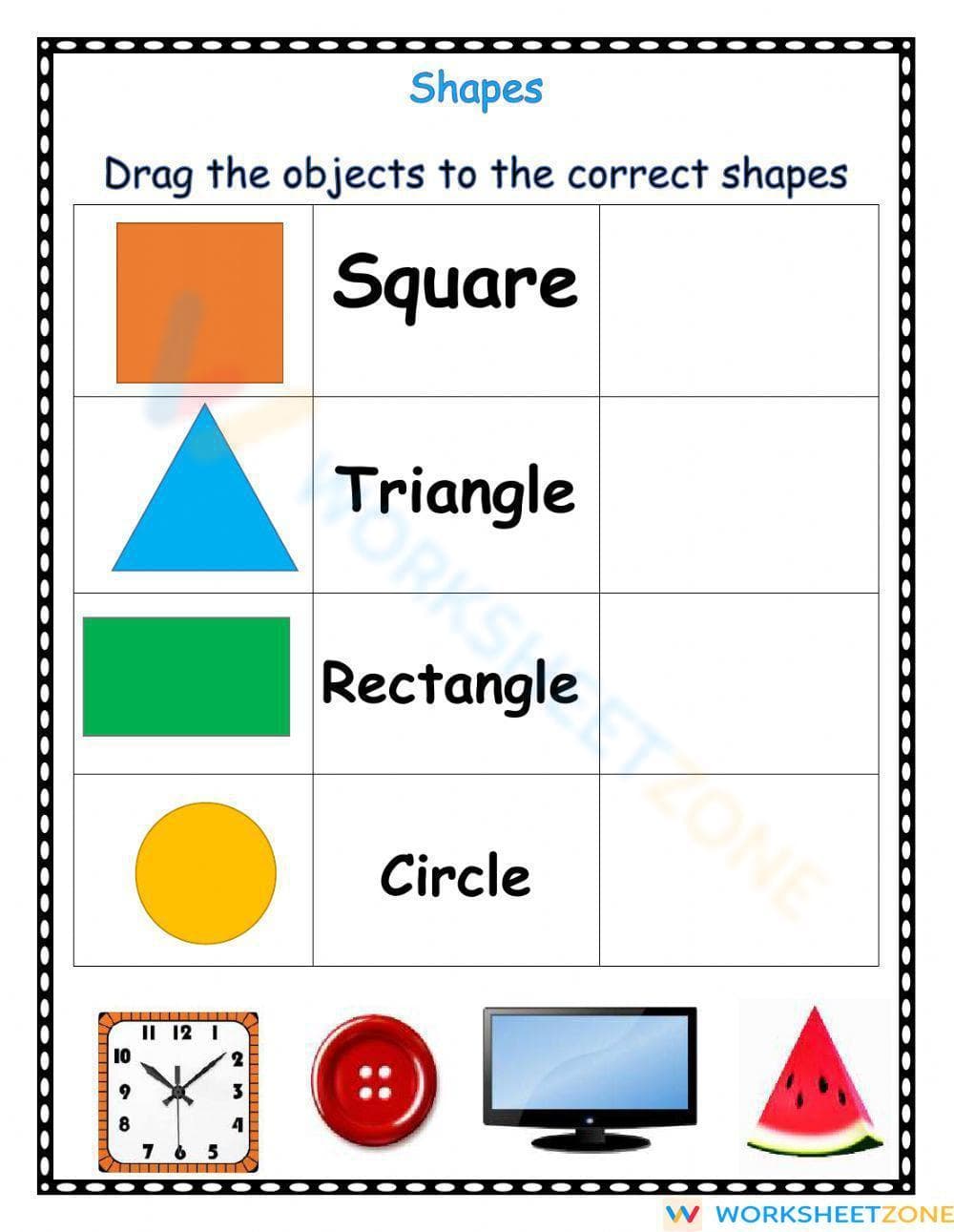
This is a shapes sorting worksheet. It features four common shapes: square, triangle, rectangle, and circle. Each shape is presented with its name, and there's a blank space next to each for sorting. At the bottom are images of real-world objects: a clock, a button, a computer monitor, and a slice of watermelon. The instructions prompt the user to 'Drag the objects to the correct shapes.'
Grade Level Suitability:
This worksheet is most suitable for preschool and kindergarten (Pre-K and K) students. The shapes are basic and easily recognizable, and the activity focuses on simple shape identification and matching, skills typically developed in these early grades.
Why Use It:
This worksheet helps children learn to identify and differentiate between basic shapes. It reinforces shape recognition skills and connects abstract shapes to real-world objects. It also develops fine motor skills (if cutting and pasting is involved) or visual discrimination skills (if it's a drag-and-drop activity).
How to Use It:
Students should identify the shape of each object at the bottom of the worksheet. Then, they should match the object to the corresponding shape at the top by either drawing a line, cutting and pasting, or dragging and dropping (if used digitally). For example, the clock would be matched to the square.
Target Users:
The target users are preschool and kindergarten children who are learning about shapes. It is also appropriate for students with special needs who are working on basic shape recognition.
This is a shapes sorting worksheet. It features four common shapes: square, triangle, rectangle, and circle. Each shape is presented with its name, and there's a blank space next to each for sorting. At the bottom are images of real-world objects: a clock, a button, a computer monitor, and a slice of watermelon. The instructions prompt the user to 'Drag the objects to the correct shapes.'
Grade Level Suitability:
This worksheet is most suitable for preschool and kindergarten (Pre-K and K) students. The shapes are basic and easily recognizable, and the activity focuses on simple shape identification and matching, skills typically developed in these early grades.
Why Use It:
This worksheet helps children learn to identify and differentiate between basic shapes. It reinforces shape recognition skills and connects abstract shapes to real-world objects. It also develops fine motor skills (if cutting and pasting is involved) or visual discrimination skills (if it's a drag-and-drop activity).
How to Use It:
Students should identify the shape of each object at the bottom of the worksheet. Then, they should match the object to the corresponding shape at the top by either drawing a line, cutting and pasting, or dragging and dropping (if used digitally). For example, the clock would be matched to the square.
Target Users:
The target users are preschool and kindergarten children who are learning about shapes. It is also appropriate for students with special needs who are working on basic shape recognition.


