


























Views
Downloads

Essential Area and Perimeter Worksheet | Grade 5 Math
Paste this activity's link or code into your existing LMS (Google Classroom, Canvas, Teams, Schoology, Moodle, etc.).
Students can open and work on the activity right away, with no student login required.
You'll still be able to track student progress and results from your teacher account.
Develop foundational geometric mastery with this comprehensive 5-page activity pack focused on area and perimeter. Students move beyond identification to apply complex formulas for squares, rectangles, triangles, and circles. By combining formula recognition with word problems and critical thinking, this resource ensures a deep conceptual understanding of 2D measurement and spatial relationships.
At a Glance
- Grade: 4–5 · Subject: Math
- Standard:
CCSS.MATH.CONTENT.4.MD.A.3— Apply area and perimeter formulas for rectangles in real-world and mathematical problems- Skill Focus: Area and Perimeter of Basic 2D Shapes
- Format: 5 pages · 20+ tasks · Answer key included · PDF
- Best For: Comprehensive Geometry Unit Review or Assessment
- Time: 45–60 minutes
What's Inside
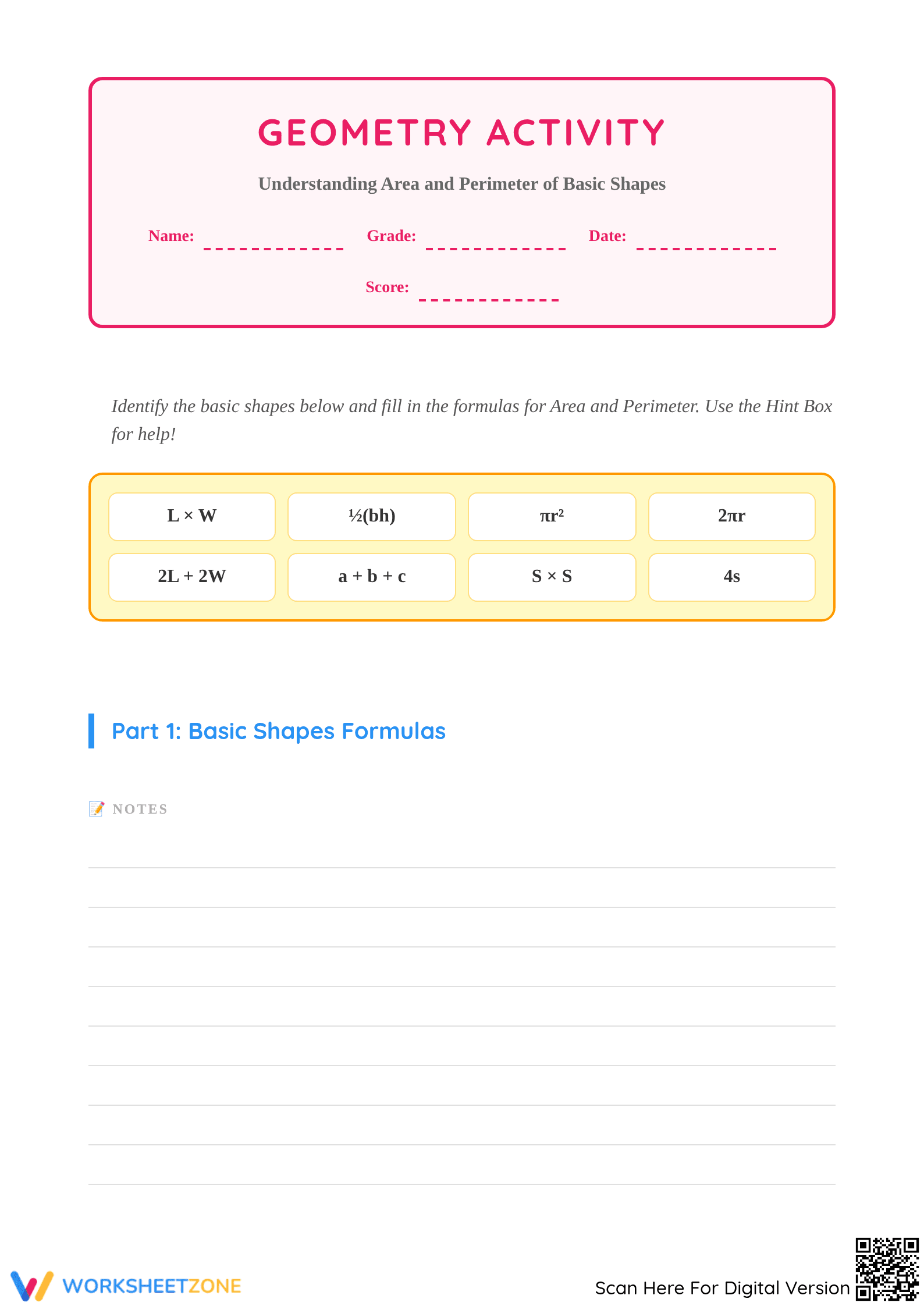
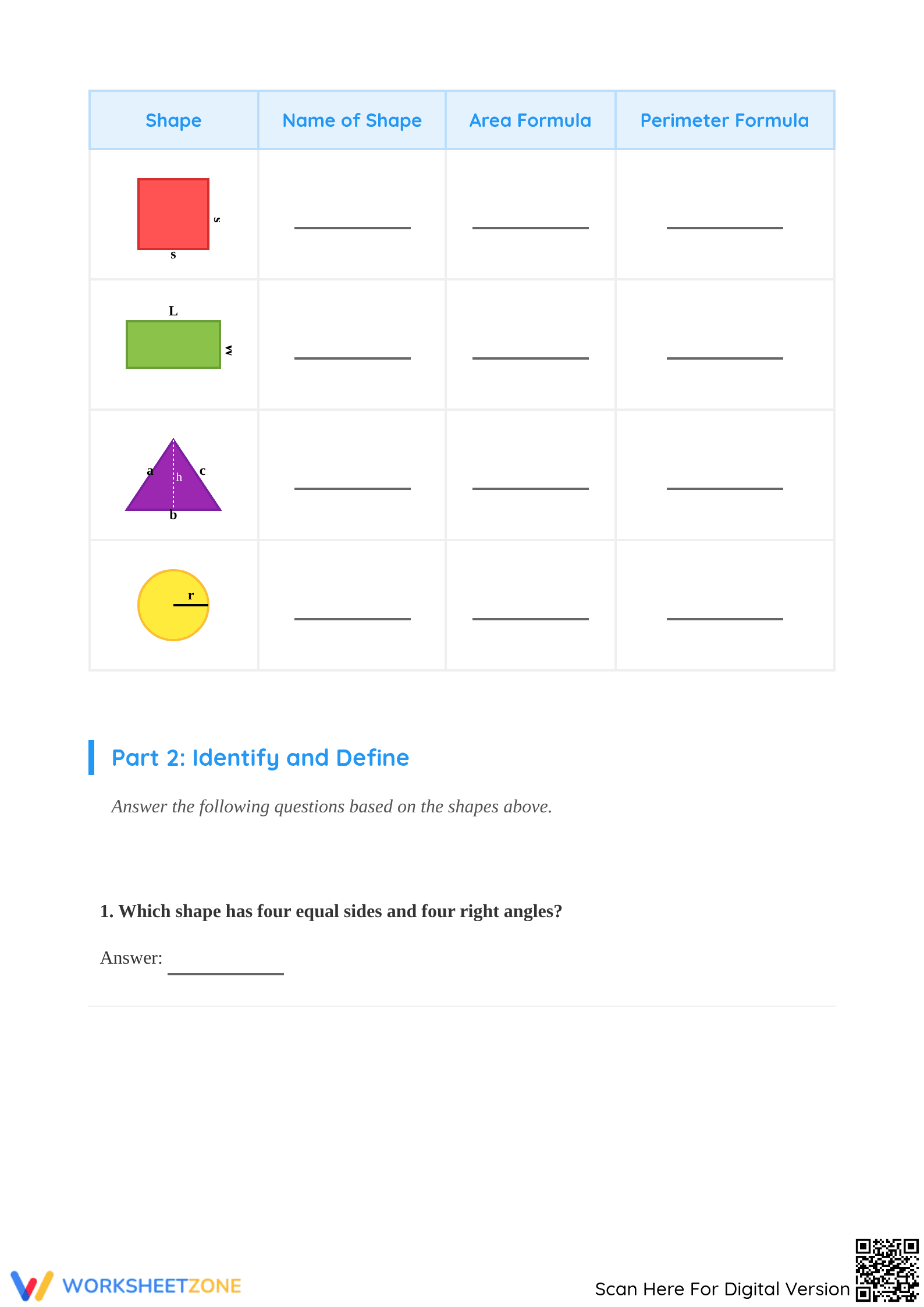
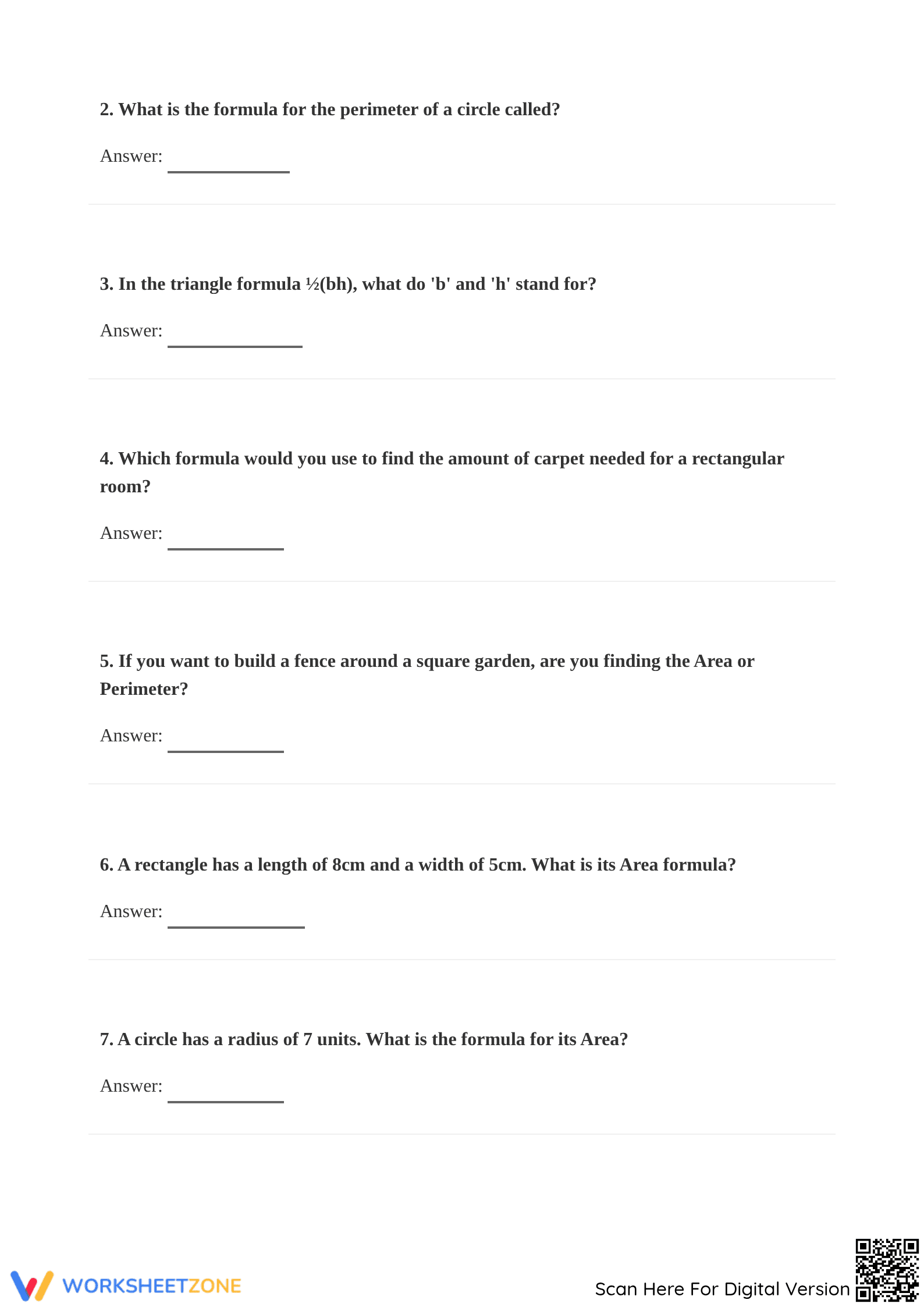
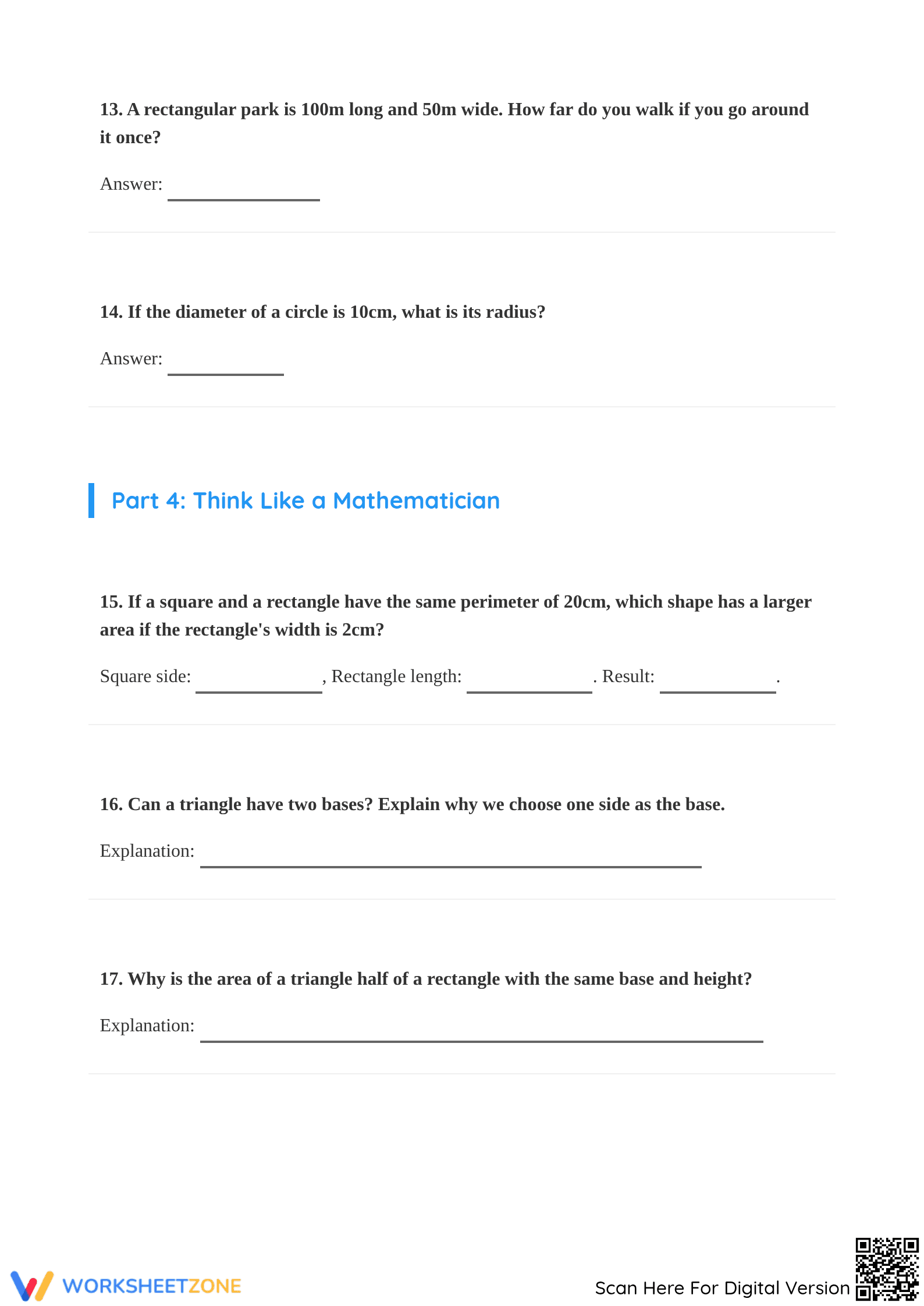
This multi-page resource features a dedicated formula hint box containing equations for area and perimeter, such as 1/2(bh) and πr². Across five pages, students encounter a shape identification table, conceptual definitions, word problems involving real-world scenarios like carpeting or fencing, and multi-step calculations. A full answer key is included for efficient grading.
Skill Progression
- Guided Practice: Students begin by identifying 2D shapes and matching them to the provided formula bank, filling in a structured table to establish foundational knowledge.
- Supported Practice: Learners solve seven conceptual and application-based questions, using definitions to explain variables like base and height before performing calculations.
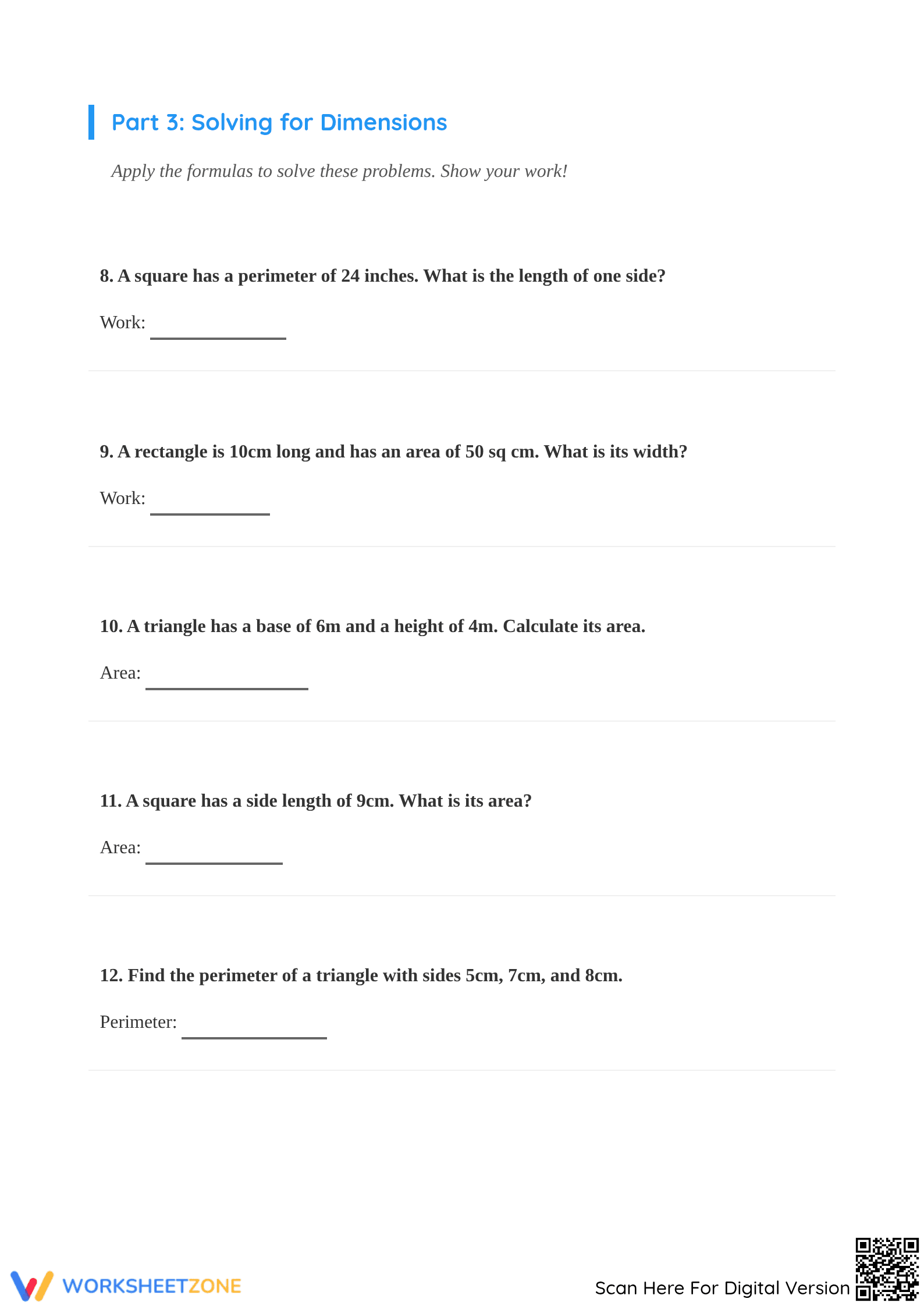
- Independent Practice: The final sections require students to solve for missing dimensions and complete the 'Think Like a Mathematician' challenge to compare geometric properties without scaffolds.
This sequence follows a gradual-release model from recognition to independent problem-solving.
Standards Alignment
The primary focus of this activity is CCSS.MATH.CONTENT.4.MD.A.3, which requires students to apply area and perimeter formulas for rectangles in real-world contexts. While the worksheet extends to triangles and circles, it maintains a core focus on the measurement of 2D attributes. This standard code can be copied directly into lesson plans, IEP goals, or district curriculum mapping tools.
How to Use It
Use this as a summative assessment at the end of a geometry unit or as a comprehensive review package before state testing. Teachers should observe students during Part 3 to see if they can reverse-engineer formulas, such as finding a side length when given the perimeter. Expect completion within 45 to 60 minutes depending on prior knowledge.
Who It's For
This activity is designed for Grade 4 and 5 students who are ready to transition from counting square units to applying algebraic formulas. It is particularly effective for learners who benefit from having a reference hint box while working. Pair this with a 2D shape anchor chart for an integrated lesson.
According to the RAND AIRS 2024 report on mathematics instructional materials, the integration of visual models with abstract formulas is critical for developing geometric fluency in upper elementary students. This worksheet directly addresses this need by requiring students to bridge the gap between identifying 2D shapes and applying correct mathematical algorithms for area and perimeter. By focusing on CCSS.MATH.CONTENT.4.MD.A.3, the activity provides a structured pathway for learners to move from basic identification to solving complex word problems requiring multi-step reasoning. Research from Fisher & Frey (2014) emphasizes that gradual release of responsibility, as seen in the transition from formula guides to 'Think Like a Mathematician' prompts, improves long-term retention of spatial concepts. This comprehensive resource ensures that students not only memorize formulas for squares, rectangles, triangles, and circles but also understand the conceptual relationships between dimensions and measurement. Teachers can reliably use these 17 targeted tasks to identify specific misconceptions in geometric calculation.


