


























Views
Plays



Microbiology & Infection Control | Essential HS Worksheet
Paste this activity's link or code into your existing LMS (Google Classroom, Canvas, Teams, Schoology, Moodle, etc.).
Students can open and work on the activity right away, with no student login required.
You'll still be able to track student progress and results from your teacher account.
This microbiology worksheet empowers high school students to master infection prevention and control. By engaging with 30 questions, learners demonstrate understanding of pathogen types, transmission, and terminology. The resource ensures students can distinguish between bacterial and viral infections while identifying effective sterilization and immunization strategies for public health safety.
At a Glance
- Grade: 9-12 · Subject: Biology / Health
- Standard:
HS-LS1-2— Illustrate the hierarchical organization of interacting systems in multicellular organisms- Skill Focus: Infection Prevention & Microbiology
- Format: 3 pages · 30 problems · Answer key included · PDF
- Best For: Unit Review or Emergency Sub Plans
- Time: 35–45 minutes
What's Inside
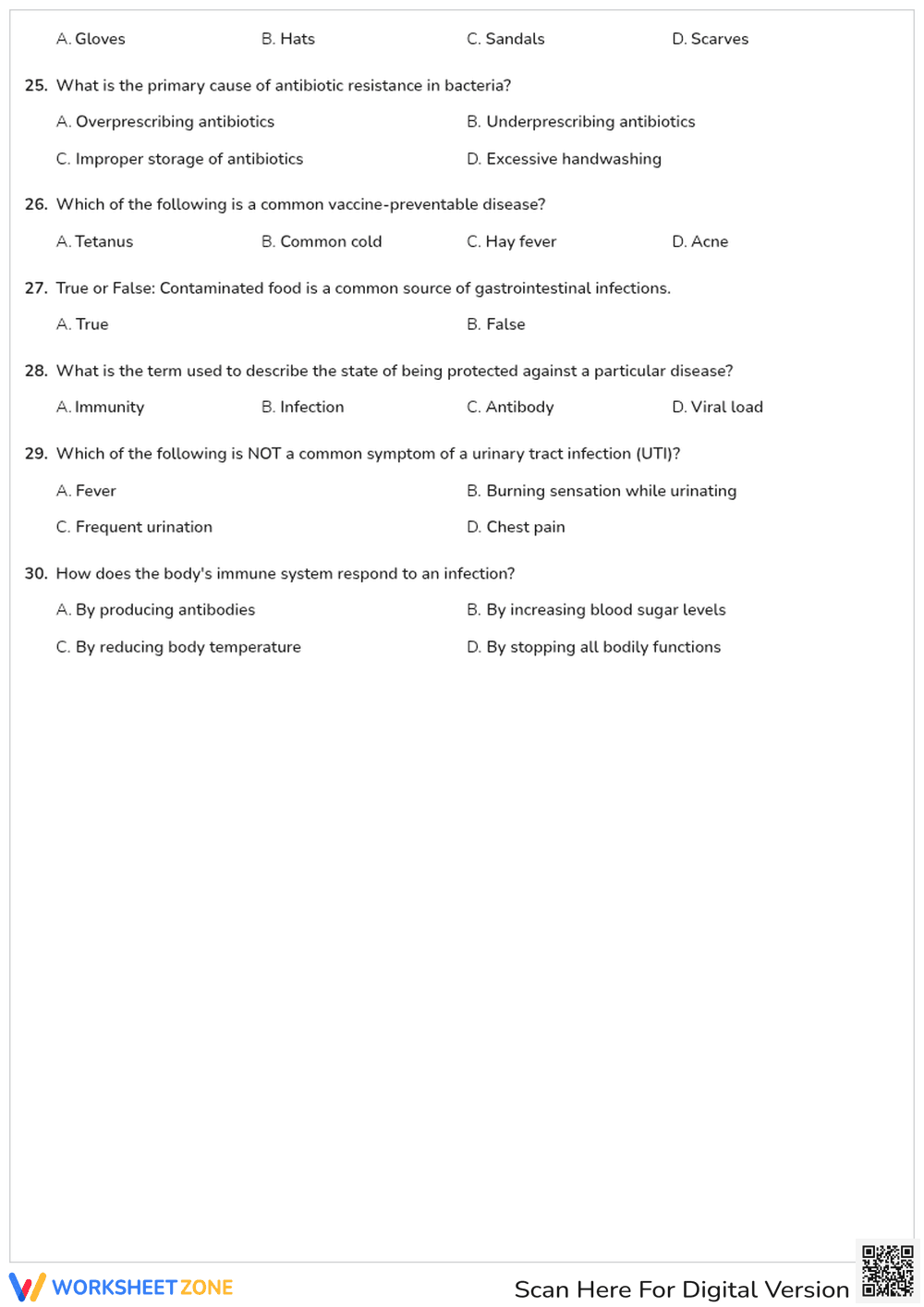
The resource contains 30 high-quality multiple-choice questions across three pages. It covers zoonotic diseases, nosocomial infections, and the mechanics of antibiotic resistance. The layout is designed for readability with clear headers. A full answer key is included to streamline grading and provide immediate feedback to learners during review sessions.
Zero-Prep Workflow
Teachers can implement this resource with minimal effort. First, print the three-page document (30 seconds). Second, distribute the worksheets to students for independent or partner work (1 minute). Finally, use the provided answer key to facilitate a rapid whole-class review or grade the submissions (5 minutes). Total preparation time is under two minutes, making it an ideal solution for busy instructional days or unexpected absences.
Standards Alignment
This worksheet is primarily aligned with `HS-LS1-2`, which requires students to illustrate the hierarchical organization of interacting systems that provide specific functions within multicellular organisms. It also supports health standards regarding disease prevention. Both standard codes can be copied directly into lesson plans, IEP goals, or district curriculum mapping tools to ensure instructional compliance and rigor.
How to Use It
Use this worksheet as a summative assessment to gauge student mastery of infection protocols. It also functions perfectly as a structured activity for a substitute teacher. During the activity, observe if students struggle with the distinction between disinfection and sterilization. Completion typically takes 40 minutes.
Who It's For
This resource is designed for Grade 9-12 Biology or Health students, including those in CTE pathways. It provides excellent support for general education and can be adapted for modified workloads. Pair this worksheet with a diagram of the immune system for a complete lesson.
According to Fisher & Frey (2014), the use of structured retrieval practice through multiple-choice assessments significantly enhances long-term retention of complex biological concepts. This worksheet aligns with the HS-LS1-2 standard, focusing on the hierarchical organization of systems and the impact of external pathogens on homeostasis. By evaluating 30 distinct scenarios involving infection prevention and control, students move beyond rote memorization toward a functional understanding of public health. Research from the NAEP indicates that students who engage with diverse question sets covering both terminology and practical application show higher proficiency in science literacy. This resource provides the necessary scaffolding for high school learners to master the nuances of microbiology, including the critical distinctions between viral and bacterial agents. It serves as a robust tool for formative assessment, ensuring that educators can identify and address misconceptions regarding antibiotic resistance and immunization protocols effectively. This evidence-based approach supports rigorous academic growth in secondary science environments.


