




























Views
Downloads

Essential Rock Cycle Chart Worksheet | Grade 4 Science

Paste this activity's link or code into your existing LMS (Google Classroom, Canvas, Teams, Schoology, Moodle, etc.).
Students can open and work on the activity right away, with no student login required.
You'll still be able to track student progress and results from your teacher account.
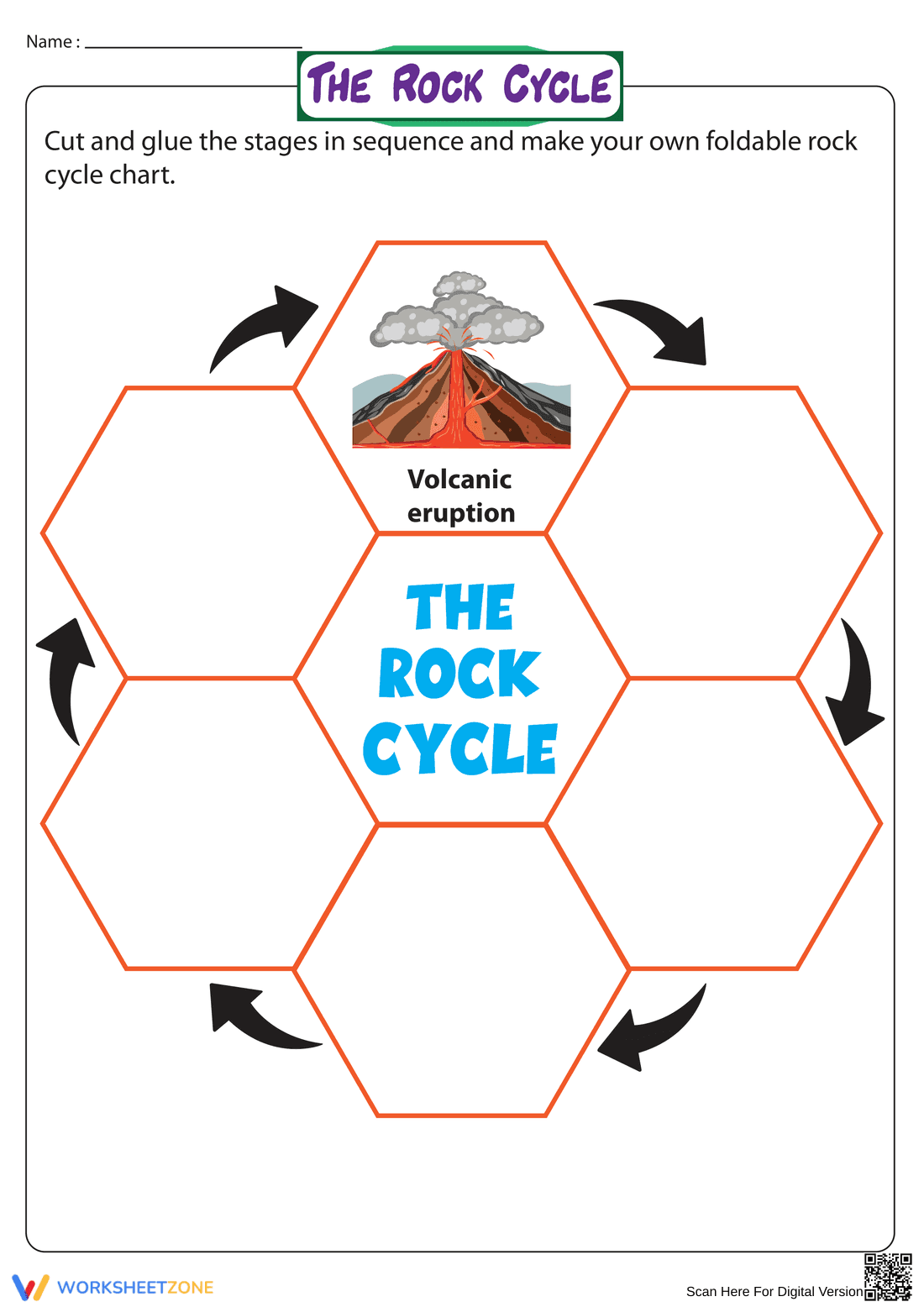
This Grade 4 rock cycle worksheet transforms abstract geological processes into a tangible learning experience. Students identify and sequence various stages of the rock cycle to construct a complete foldable reference chart. By engaging with this hands-on activity, learners visualize how earth materials change over time through volcanic activity, weathering, and transformation into new forms.
At a Glance
At a Glance
- Grade: 4 · Subject: Science
- Standard:
4-ESS1-1— Identify evidence from patterns in rock formations and fossils in rock layers- Skill Focus: Sequencing geological processes
- Format: 2 pages · 6 stages · Answer key included · PDF
- Best For: Interactive science journals and earth systems review
- Time: 20–30 minutes
What's Inside
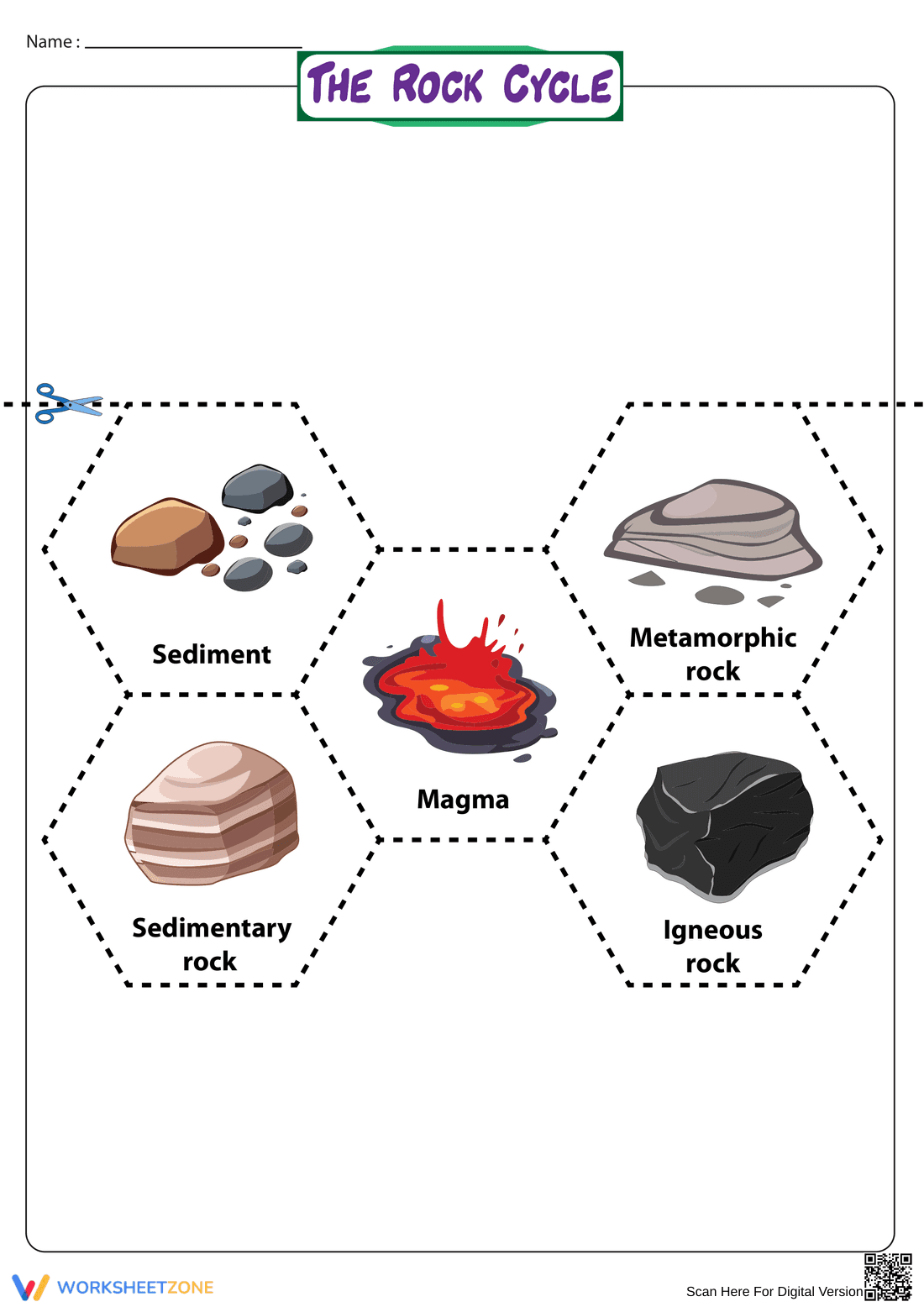
This 2-page PDF set includes a primary hexagonal graphic organizer and a corresponding page of cut-out tiles. The main page features a central "The Rock Cycle" anchor with six perimeter nodes, one of which is pre-filled with "Volcanic eruption" to provide a starting point. Students use the second page to cut out descriptions of sedimentation, metamorphic change, and cooling to finish the foldable.
Zero-Prep Workflow
The classroom implementation for this activity requires zero teacher preparation beyond printing. Step 1: Print the two-page set for each student (30 seconds). Step 2: Distribute the sheets and have students cut out the stage hexagons (5 minutes). Step 3: Review the completed cycles using the included answer key for immediate feedback (5 minutes). Total preparation time is under 2 minutes, making this ideal for sub plans.
Standards Alignment
Primary alignment is with 4-ESS1-1: "Identify evidence from patterns in rock formations and fossils in rock layers to support an explanation for changes in a landscape over time." This worksheet supports the standard by requiring students to understand the cyclical nature of rock formation. Both standard codes can be copied directly into lesson plans, IEP goals, or district curriculum mapping tools.
How to Use It
Use this activity as a summative check during your Earth Systems unit after students have learned about igneous, sedimentary, and metamorphic rocks. As a formative assessment tip, observe students as they begin the sequencing; those who struggle to place the tiles after "Volcanic eruption" may need a review of cooling. The activity typically takes 25 minutes from distribution to completion.
Who It's For
This resource is designed for fourth-grade classrooms, specifically targeting visual and kinesthetic learners who benefit from physical manipulation of concepts. It works well as a companion to an anchor chart on geological time or as an entry in an interactive science notebook. For English Language Learners, the visual cues in the illustrations provide essential scaffolding for technical vocabulary.
According to the RAND AIRS 2024 report on elementary science literacy, hands-on modeling of cyclical systems significantly increases long-term retention of technical vocabulary and conceptual hierarchies. This Rock Cycle worksheet directly addresses the sequencing skills identified in the report by requiring students to physically map the transition between geological states. By centering the activity on 4-ESS1-1, the resource ensures that Grade 4 students are not merely memorizing names but are understanding the causal relationships between volcanic activity, weathering, and lithification. Research from Fisher & Frey (2014) highlights that graphic organizers with built-in scaffolds, such as the pre-filled "Volcanic eruption" node in this chart, facilitate the gradual release of responsibility. This design allows students to apply their knowledge of Earth's systems independently while maintaining the structural support necessary for mastery of complex geological patterns and time-based sequences in the elementary science curriculum.


