




























Views
Downloads
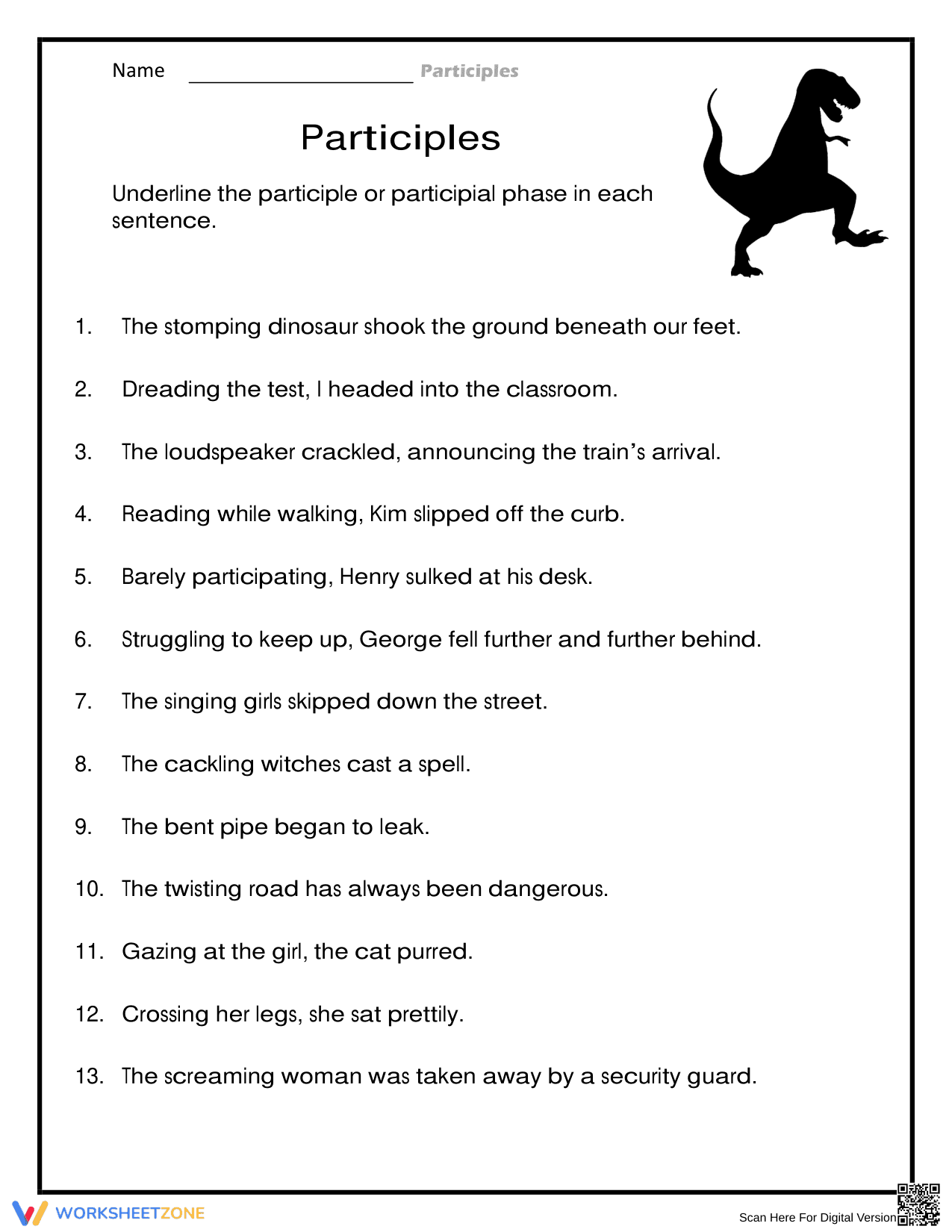

Grade 8 Participles & Phrases — Essential Worksheet

Paste this activity's link or code into your existing LMS (Google Classroom, Canvas, Teams, Schoology, Moodle, etc.).
Students can open and work on the activity right away, with no student login required.
You'll still be able to track student progress and results from your teacher account.
This Grade 8 participial phrases worksheet provides students with targeted practice in identifying verbals that function as adjectives. By analyzing 13 unique sentences, learners develop the ability to distinguish between simple participles and complex phrases that modify nouns or pronouns. This resource ensures students master sentence variety and grammatical precision in their writing.
At a Glance
- Grade: 8 · Subject: ELA Grammar
- Standard:
CCSS.ELA-LITERACY.L.8.1.A— Explain the function of participles and their role in modifying specific nouns- Skill Focus: Participial Phrases
- Format: 1 page · 13 problems · Answer key included · PDF
- Best For: Middle school grammar bell-ringers
- Time: 10–15 minutes
What's Inside
This single-page printable contains 13 sentence-level exercises focused on present and past participles. The "Sentence Squasher" layout features a clear design with a dinosaur graphic, making it engaging for middle schoolers. Each task requires students to underline the specific participle or the entire participial phrase. A comprehensive answer key is included to facilitate rapid grading or student self-correction.
Zero-Prep Workflow
Print the single PDF page in seconds. Distribute the copies to your class; the self-explanatory instructions allow students to begin immediately with zero setup. Review the answers as a group or collect them for a quick check, requiring under two minutes of teacher preparation time. This efficiency makes it an ideal candidate for emergency sub plans or last-minute literacy centers.
Standards Alignment
The primary focus is CCSS.ELA-LITERACY.L.8.1.A, which requires students to explain the function of verbals, specifically participles, in general and their function in particular sentences. By identifying how these phrases act as adjectives to modify nouns, students build foundational knowledge for complex sentence construction. This standard code can be copied directly into lesson plans, IEP goals, or curriculum mapping tools.
How to Use It
Use this worksheet as a formative assessment after direct instruction on verbals to check for initial understanding. Alternatively, assign it as a "warm-up" during a writing workshop to remind students how to use participial phrases for better sentence flow. Teachers should observe whether students can identify the entire phrase boundaries. Completion typically takes between 10 and 15 minutes.
Who It's For
This resource is tailored for Grade 8 students but works for Grade 7 reinforcement or as a high school review. The clear examples provide scaffolding for English Language Learners while varied structures challenge on-grade students. It pairs naturally with a descriptive passage that utilizes modifiers to show grammar in a real-world context.
Effective grammar instruction requires students to move beyond rote memorization to the active identification of structural components. Research from Fisher & Frey (2014) on the gradual release of responsibility suggests that scaffolded identification tasks like the one presented in this CCSS.ELA-LITERACY.L.8.1.A worksheet are essential for transitioning students toward independent mastery. By isolating participial phrases in 13 discrete sentences, this resource provides the high-frequency exposure needed to internalize how verbals function as modifiers. This approach aligns with NAEP findings suggesting that a strong grasp of sentence-level grammar is a significant predictor of overall writing proficiency. Educational facilitators can use this tool to justify the inclusion of targeted verbal practice within broader literacy curricula, ensuring student outcomes meet the rigorous demands of national standards.


