


























Views
Downloads



Segment Addition Worksheet | Grade 9 Geometry Ready
Paste this activity's link or code into your existing LMS (Google Classroom, Canvas, Teams, Schoology, Moodle, etc.).
Students can open and work on the activity right away, with no student login required.
You'll still be able to track student progress and results from your teacher account.
This Grade 9 geometry worksheet guides high school students through calculating missing segment lengths using the Segment Addition Postulate. By solving linear segment equations across whole numbers, decimals, and algebraic binomials, learners build essential geometric reasoning and algebraic fluency required for formal geometric proofs.
At a Glance
- Grade: 9 · Subject: Math (Geometry)
- Standard:
HSG-CO.A.1— Apply definitions of line segments and calculate distances along straight lines- Skill Focus: Segment Addition Postulate and linear equations
- Format: 3 pages · 20 problems · Answer key included · PDF
- Best For: Independent practice and foundational geometry review
- Time: 30–45 minutes
What's Inside
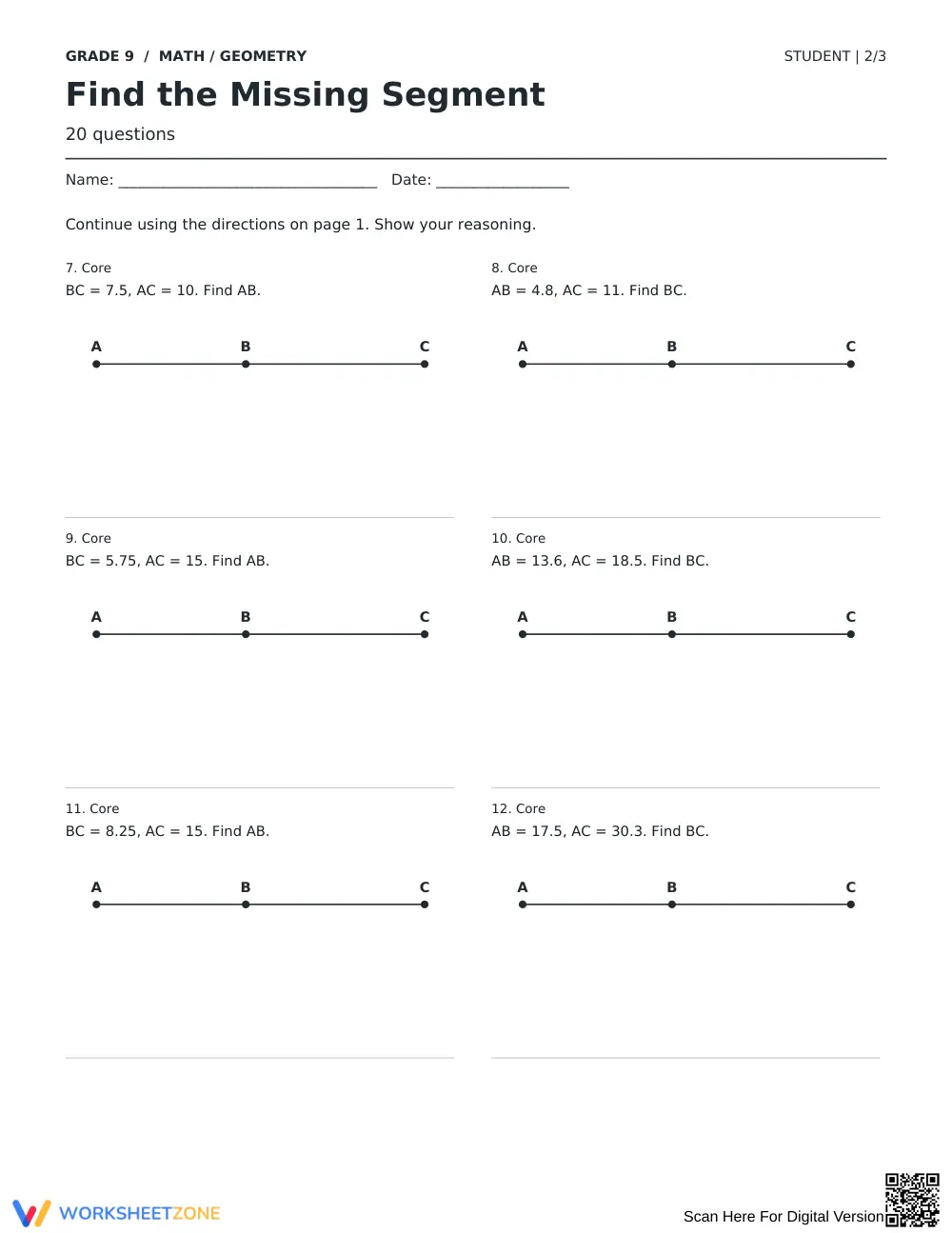
The 3-page student activity contains 20 structured geometry exercises paired with a comprehensive 2-page answer key featuring step-by-step subtraction equations and algebraic solutions. Each question provides a clean horizontal line diagram with points A, B, and C to help students visualize collinear segment relationships before formulating an algebraic equation.
Skill Progression
- Guided practice (Problems 1–6): Foundation items use whole numbers where students set up single-step subtraction equations (AC - BC = AB) using visual line segments.
- Supported practice (Problems 7–16): Core items introduce decimal measurements with tenths and hundredths, requiring students to write precise subtraction equations.
- Independent practice (Problems 17–20): Challenge problems present algebraic expressions (such as AB = 3x - 2), requiring students to set up linear equations, solve for x, and determine missing lengths.
This sequence implements a gradual-release model transitioning learners from basic arithmetic to multi-step algebraic geometry.
Standards Alignment
This worksheet aligns directly to `CCSS.MATH.CONTENT.HSG-CO.A.1`, which requires students to apply precise geometric definitions of line segments and calculate distances. It also supports `CCSS.MATH.CONTENT.HSG-CO.C.9` by developing algebraic foundations used to prove segment relationships. Both standard codes can be copied directly into lesson plans, IEP goals, or district curriculum mapping tools.
How to Use It
Assign this worksheet following direct instruction on the Segment Addition Postulate as independent practice or homework. During formative assessment, check Problems 7–12 to ensure students write the algebraic relationship rather than guessing decimal differences. Expected completion time is 30 to 45 minutes.
Who It's For
This resource is built for Grade 9 geometry students, integrated math classes, and intervention groups requiring algebraic reinforcement. Pair this printable worksheet with a direct instruction lesson on collinear points or a classroom anchor chart on segment properties.
Mastering line segment calculations under standard HSG-CO.A.1 is a fundamental milestone in high school geometry that bridges middle school measurement with advanced geometric proofs. According to Fisher & Frey (2014), structured instructional scaffolds that move systematically from guided foundation items to independent algebraic tasks significantly increase procedural accuracy and conceptual retention in secondary mathematics. When ninth-grade learners practice calculating segment lengths using the Segment Addition Postulate across whole numbers, rational decimals, and linear binomial expressions, they develop the algebraic reasoning necessary for formal coordinate and Euclidean proofs. This 20-problem resource provides explicit practice identifying collinear relationships, formulating one-variable equations, and isolating unknown geometric lengths. By integrating systematic scaffolding and immediate verification via a complete answer key, teachers can reliably diagnose misconceptions and ensure all high school geometry students achieve verifiable mastery of fundamental segment relationships.


