


























Views
Downloads


Segment Addition Word Problems | Grade 9 Printable
Paste this activity's link or code into your existing LMS (Google Classroom, Canvas, Teams, Schoology, Moodle, etc.).
Students can open and work on the activity right away, with no student login required.
You'll still be able to track student progress and results from your teacher account.
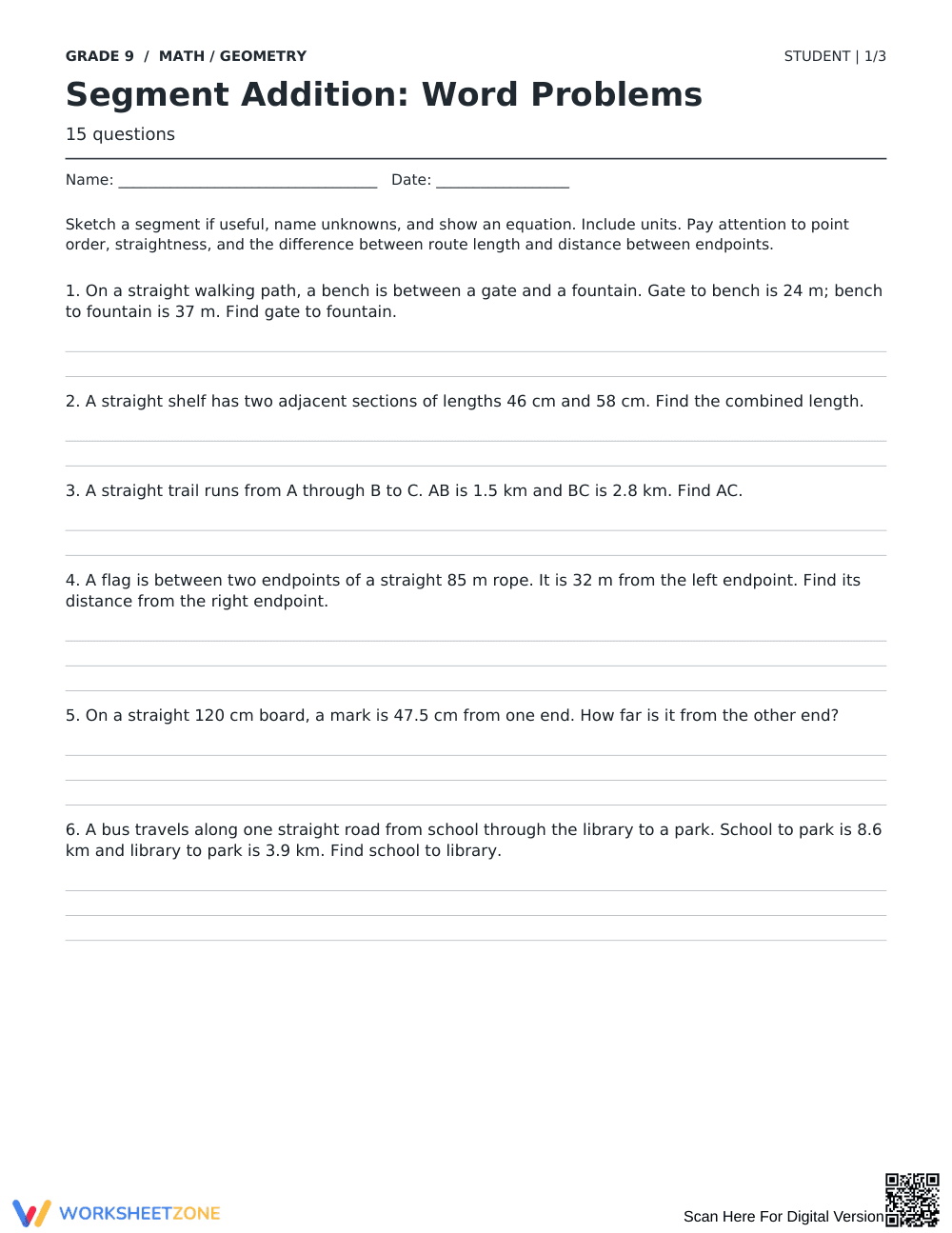
This high school geometry worksheet strengthens students' ability to model real-world scenarios using the segment addition postulate. High school learners translate verbal descriptions into geometric diagrams, set up linear algebraic equations, and calculate unknown lengths. Through structured practice, students build confidence moving from concrete whole-number and decimal distances to multi-step expressions and conceptual reasoning.
At a Glance
- Grade: 9 · Subject: Math (Geometry)
- Standard:
HSG.CO.A.1— Apply precise geometric definitions of line segments and distance along straight paths- Skill Focus: Segment Addition Postulate word problems and algebraic equations
- Format: 3 pages · 15 problems · Answer key included · PDF
- Best For: Geometry skill practice and homework
- Time: 30–45 minutes
What's Inside
This 3-page printable set includes 15 varied word problems designed to reinforce linear distance relationships. Students encounter real-life contexts involving paths, ropes, cables, and roadways. The worksheet provides ample lined workspace under each prompt for sketching segments, defining variables, and writing complete equations. A full 2-page answer key includes final numerical values and step-by-step algebraic setups.
Skill Progression
- Guided practice (Problems 1–6): Direct numeric computations with two adjacent segment pieces, using integers and decimals to find total lengths or missing parts.
- Supported practice (Problems 7–11): Intermediate verbal relationships requiring proportional reasoning, midpoints, and multi-segment partitions along a line.
- Independent practice (Problems 12–15): Advanced algebraic modeling with linear binomials (such as
AB = 3x + 2), multi-step equations, and conceptual analysis of collinearity.
This structured sequence reflects the gradual release framework, ensuring students establish strong visual intuition before managing abstract algebraic expressions.
Standards Alignment
This resource aligns directly to `CCSS.MATH.CONTENT.HSG.CO.A.1`, which calls for precise definitions of angle, circle, perpendicular line, parallel line, and line segment based on the undefined notions of point, line, and distance along a line. It also supports foundational skills for `CCSS.MATH.CONTENT.HSG.CO.C.9` by establishing algebraic justifications used in geometric proofs. Both standard codes can be copied directly into lesson plans, IEP goals, or district curriculum mapping tools.
How to Use It
Assign this resource during direct instruction after introducing the Segment Addition Postulate, or use it as an independent practice set during an introductory geometry unit. During independent work time, check whether students are drawing accurate collinear diagrams with labelled endpoints before writing equations. The 15-item worksheet typically takes 30 to 45 minutes to complete in class or as homework.
Who It's For
This activity is designed for Grade 9 geometry students, integrated math courses, and high school intervention groups needing structured practice with geometric modeling. It pairs effectively with introductory guided notes on segment definitions or coordinate midpoint lessons.
According to Fisher and Frey (2014), structured scaffolds in mathematical word-problem solving enable secondary learners to transfer foundational geometric definitions into formal algebraic representations successfully. This printable resource provides systematic, targeted practice aligned to standard CCSS.MATH.CONTENT.HSG.CO.A.1, prompting ninth-grade students to sketch collinear diagrams, assign algebraic variables, and calculate unknown linear measurements across fifteen contextualized scenarios. By moving progressively from direct integer calculations to multi-step linear binomial expressions and midpoint relationships, learners strengthen essential spatial visualization and abstract reasoning skills. Engaging with these linear modeling tasks reinforces precision in mathematical language while establishing crucial problem-solving habits. Ultimately, mastering the segment addition postulate through structured real-world applications equips high school geometry students with the analytical fluency, algebraic competence, and geometric intuition required for advanced coordinate proof, angle relationships, and deductive reasoning units throughout their high school mathematics coursework.


