


























Views
Downloads
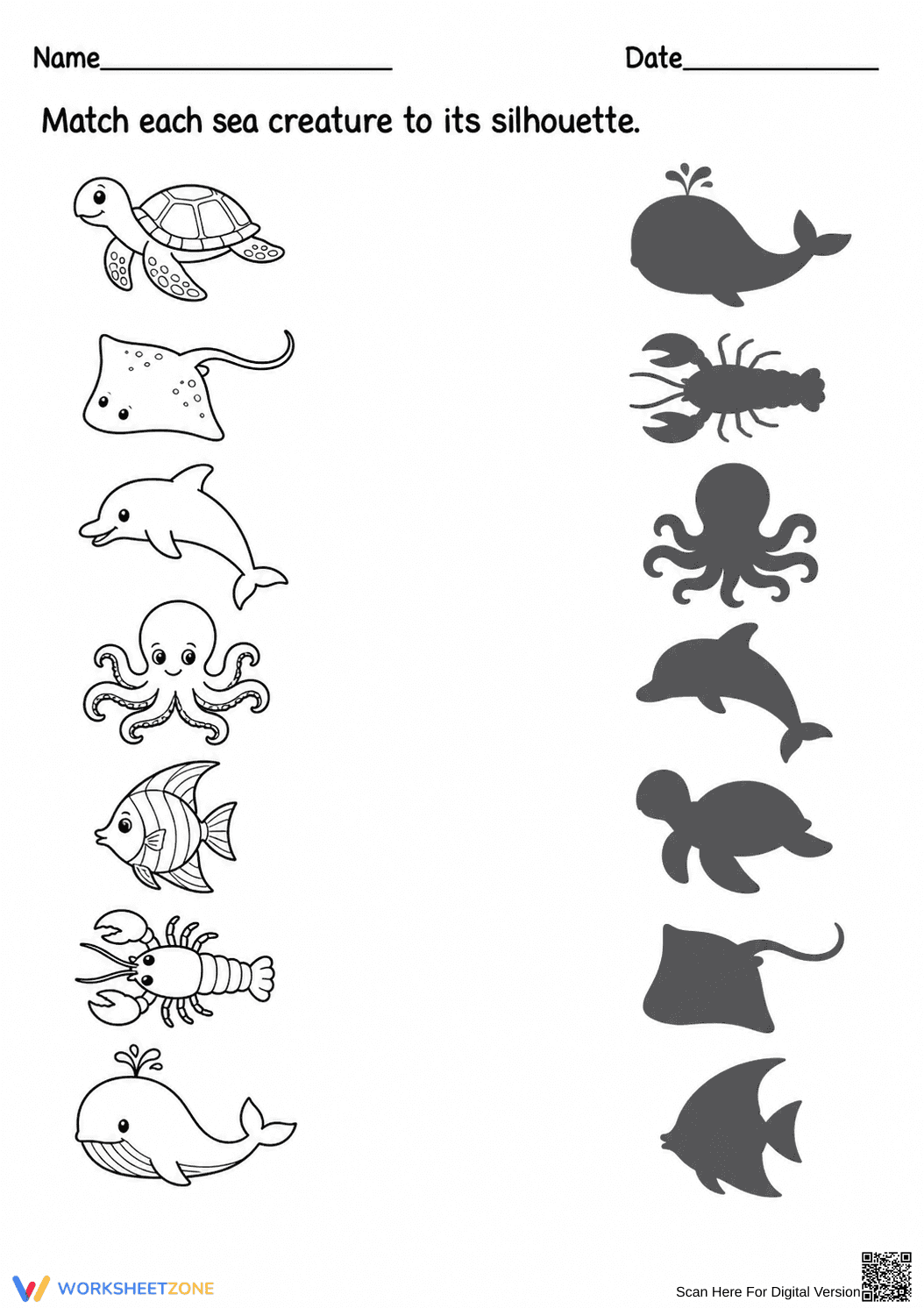

Printable Sea Creature Silhouette Match | Preschool Science
Paste this activity's link or code into your existing LMS (Google Classroom, Canvas, Teams, Schoology, Moodle, etc.).
Students can open and work on the activity right away, with no student login required.
You'll still be able to track student progress and results from your teacher account.
This Preschool sea creature silhouette matching worksheet helps early learners develop essential visual discrimination skills while exploring marine life. Students identify 7 different aquatic animals and connect them to their corresponding shadows, reinforcing cognitive associations and fine motor control. It serves as an effective resource for introductory science lessons on living things and ocean environments.
At a Glance
- Grade: Preschool · Subject: Science
- Standard:
PK.LS1-1— Observe and describe the characteristics of various living organisms in aquatic environments- Skill Focus: Visual discrimination and animal pattern matching
- Format: 1 page · 7 problems · Answer key included · PDF
- Best For: Independent practice or morning work
- Time: 10–15 minutes
This single-page PDF features seven high-contrast illustrations of sea creatures on the left—including a turtle, stingray, dolphin, and octopus—with their corresponding silhouettes arranged in a scrambled column on the right. The clear, kid-friendly line art is designed for easy recognition and can even be used as a coloring activity after the matching task is completed.
This resource is designed for an efficient "print-and-go" experience. Step 1: Print the single-page PDF (less than 30 seconds). Step 2: Distribute to students during your ocean unit or as a transition activity (1 minute). Step 3: Briefly review the animal names together to build vocabulary while students draw their matching lines (5 minutes). The total teacher preparation time is under two minutes, making it a perfect solution for unexpected sub days or quick science center rotations.
Aligned to PK.LS1-1, students will observe and describe the characteristics of various living organisms. By identifying unique anatomical shapes like fins, shells, and tentacles to match creatures to their shadows, students practice the foundational scientific skill of observation. This standard code can be copied directly into lesson plans, IEP goals, or district curriculum mapping tools.
Use this worksheet as a quiet-time activity after a group reading of an ocean-themed book or as a formative assessment to check for visual discrimination readiness. While students work, observe their matching strategy—look for those who identify specific features like the lobster's claws—to gauge their attention to detail. Completion typically takes 10 to 15 minutes.
This worksheet is specifically tailored for preschool and Pre-K learners but can also serve as a remedial visual exercise for Kindergarten students or English Language Learners (ELLs). It pairs naturally with ocean-themed anchor charts or plastic sea animal manipulatives to provide a multi-sensory learning experience during a unit on aquatic habitats.
According to recent research in early childhood development, visual discrimination tasks involving animal silhouettes are vital for developmental readiness, as they train the eye to recognize distinct shapes and orientations (Fisher & Frey, 2014). This sea creature worksheet aligns with the PK.LS1-1 standard by encouraging students to observe and identify specific anatomical features of marine life. By engaging in these pattern-matching exercises, preschoolers build the cognitive framework necessary for more complex biological classifications and alphabet recognition later in their academic journey. ScienceDirect TpT Analysis (2024) indicates that zero-prep matching activities significantly reduce teacher burnout while maintaining high levels of student engagement in thematic centers. This resource provides a structured, evidence-based approach to early science education, ensuring that even the youngest learners begin to develop a systematic way of observing the natural world through guided, printable practice.


