


























Views
Downloads
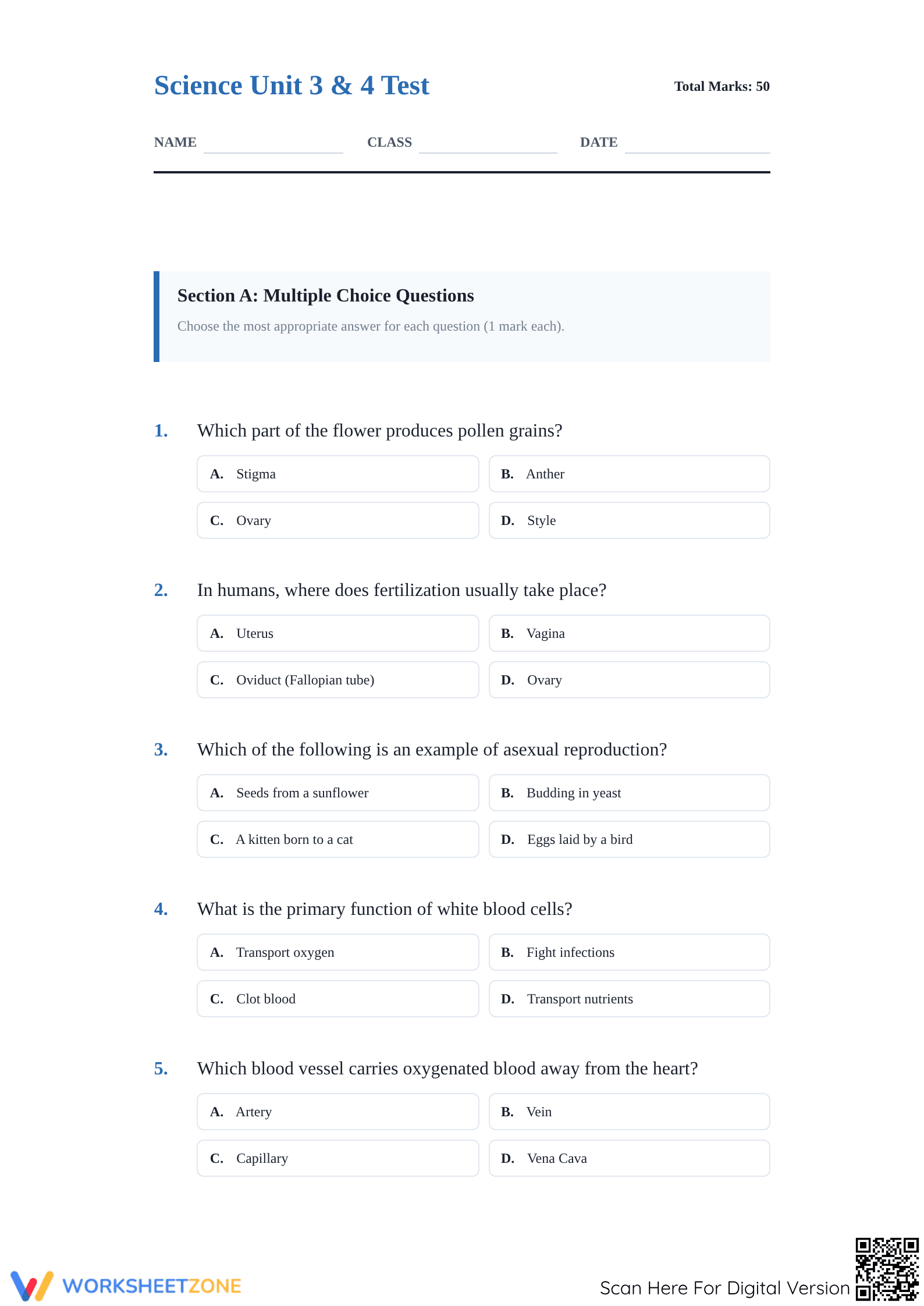



Printable Stage 8 Math Test: Decimals Units 3 & 4 Aligned
Paste this activity's link or code into your existing LMS (Google Classroom, Canvas, Teams, Schoology, Moodle, etc.).
Students can open and work on the activity right away, with no student login required.
You'll still be able to track student progress and results from your teacher account.
This Grade 8 decimals assessment provides a rigorous evaluation of student mastery for Units 3 and 4. It systematically tests the ability to perform complex operations, solve multi-step word problems, and demonstrate deep conceptual understanding of decimal place value and rational numbers. This printable resource ensures students are fully prepared for high-stakes mathematical evaluations.
At a Glance
- Grade: Grade 8 · Subject: Math (Decimals)
- Standard:
CCSS.MATH.CONTENT.7.NS.A.3— Solve real-world mathematical problems involving the four operations with rational numbers.- Skill Focus: Multi-step Decimal Operations
- Format: 4 pages · 30 problems · Answer key included · PDF
- Best For: Summative unit assessment or final review
- Time: 45–60 minutes
This extensive 4-page assessment features approximately 30 diverse problems ranging from computational fluency to critical thinking applications. The worksheet includes structured sections for each unit, clear labeling, and ample white space for student calculations. A full, page-for-page answer key is provided to streamline the grading process and facilitate immediate student feedback during review sessions.
The test is designed to provide clear evidence of student proficiency across three distinct cognitive tiers. Section one assesses computational accuracy (Approaching), while section two requires application in context (Meeting). The final problems demand synthesis and justification (Exceeding), allowing teachers to map scores directly to standards-based gradebooks or IEP progress monitoring tools for rational number mastery.
The primary alignment is CCSS.MATH.CONTENT.7.NS.A.3, which requires students to solve real-world and mathematical problems involving the four operations with rational numbers. This test specifically isolates decimal forms to ensure foundational accuracy before transitioning to complex algebraic functions. Both standard codes can be copied directly into lesson plans, IEP goals, or district curriculum mapping tools.
Deploy this resource as a summative end-of-unit exam to capture final mastery data for decimal operations. Alternatively, use individual pages as formative "check-points" during the instruction of Units 3 and 4 to identify specific instructional gaps. Teachers should observe whether students consistently align decimal points during addition and subtraction as a key indicator of place-value understanding.
This test is ideal for Grade 8 students in general education settings or advanced Grade 7 learners ready for Stage 8 curriculum demands. It serves as an excellent resource for homeschool educators or tutors focusing on middle school math intervention. The structured layout naturally supports students who benefit from clear visual boundaries and consistent problem formatting.
The design of this decimals assessment aligns with the "Gradual Release of Responsibility" model described by Fisher & Frey (2014), ensuring students move from scaffolded computational tasks to independent problem-solving. Research from the RAND AIRS 2024 report emphasizes that frequent, standards-aligned summative assessments are critical for identifying learning loss in middle school mathematics, particularly in foundational rational number operations. By utilizing a 4-page format that covers multiple units, this resource provides the necessary depth to distinguish between procedural fluency and conceptual understanding. The inclusion of a detailed answer key supports immediate corrective feedback, a practice cited by the NAEP as a high-leverage strategy for improving student outcomes in numeracy. This worksheet serves as a robust tool for data-driven instruction in any middle-grade classroom.


