


























Views
Downloads

Interactive Science Journal | Grade K-2 Essential
Paste this activity's link or code into your existing LMS (Google Classroom, Canvas, Teams, Schoology, Moodle, etc.).
Students can open and work on the activity right away, with no student login required.
You'll still be able to track student progress and results from your teacher account.
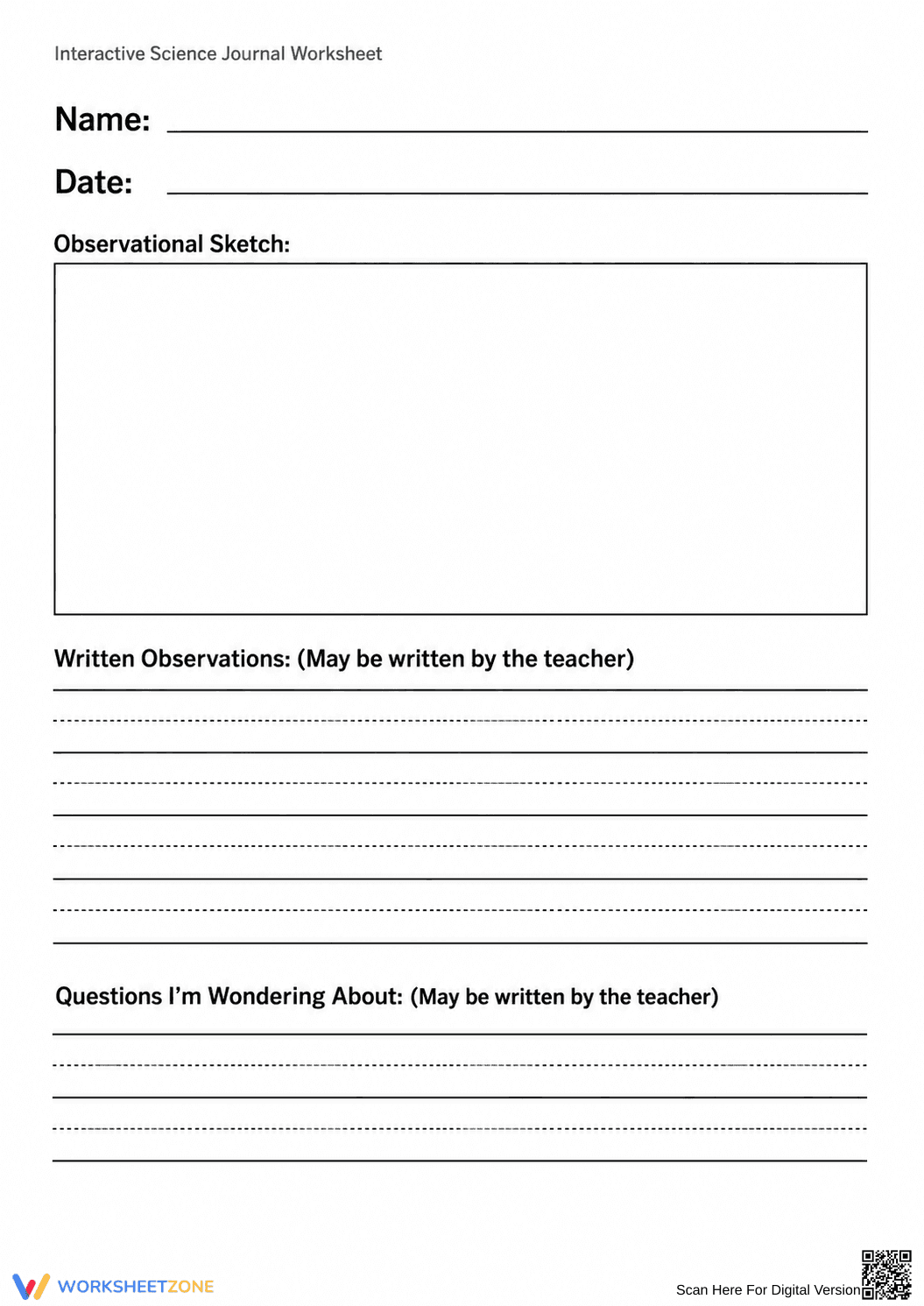
This Grade K-2 science journal worksheet empowers young learners to document their findings through visual and written evidence. By focusing on the intersection of art and inquiry, students develop the foundational skills necessary to communicate scientific ideas. It transforms simple observations into structured data points for classroom discussion and discovery.
At a Glance
- Grade: K-2 · Subject: Science
- Standard:
K-LS1-1— Use observations to describe patterns of what plants and animals need to survive- Skill Focus: Scientific observation and inquiry
- Format: 1 page · 3 tasks · Answer key not applicable · PDF
- Best For: Daily science logs and nature walks
- Time: 15–20 minutes
The worksheet features a large observational sketch box for visual data collection, followed by primary-ruled lines for written observations. A dedicated section for inquiry allows students to record questions they are "wondering about." The layout includes specific parenthetical notes allowing teacher transcription, ensuring accessibility for pre-writers and emerging literacy learners.
Zero-Prep Workflow
- Print: Select the single-page PDF and print enough copies for your cohort (30 seconds).
- Distribute: Hand out journals alongside a specimen, such as a germinating bean seed or a living organism (1 minute).
- Review: Circulate to provide transcription support or to prompt deeper questioning based on the student's sketch (Ongoing).
This streamlined process makes the worksheet an ideal choice for substitute teacher folders or spontaneous outdoor learning sessions.
Standards Alignment
Aligned to `K-LS1-1`: "Use observations to describe patterns of what plants and animals (including humans) need to survive." This resource also supports CCSS.ELA-LITERACY.W.K.2 by using a combination of drawing and writing to compose informative texts. Both standard codes can be copied directly into lesson plans, IEP goals, or district curriculum mapping tools.
How to Use It
Use this as a formative assessment during a plant life cycle unit. Have students observe a bean plant at three different stages of growth to track changes over time. It also serves as an excellent exit ticket after a nature walk, where students must record one living thing they encountered and one question they have about its habitat. Expect completion within 20 minutes depending on the complexity of the specimen.
Who It's For
This resource is designed for Kindergarten through 2nd-grade students, particularly those in inclusive classrooms where teacher-led transcription is a common accommodation. It pairs perfectly with a classroom Science Center or a seed-starting kit, providing a consistent structure for daily or weekly scientific logging for all ability levels.
According to the RAND AIRS 2024 report on elementary science instruction, the integration of drawing and writing in early childhood significantly improves the retention of complex biological concepts. This worksheet addresses the K-LS1-1 standard by requiring students to use observations to describe patterns in the natural world. By providing a structured space for both "Written Observations" and "Questions I’m Wondering About," the tool facilitates the transition from passive viewing to active scientific inquiry. Research from Fisher & Frey (2014) suggests that scaffolds like teacher transcription allow students to focus on high-level conceptual thinking before their fine motor skills are fully developed. This printable resource ensures that all students, regardless of their current writing proficiency, can participate in the scientific process and meet grade-level expectations for data collection and evidence-based reasoning in the life sciences.


